Kwangwoon University ROBIT 2010 (Kid Size League) Team Description Paper
Jang Dong Uk, Choi In Sung, Kim Young Yong, Lee Dong Hun, Kim Myung Jong, Kim Jin Yeong, Park Hyun Woo, Oh Jin Hwan
Kwangwoon University, Wolgae Dong, Nowon Gu, Seoul City, South Korea
http://cafe.naver.com/robit.cafe
Abstract This document describes both hardware and software specifications and practical functions of the humanoid robot Stepper kid, developed by team ROBIT as a platform for research in bipedal locomotion, robot self-localization and multi-robot cooperation. The robots will also be used to participate in Humanoid League (Kid Size) of ROBOCUP 2010 Singapore.
1 Introduction
The ROBIT is a professional robot game team of Kwangwoon University in Korea. Founded since November 2006, the ROBIT has participated in several domestic and international tournaments and received more than 100 awards in competitions. The ROBIT members have accumulated about technology of robot for 3years. To get qualifications of ROBOCUP, we have studied about robots so far.
Robot system for the ROBOCUP will be covered.
Briefly, Our robot systems are working after Pico board processes pictures of match situations then send these to DSP board though USART communication. As you can see the pictures, using RX-106 motor and the RX-28 motor, we developed the robots light and rugged.
2 Overview of the System
Figure.1 was our prototype robot design. As this robot was not perfectly completed, we will upgrade lighter and robust. You can see the detail specification table 1.
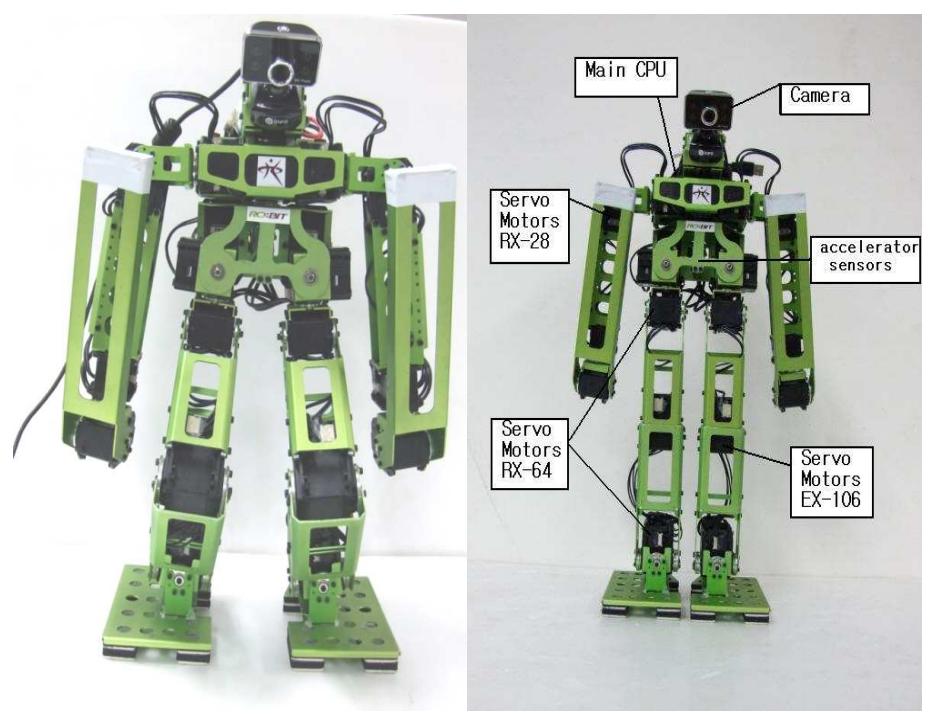
Table 1: Specification of the Robot
| Specification | Details |
|---|---|
| Weight | 4.73 kg |
| Height | 45 cm |
| Leg Height | 32.5 cm |
| Arm Height | 31.5 cm |
| Sole of a foot Height | 13 cm |
| Sole of a foot Width | 8.2 cm |
| All of DOF | 23 DOF |
| LEG DOF | 6 DOF |
| ARM DOF | 5 DOF |
| EX-106 Motors | 10 (0.126 speed sec/60degree) |
| RX-64 Motors | 3 (0.157 speed sec/60degree) |
| RX-28 Motors | 10 (0.157 speed sec/60degree) |
| Walking speed | 0.157 speed (sec/60degree) |
| Computing units | EPIA – p700, CPU: 1.GHz VIA C7, BIOS: Award BIOS, RAM: DDR2 533/667 (1G), USB: 4 USB PORT |
| Camera | 800 still image, CMOS 4608 * 3456, 30FPS, USB2.0 Use |
| Sensors | Degree of sensors |
3 Robot Control System
Our robot control systems are divided into three parts.
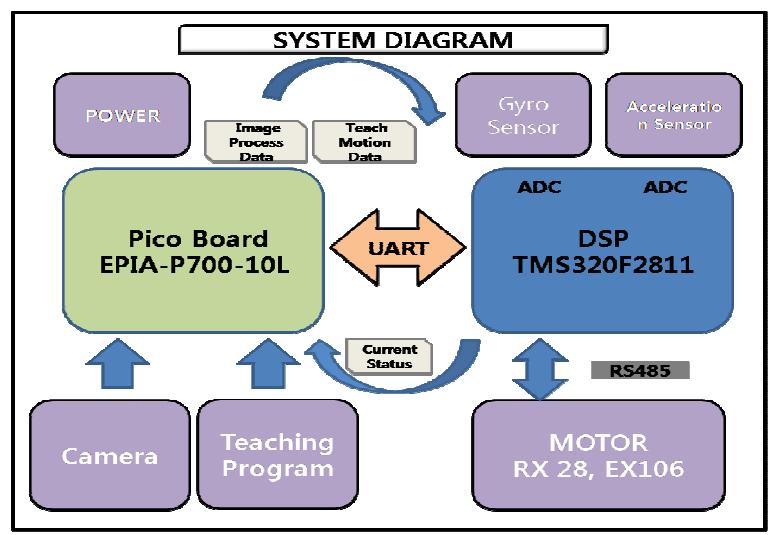
First part of robot systems is 'DSP Board' (TMS320F2811) which control over 20 actuators and several sensors.
Second part is 'Pico Board' which gets information and processes pictures of game situations.
The last is teaching system for make a basic robot motion such as shoots or blocks a ball.
3.1 System Diagram
Figure.2 is a diagram of our robot system briefly.
'Pico board' is process image data, communicating with DSP and using a teaching program for make basic motion. 'DSP Board' receives processed image data from 'Pico Board' and makes inverse kinematics motions and control actuators.
We use gyro and accelerator sensors for correct walking motions as well.
3.2 Teaching Software
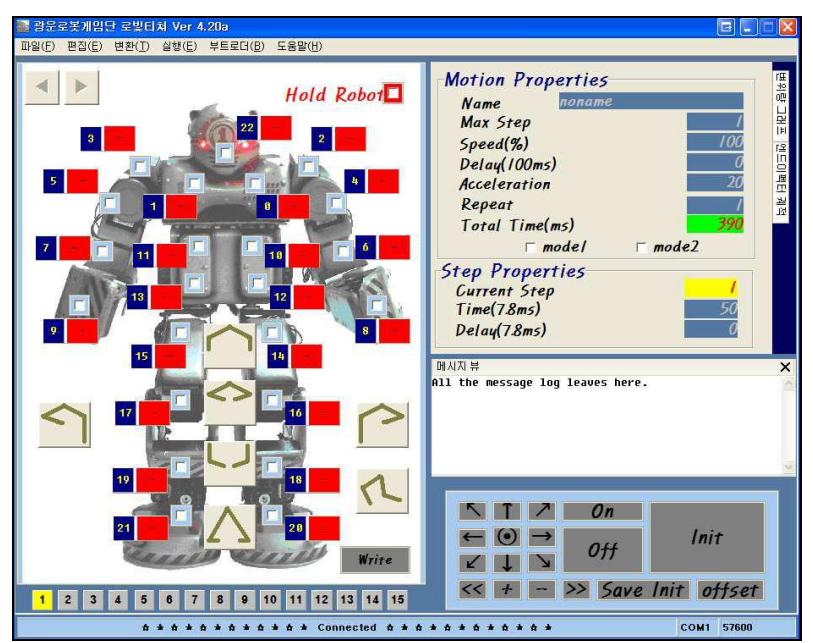
Figure.3 is a Teaching program.
This is used to make fundamental motion, consist of several connected slides. With that, we fix specific robot body postures using different robot IDs. Then these slides reserve as data in DSP.
4 Image Processing & Communication
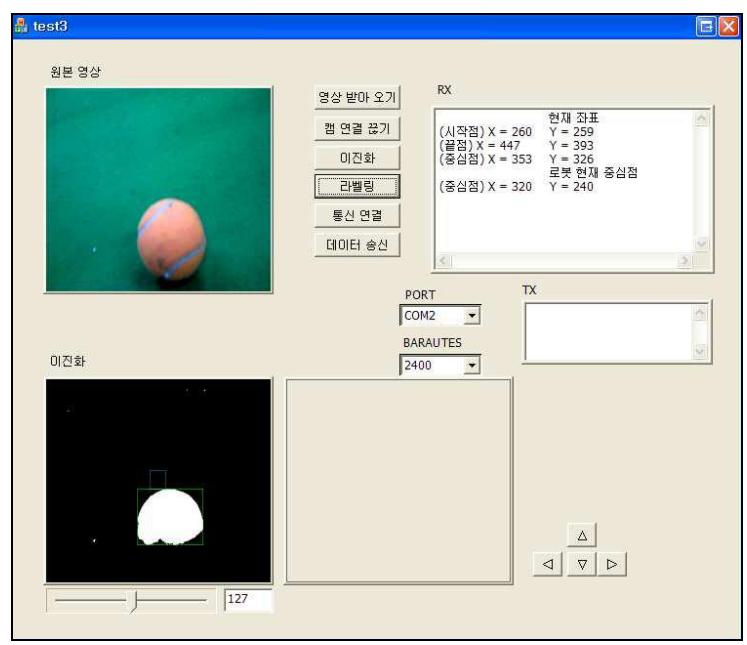
This is a trial picture, taken by a test program.
We have developed a program to participate in ROBO CUP though 'OpenCV' and GUI programs. For communication with robot, we used 'USB to Serial'.
Nowadays, we have developed a USART communication program to operate robot more easier.
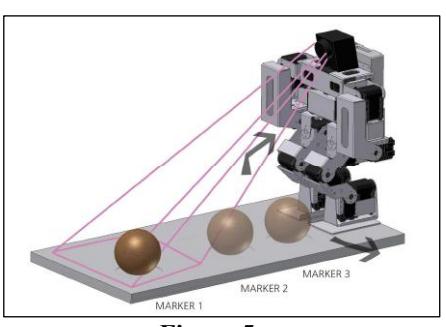
The Figure.5 is using algorithms which detect exact distance between a ball and a robot with triangular functions in robot's standard.
A particular point is this algorithm assigns 3 parts of a place where a ball put on. It is easy to find a distance between the ball and the robot faster.
5 Walking System
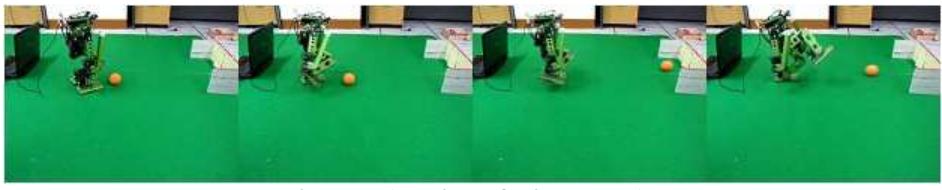
Approximately for three years, we have accumulated experiences and know-how through trials and errors. It makes robot's strength point which is fast and accurate walking motion.
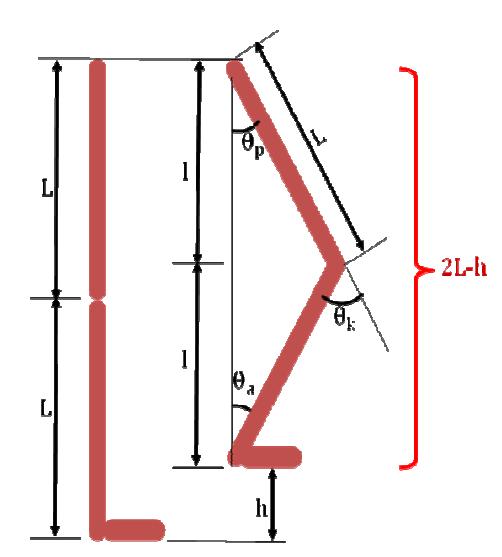
Robot's walking motion is not fixed, it can vary by sensors and inverse kinematics.
The sensors mounted on the robot, control relative values for finding the ball and keeping the ball moving fast and accurate. So robot can control the ball easily and shoot properly.
6 Conclusion
Our system was described in the Abstract.
Since 2006, we completed the design and built, based on our experience to try to join the 2010 ROBOCUP competition.
Higher level of robot mobility and powerful shot also accurate imaging breakthrough in tracking the movements of the robot will be able to determine.
References
- Lee Sang Yeop, "Visual C++ Programming Bible Ver 6.X" (1998)
- Jeong Seong Hwan, Lee Mun Ho, "Computer Vision Working Programming" (2007)
- Spong, Vidyasagar, "Robot dynamics and control" (1994.01.01)
- Byeon Jin Su, Yu Pan Yeol, Bak Hyeong Bae, "Inventor: Practical 3D Working" (2008)
- TI, "www.Ti.co.kr", "http://www.tms320.co.kr" "TMS20x281x Application Datasheet"
- Joseph Duffy, "Statics and kinematics of the robot" (2000)
- Lee Jong Yeol, "Edge extraction for automatic feature identification in high spatial resolution remotely sensed images" (2000)