YRA Team Description 2010
Mohammad Hossein Kargar, Meisam Bakhshi, Ghazanfar Zahedi, Ehsan Ghasemi, Mohsen Mollahosseini, Mohammadreza Jenabzadeh
Yazd Robotic Association, Islamic AZAD University YAZD Branch, Safaeieh, YAZD, IRAN
Abstract This document describes hardware and software of the robotsdeveloped by the "YRAman" Team for the RoboCupsoccer kid-size competitions to be heldin Singapore 2010 .The system we developed has some features .They are high mobility, strong kicks, well-designed control system, position estimation by one camera and user-friendly interface .The robot has 19 actuated degrees of freedom based on Dynamixel AX12 servos .Central Processing, including Machine vision, Planning and control is performed using a Gumstixverdex XL6Pwhich is an ARM based 600MHz platform .This paper explains the software and hardware used for the robot as well as control and stabilization methods developed by our team.
1. Introduction
Humanoid robots have many potential applications, which make this area very attractive for researchers . However many of the yet developed humanoids suffer from over-designed and too complicated hardware and software which is still far from the human model.
The YRAman team was started in 2009 in the Yazd Robotic Association at Azad University of Yazd, which has had a successful and long history in RoboCup with the YRA rescue and deminerteams.
This is the first experiment of YRA in RoboCupsoccer at kid-size class .so we try to show new performance and solutions, that we describe some of them in this paper.
2. The hardware of YRAman
2.1 Mechanical Structure
The actuators used in the YRAman robots is the Dynamixel servo motor family produced by RobotisInc .Korea . The motion mechanism consists of 19 degrees of freedom distributed in 6 per leg, 3 per arm and other one degrees of freedom as a pan-tilt system holding the head.
Fig.1 shows one of the constructions used for the motion mechanism of the robots.
Mechanical Structure of YRAman robots started with Bioloid robot kit produced by RobotisInc .but now we are working on a new and optimized structure ofHumanoid robots to participate in Robocup competitions.
Table1 illustrates the physical measurements of the robot .To facilitate exchange of the players, all robots use mechanically the same structure.
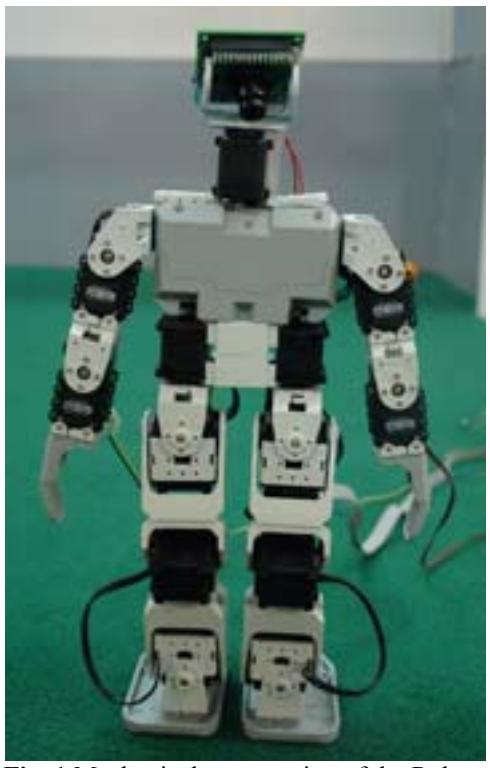
Table 1. Physical measurements of the robot
| Quantity | Value | Unit |
|---|---|---|
| Overall Height | 48 | Cm |
| Weight | 2350 | G |
| Leg Length | 24 | Cm |
| Foot Area | 60 | cm2 |
| Arm Length | 19 | Cm |
| Head Length | 12 | Cm |
2.2 Actuators
The actuators used in YRAman robots are "Dynamixel AX-12" servomotors, produced by RobotisInc .Each actuator has its own microcontroller which implements adjustable position control using potentiometer position feedback .It also calculates many other parameters such as rotation speed and motor load which can be accessed through a single-bus, high-speed serial communication protocol .This facilitates the construction of an extendable network of motors which can be individually accessed and controlled by a single microprocessor. The parameters of the actuators used in YRAman robots are summarized in table 2.
Table 2. Characteristics of the servomotors used in YRAman Robots
| Actuator | Weight (g) | Gear Ratio | Max Torque (kgf.cm) | Sec/60degree | Resolution (degrees) |
|---|---|---|---|---|---|
| Dynamixel AX-12 | 55 | 1 : 254 | 16.5 (at 10v) | 0.196 | 0.35 |
2.3 Processors and communications
Each Robot has a Gumstixverdex pro XL6P on board .The Processor is a Marvell® PXA270 with XScale™ running at 600MHz .The gumstix motherboard has several interesting features which make it ideal as a brain for humanoid robots .These include low weight and power consumption, direct camera connection and easy extension.
All hardware units including motors and Camera are connected to the main processor via an RS485 and RS232 bus .Each unit has a unique ID for packet identification .A broadcasting ID can be used to send the same data packet to all existing units on the bus.
2.4 Vision
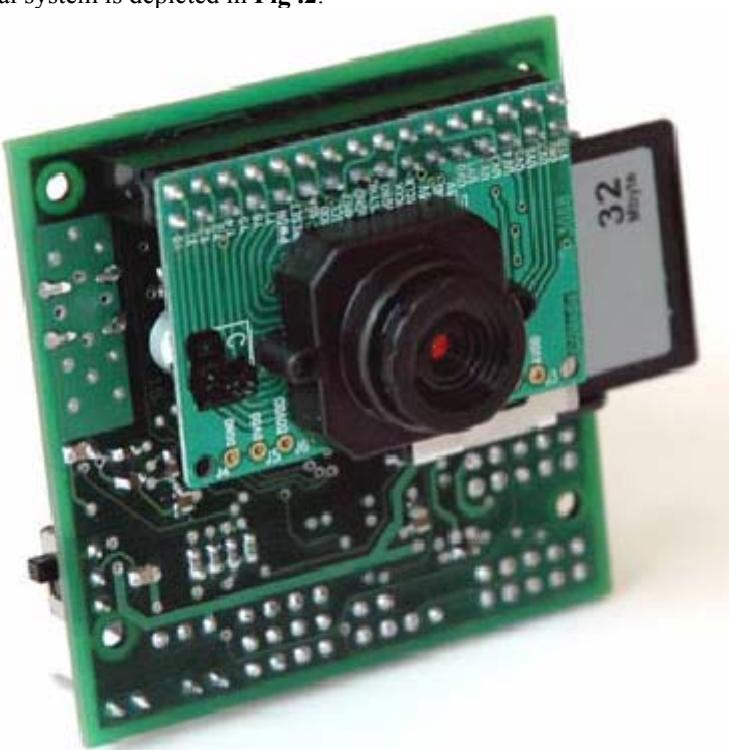
The image proccessing of YRAman were programmed using the vision system CMUCam3 incorporating features like color segmentation algorithms, object recognitions, distance estimation, self-localization and object tracking. Ball-tracking was implemented in CMUcam3 and provides estimation of relative distance that is sent to main processor for decision of motions towards ball.
The appearance of visual system is depicted in Fig. 2.
3. Software Design
Overview
We are using Visual C#.NET environment to build interfaces with communication and data acquisition systems .Also we are now focusing in the communication between robots on game through a Game Controller.
3.1 Main Programme
The program consists of 4 main blocks:
Hardware Interface: Contains all low level routines to access hardware of the robot including sensors and actuators .
Vision : Contains image processing algorithms such as recognition of landmarks and other object .
Planning : Planning system of the robot is based on a multi layer, and multi thread structure.The layers are named Strategy, Role, Behavior and Motion.
Network : Mainly responsible for the wireless communication of the robot with the other robots or the referee box .This is done via WLAN.
3.2 Decision Algorithms
The main processor performs three tasks:
- (1) a walking-pattern generator .Using the analytical inverse kinematics of legs and a parameterized leg-path generator is possible to easily perform omni -directional walking.
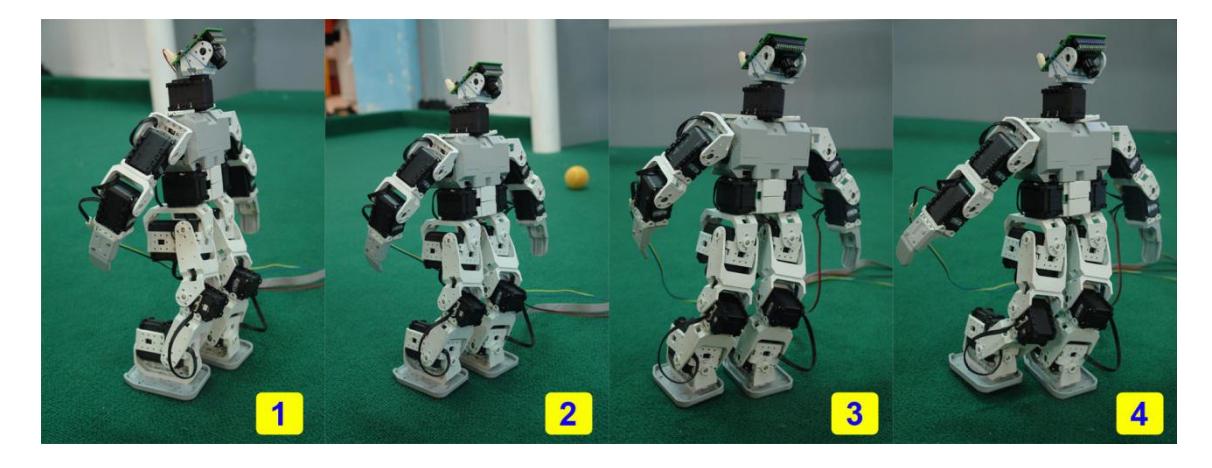
- (2)some simple motions like standup, kick and block are developed with frame-based motion
- (3) off-line decision-making algorithms are run to produce individual player's behaviors.
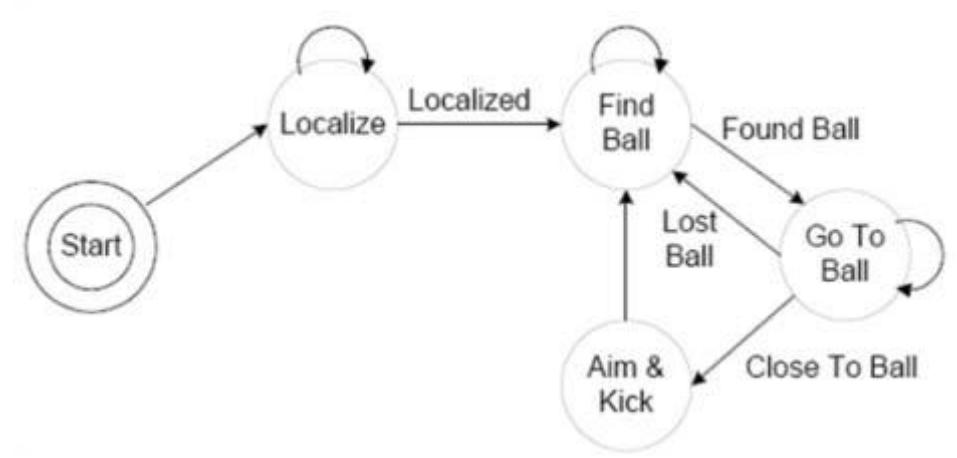
Off-line decision-making algorithms are run to produce individual player's behaviors. For example, a player behavior sequence is:
- (1) find the ball.
- (2) go close to the ball.
- (3) get control of the ball.
- (4) find opponent goal or pass the ball to a teammate**.**
- (5) aligning to opponent goal
- (6) shoot towards
- (7) keep defensive posture.
A summarized graphic version of our decision algorithm is presented in Figure 3.
4. Ability Demonstration
Kicking Ball
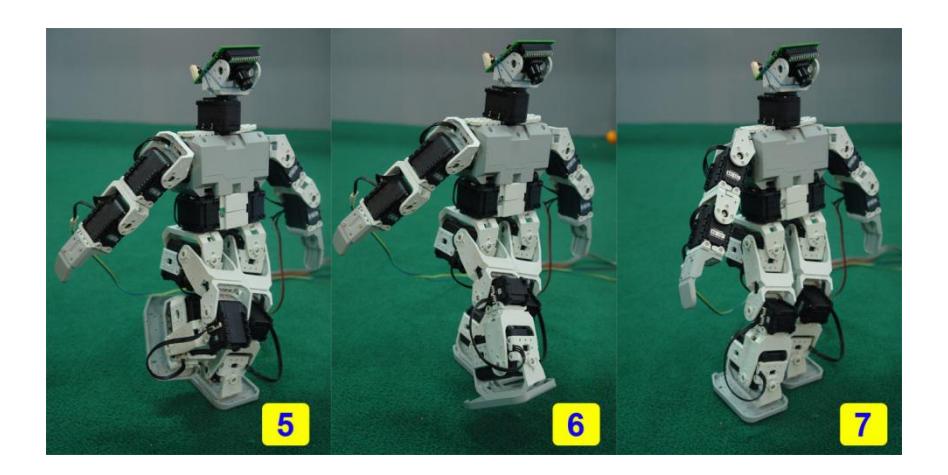
5. Conclusion
In this paper we described on our system .Our system has some features .They are high mobility, strong kicks, well-designed control system, position estimation by one camera and user-friendly interface. And we are working to design a new and optimized mechanical structure, and develop unique decision algorithms, and football coaching.
6. Refrences
References
- Robotis servomotors, http://www.robotis.com/zbxe/dynamixel_en
- CMUCam3 vision system, http://www.cmucam.org/
- FUmanoid Team Description 2009
- Bogobots-TecMTY humanoid kid-size team 2009
- H. Miura and I. Shimoyama, "Dynamic walking of a biped," Int. J. Robot. Res., vol. 3, no. 2, pp. 60–74, 1984.
- M. Rodrigues, F. Silva, V. Santos Visual Tracking on an Autonomous Self-contained Humanoid Robot, The 11th International Conference on Climbing and Walking Robots and the Support Technologies for Mobile Machines CLAWAR2008, Portugal, Coimbra, 8-10 Sep, 2008.
- CMUcam3 User manual