Cyberlords RoboCup 2011 Humanoid KidSize Team Description Paper
Luis F Lupi´an, Alberto Romay, Andr´es Esp´ınola, Erick Ram´ırez
Mobile Robotics and Automated Systems Lab, Universidad La Salle, M´exico
Abstract We describe the RoboCup KidSize humanoid robots to be used by team Cyberlords in the RoboCup 2011 competition to be held in Istanbul, Turkey. For this edition of the competition we will present two different architectures. One of them is an upgrade from our robot T1 presented at RoboCup 2010, which is originally based on the Robonova-1 robot. The second architecture is a new model, named T2, which is based on the Kondo KHR-3HV with several customizations in the body, electronics and software. This paper describes both architectures in general terms.
1 Introduction
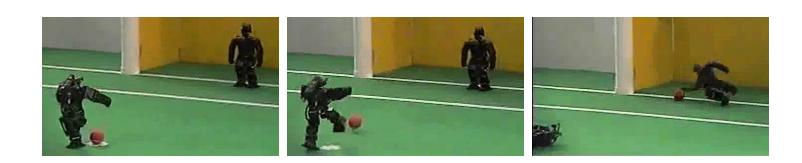
Team Cyberlords La Salle, which is part of the Mobile Robotics and Automated Systems Laboratory at Universidad La Salle M´exico, started working on our RoboCup Humanoid KidSize project in July 2008. The starting point of the project was a pair of Robonova-1 humanoids, which we had to adapt mechanically, interface to several sensors and program to give them the ability to play football autonomously. By September 2008, we had the first functional version of our football-playing humanoids and debuted them in official competition during the 1st Mexican RoboCup Open where we faced team Bogobots and Pumas UNAM. Our robots became 2008 mexican champions by winning the semifinal and final games by a narrow margin of 1:0 in penalty kicks. Figure 1 depicts a practice shot between our striker Roboldinho and our goalie Robo Ochoa. For the RoboCup world championships in 2009 and 2010 we participated in collaboration with the Robotics and Artificial Vision Laboratory of Cinvestav [1], [2]. Upon our return from Singapore, our labs have been working independently of each other.
In our first world championship, the RoboCup 2009 in Austria, our robots scored a total of two goals but fell short from advancing to the second round, while in the following world championship, the RoboCup 2010 in Singapore, we clearly outmatched our own results from the previous year by scoring a total of six goals and reaching the second round of the competition. Shortly after the 2010 world championship, our team became Latin American champions at the RoboCup Latin American Open which took place in S˜ao Bernardo do Campo, Brazil in October 2010.
2 General Architecture
For the 2011 competition, our team is developing two different architectures with some features in common. The main differences are in the mechanical structure, while the common features are those related to the computing unit, sensors and software (both at the low and high levels).
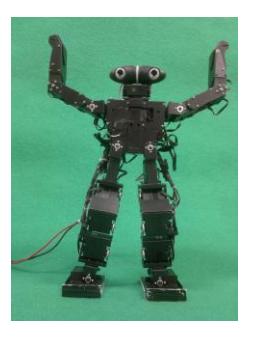
The mechanical structure of our design for the 2010 competition, the model T1, is based on the commercial platform Robonova-1 from Hitec, with several significant mechanical customizations. Most notably, we added a much needed vertical degree-of-freedom (DOF) to the hip-leg interface so that our robot can now perform turning motions in a much more efficient way. We also replaced most of the HS-8498HB leg servomotors with the higher torque HSR-5498SG servos. The head pan-and-tilt mechanism is actuated by two HS-8498HB, which gives the camera a faster and wider range of motion. This design has a total of 20 DOF and is depicted in Fig. 2.
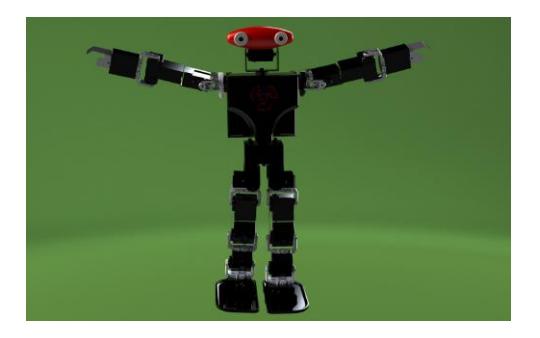
The second of our designs for the 2011 competition, the model T2, is based on the Kondo KHR-3HV. Although in its original state, this robot has 17 DOF actuated by KRS-2552HV servomotors, we are adding 4 DOF for a total of 21 DOF: six on each leg, three on each arm, one on the waist, and two for the pan and tilt mechanism of the head. The original chest of the Kondo KHR-3HV is too small to hold the computing unit, batteries and sensors, so we are integrating a redesigned chest while keeping the original legs and arms, as shown in Fig. 3.
In both cases, we are using a ROBOARD main computer: a RB-100 for the model T1 and a RB-110 for the model T2. Both versions of this ROBOARD computer are based on the 32-bit x86 VORTEX86DX CPU running at 1GHz with 256MB of DDR2 RAM. In addition, this computer board includes many peripherals specifically tailored for mobile robotics. Among these ports we have: RS-485, PWM channels, USB 2.0, SPI/I2C bus, 8 10-bit ADC ports and a mini PCI socket which is being used for a 802.11b/g wireless adapter. The main difference between these two computer boards is that the RB-110 features a high speed UART which can communicate at speeds up to 12Mbps and has less PWM ports than the RB-100, which are really not needed for the KONDO KHR-3HV. Our software implementation for the RoboCup 2010 had performance problems which we have already solved for the 2011 implementation for a significantly better performance.
3 Perception and Low-Level Motion Control Systems
For the purpose of giving our humanoids some degree of autonomy three kinds of exteroceptive sensors were interfaced to them:
- A single MINORU USB 2.0 camera for stereo vision, which is mounted on a 2 DOF pan and tilt mechanism above the shoulders of the robot.
- A 6 DOF inertial measurement unit (IMU) based on ST's LPR530AL and LY530ALH gyroscopes plus Analog Devices' ADXL335 triple-axis accelerometer which allows the robot to compensate motions in order to prevent falling to a certain degree plus allows it to know the sequence of motions necessary to get up in case of a fall.
Self localization of our robots within the field is performed by inverse-pose estimation of the camera based on instantaneous observations of well known features of the field, such as the goal posts and the landmark poles. This instantaneous visual information is used for the correction step of a Kalman filter that predicts the robot pose within the field based on the gait's forward kinematics. In our current implementation, we already have a very robust and reliable landmark pole feature extraction. However, we are in the process of re-writing from scratch the goal post feature extraction part from the visual perception module in order to make it more reliable than it was in 2010.
All servomotors and sensors, including the camera, are directly interfaced to the ROBOARD, which is the only programmable computing unit on-board the robot. HITEC servomotors are interfaced to the RB-100 through the PWM ports, while KRS-2552HV servos are interfaced through the RCB-4 controller which is an integral part of the KONDO KHR-3HV robot kit. The IMU outputs are interfaced to the ROBOARD using six of the ADC input ports. The MINORU camera uses one of the USB 2.0 ports available on the board. IMU sensory data is used for active compensation of the motion of arms and hip.
Using a Robot Pose Editing software tool developed by Andrés Espínola in our lab we are continually optimizing the sequences of key frames required for all motion behaviors, including forward and lateral gaits, kicking, goalie diving and getting up. These key frames are then interpolated in realtime inside the robot in order to achieve smooth motions.
For this edition of the RoboCup world championship we will bring a significantly better ball distance and speed perception algorithm. Our algorithm is based on a Kalman filter which makes predictions of the ball state using a simple kinematic model combined with corrections from visual perception information from the stereo camera. This makes this decision independent of whether the goalie itself is moving or stationary, and allows our robot to make more accurate decisions about the direction and moment of a dive in order to block a shot towards the goal.
4 Robot Behavior Control
The behavior control architecture for our robots is based on a hierarchical finite state machine (FSM) implemented in several layers as a polymorphic hierarchy of classes in C++. The topmost layer of this hierarchical FSM is the Game which simply reacts to the referee box in accordance to the RoboCup Game Controller specification. Each of the states on this top layer is in turn itself a state machine. The most important of these state machines is of course the one that corresponds to Playing. The Playing FSM implements one state for each high-level action to be performed by the robot, such as GetUp, WalkTowardsBall, FindBall, KickBall, and so on. Several of these high-level states may in turn be implemented as a lower-level FSM. For example, the high-level FindBall state is implemented by a low-level FSM that moves the head in a predefined sequence testing for the presence of the ball at each step.
The FSM transitions from one state to another triggered by a set of crisp conditions that depend on high-level interpretation of sensory information. These include AccelFallen, BallFound, ShotFilter, BallFar, BallFoot, and so on. More than one condition may be triggered at any one time, so a conflict-resolution strategy is needed. Our approach is to give priorities to each condition so, for example, AccelFallen would have a higher priority than BallNotFound (or any other state for that matter). Within each state, conditions are tested in the order of their priority, so whenever more than one condition applies only the highest-priority condition is taken care of, while the rest are not even tested. This makes sense since, for example, whenever the robot falls over it doesn't matter whether it knows where the ball is or not, the only thing that matters at that point is getting up.
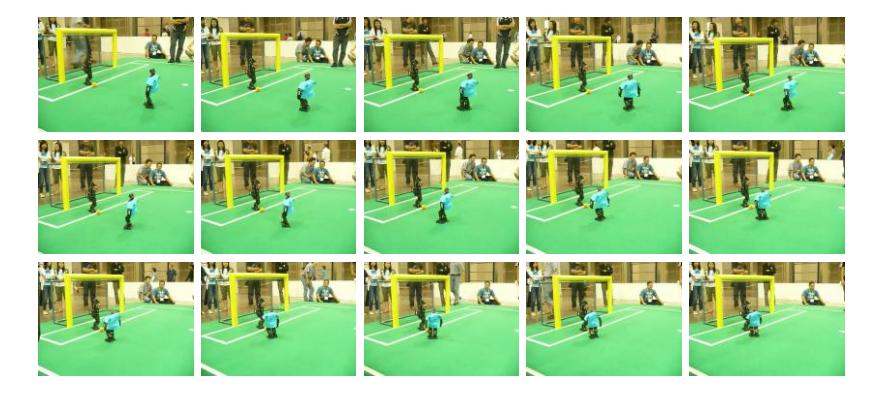
Although it might make initial sense to approach the ball through a straightline trajectory, it turns out that this is not necessarily the best solution provided that the initial and final yaw angle of the robot with respect to the field in general do not coincide with this straight line, requiring an in-place turning motion at the start and end points of the trajectory. In our current implementation, the WalkTowardsBall state is implemented as a low-level FSM that executes specific step motions depending on the relative position of the robot with respect to the ball and the desired final yaw angle of the robot (which depends on where the goal is with respect to the ball). The result is a curved path that generally requires less steps than the corresponding straight-line path. This is illustrated by Fig. 4 where our robot T1 (on cyan uniform) is walking towards the ball in preparation for scoring our first goal in the RoboCup 2010.
5 Conclusion and Future Work
We have described the hardware and software features of both humanoid robot architectures to be used by team Cyberlords La Salle in the RoboCup 2011 world championship. One of these two designs is an upgraded version of our model T1, which debuted in 2010. The second one, our model T2, is based on a new mechanical architecture (the Kondo KHR-3HV) but shares almost all the rest of the elements of our already tested model T1 (computing unit, sensors, software).
There are many more enhancements in their initial phase of development. Among them:
- A kinematic modeling tool that will provide forward and inverse kinematic models form geometric and structural information. Building on the expertise we have from previous projects [3, 4] this modeling tool will be coupled with a corresponding OpenGL 3D visualization. This will be the basis for a faster redesign of all motion sequences for our robots.
- Feet soles instrumented with force sensing resistors for the purpose of providing feedback information for gait motion compensation.
- Although we have a functional solution to the ball-approaching problem it still can not be considered optimal. We are investigating ways to solve this problem using optimal control techniques.
Acknowledgements
This and other mobile robotics projects developed at the Mobile Robotics and Automated Systems Lab are supported in part by the School of Engineering at Universidad La Salle M´exico, ICyTDF, CONACyT, the Mexican Robotics Federation as well as Scitum and Scanda corporations.
Team Members
Team Cyberlords for 2011 will be integrated by at least the following people:
- Team leader: Prof. Luis F. Lupi´an.
- Team members: Alberto Romay, Andrea Hidalgo, Andr´es Esp´ınola, Cristhian Corte, Diego M´arquez, Erick Ram´ırez, Francisco Lecumberri, Jessica Carbajal, Jes´us Olgu´ın, Paulina Garc´ıa.
References
- Lupi´an, L.F., Romay, A.I., Monroy, P., Esp´ınola, A.F., Cisneros, R., Ben´ıtez, F.: Cyberlords RoboCup 2009 Humanoid KidSize team description paper. In: RoboCup World Championship, Graz, Austria, RoboCup Federation (July 2009)
- Lupi´an, L.F., Romay, A., Esp´ınola, A., Cisneros, R., Ibarra, J.M., Guti´errez, D., Hunter, M., del Valle, C., de la Loza, K.: Cyberlords RoboCup 2010 Humanoid KidSize team description paper. In: RoboCup World Championship, Singapore, RoboCup Federation (June 2010)
- Lupi´an, L.F., Avila, R.: Stabilization of a wheeled inverted pendulum by a ´ continuous-time infinite-horizon LQG optimal controller. In: Latin American Robotics Symposium, Salvador, Bahia, Brazil, IEEE (October 2008)
- Lupi´an, L.F., Rabad´an Martin, J.R.: Segment-wise optimal trajectory execution control for four-wheeled omnidirectional mobile robots. In: Robotic Symposium, IEEE Latin American, Valpara´ıso, Chile (2009)