Team Description Paper: HuroEvolutionKD Humanoid Robot for Robocup 2011 Humanoid League
Chung-Hsien Kuo, Hung-Chyun Chou, Jui-Chou Chung, Guan-Ting Chen, Yu-De Lien
Department of Electrical Egineering, National Taiwan University of Science and Technology, 43 Sec. 4, Keelung Rd, 106 Taipei, Taiwan
http://www.robocup.org/ · http://www.atmel.com/products/AVR/ · http://www.robotis.com/ · http://www.fira.net/ · http://www.p4c.philips.com/cgibin/dcbint/cpindex.pl?ctn=SPC900NC/00&scy=gb&slg=en · [http:// www.analog.com](http:// www.analog.com)
Abstract In this team description paper, our KidSize humanoid robot entitled HuroEvolutionKD is introduced for the Robocup 2011 humanoid league. The HuroEvolutionKD is constructed as a sixteen degree-of-freedom biped humanoid robot. A CMOS USB camera system is connected to a PICO-820 single board computer to perform autonomous image captures and motion controls. The functions within localization of unknown ball position, walking ability towards the ball, robot positioning at the ball for kicking, kicking the ball towards the goal, and ability of getting up autonomously from a fall are all desired to perform qualifications for Robocup 2011 humanoid league. At the same time, the joint motors use Robotis DYNAMIXEL series Servo motors to reduce motion control complexity. As a consequence, thee humanoid robots are organized in our team to complete competitions for the Robocup 2011 humanoid league.
1 Introduction
Small size humanoid robot studies are fast increasing in the last decade. In resent year, RoboCup [1] is one of the most important competitions within humanoid robot researches. Due to the design limitations of robot size, mechanical structure, and control components, the development of a kid size humanoid robot becomes a challenging task. On the other hand, competition situations are fast transiting, and humanoid robot are required to be justified according to situation changes. Therefore, an artificial intelligence (AI) based decision making module is developed using strategy based rules. These rules are fired with respect to the vision system of our robot.
On the other hand, the walking patterns are generated in terms of an AVR [2] based gait controller, and UART serial motion commands are further generated to control the positions sixteen Dynamixel RC servo motors [3]. As consequence, the overall hardware components of our HuroEvolutionKD humanoid robot is composed of a single board computer with windows XP operation system, a conventional web camera, an AVR micro controller, battery and power regulations module. The software components consist of the functions of image capture, image recognition, localizations of a ball and a goal, strategies and decisions, gait pattern generations, acceleration data detection, and motor controls.
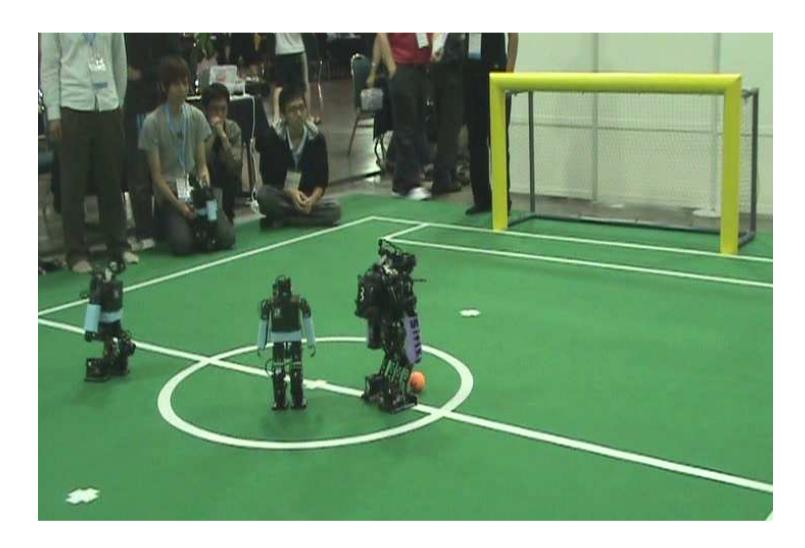
This team project is the second time of our team to participate the RoboCup. However, in last four years, we participated the Hurocup of FIRA [4] from 2006 to 2010. We awarded the forth place of the overall rating of FIRA HuroCup in 2006 (robot name: Taiwan 101 [5] from the team advisor's former university) and third place in 2010. The current developments of the HuroEvolutionKD are designed based on our previous experiences. In RoboCup 2010, we reached the quart-final in humanoid kid-size competition. Fig. 1 shows the humanoid robots in a competition of our team and the team Sitik KIT from Japan.
2 Mechanical Design
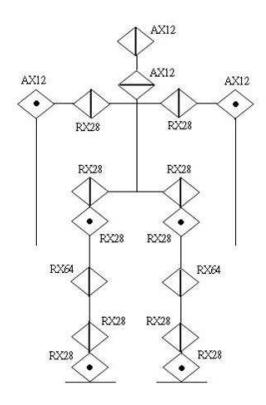
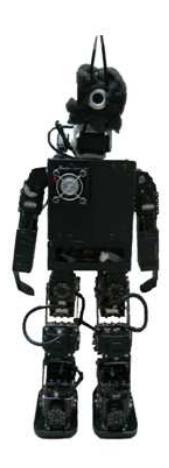
The HuroEvolutionKD is designed as a sixteen degree-of-freedom (DOF) humanoid robot; where 10 DOF joints are desired for two legs, 4 DOF joints are desired for two arms, and 2 DOF joints are desired for head. The mechanical structure is shown in Fig. 2. A conventional web camera is mounted on the robot head. An accelerometer is attached on the chest of the body so that the falling down situation can be detected. As a consequence, the photo of our HuroEvolutionKD is shown in Fig. 3.
3 Hardware design
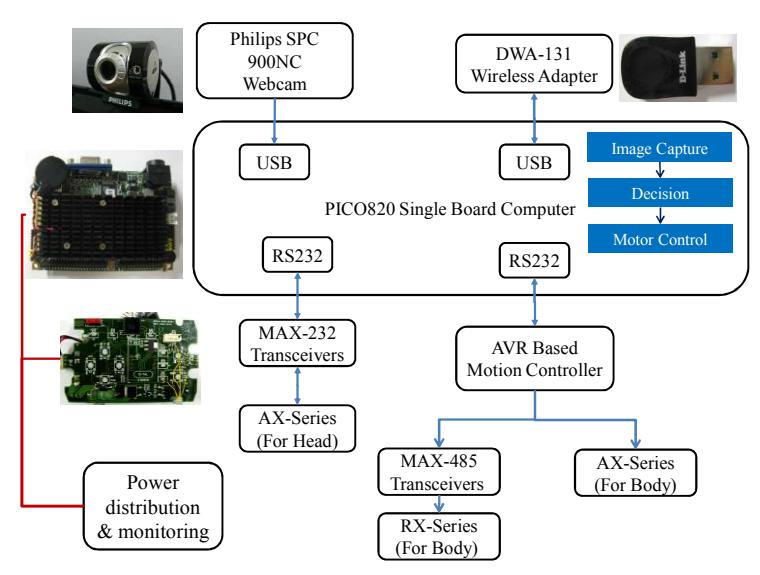
Five hardware modules are desired for the HuroEvolutionKD humanoid robot, and they are a single board computer, a conventional web camera, an AVR micro controller, accelerometer sensor board, and RC servos. The hardware architecture is shown in Fig. 4, and the hardware specification is shown in Table 1. These modules are further introduced:
- Single board computer: Due to power consumption and size concerns, an Axiomtek PICO-820 single computer board is used. The single computer board uses the Microsoft Windows XP as its operation system. The software modules of image capture, image recognition, falling down detection, and gait decision are all implemented based on this single board computer. On the other hand, an AVR based gait pattern generator is connected with a PICO820 board to generate real-time gait patterns for a specific gait decision.
- Conventional web camera: In this team project, a conventional web camera (Philips SPC-900NC [6]) is desired to capture images in front of the robot.
- AVR microcontroller: The AVR based microcontroller is used to implement real-time gait pattern generations by either a kinematics or training based motion patterns. The input of the gait generator is a "gait decision", and the outputs are a set of synchronized motor position commands via UART communications.
- Accelerometer sensor board: In this board, an accelerometer with ADXL345 [7] is used for this project to detect the falling down situations. More specially, the sensor data is collected by the AVR microcontroller.
- RC servos: Sixteen RC servos with Robotis Dynamixel model are used to perform the desired gait motions.
4 Software design
In addition to the hardware, the software components are also introduced. The software components consist of the modules of image capture, image recognition, localizations of a ball and a goal, strategies and decisions, gait pattern generations, acceleration data detection, and motor controls. These modules are implemented on either the PICO-820 or AVR. They are further described in the follows.
- Image capture and image recognition: This module is responsible of retrieving the pixel regions of the ball and goal. If the ball and goal cannot be recognized, the robot may rotate itself or move forward and try to find them.
- Localizations of a ball and a goal: This module is responsible of retrieving the directions of the ball and goal as well as the approximate distance of the ball and goal.
- Strategies and decisions: To finish a competition, a rule based decision subsystem is developed according to different strategies. In addition, a simple coordinated subsystem is further introduced to define the role of robots.
- Gait pattern generations: Several basic gait patterns such as "moving forward", "side-shifting", "rotating itself", "standing up from a fall", "backward walking", and so on are generated via a AVR microcontroller. In the current version, the gait patterns may be generated from kinematics or on-site training modes. The use of mode is determined by different characteristics of the gaits.
- Acceleration data detection: A serial communication packet is decoded to retrieve the acceleration data so that the falling down situation can be detected.
- Motor control: Due to the uses of Robotis Dynamixel RC servos, the motor control is implemented using a sequence of serial communication packet.
Table 1. Hardware specification
| ROBOT Name | HuroEvolutionKD | ||
|---|---|---|---|
| Height of Robot | 460mm | ||
| Arm length | 490mm | ||
| Weight of Robot | 3.1kg | ||
| Walking Speed | Maximum: 10 cm/s | ||
| Type of motor | 6xAX-12(Servo motor) | 8xRX-28(Servo motor) | 2xRX-64(Servo motor) |
| Torque | 12.0kg/cm~ 16.5kg/cm | 28.3kg/cm~ 37.7kg/cm | 64.4kg/cm~ 77.2kg/cm |
| Speed | 0.196 sec/60° | 0.126 sec/60° | 0.157 sec/60° |
| Degree of freedom | 16 | ||
| With Leg: 5 x 2 (RX-28 & RX-64) |
|||
| Arm: 2 x 2 (AX-12) Head: 2 (AX-12) |
|||
| Computing unit | PICO820(Single Board Computer) | ||
| Processor: Intel® ATOM™ processor Z530 | |||
| Operating System: Windows XP | |||
| Motion Controller | AVR ATmega1280 | ||
| Camera | Webcam(Philips SPC900NC) | ||
| Frame rate: 90fps | |||
| Total Picture Element 1024 (H) x 768 (V) | |||
| Batteries | 1 x Li-Po 11V 1500mAh , 1 x Li-Po 14.8V 1500mAh | ||
| Accelerometer | ADXL345 |
5 Conclusion and Future Work
Humanoid robotic research is a very challenging research topic. Our laboratory has devoted 5 years in the development of humanoid robot from small size humanoid robots [5, 8], full size humanoid robot [9], parallel kinematics based humanoid robot [10] and hybrid-structure humanoid robots [11]. We also participate the FIRA competitions for 4 years. We are now trying to extend our research interests to the most important humanoid robot competition, Robocup. We believe the participations of Robocup will induce more research potential for our team via sharing and learning with other teams. The current version is just a prototype to be submitted for the qualification. In the future, a Linux kernel will be used for the future study to improve the real-time performance. On the other hand, fast and stable humanoid locomotion is another issue for use to improve the walking performance. Finally, modular, flexible as well as reusable software and control architectures are also to be justified to increase the efficiency of on-site adjustments on the competition field.
References
- Robocup Humanoid League Competition Information, http://www.robocup.org/
- AVR Product Information, http://www.atmel.com/products/AVR/
- Robotis Product Information, http://www.robotis.com/
- FIRA HuroCup Competition Information, http://www.fira.net/
- Kuo, C.H., Hung, Y.C., Lin, E.C., Chen, J.C., Lee, M.K., Sun, C.C.: Autonomous Humanoid Soccer Robot: Taiwan 101 V1, In FIRA Robot World Congress, Paper ID: 07-119, U.S.A. (2007)
- Philips SPC-900NC Product Information, http://www.p4c.philips.com/cgibin/dcbint/cpindex.pl?ctn=SPC900NC/00&scy=gb&slg=en
- ADXL345 Product Information, http:// www.analog.com
- Kuo, C.H., Chen, C.Y.: Development of Vision Guided Small Size Humanoid Soccer Robot Using Chip Based Controllers, In International Automatic Control Conference, pp. 854-859, Taiwan (2007)
- Kuo, C.H., Chen, C.C., Siao, J.W., Chen, C.T.: Development of Modular-Based Large Size Humanoid Robots, In Journal of Harbin Institute of Technology, Vol. 15, No. 2, pp. 190-194 (2008)
- Kuo, C.H., Chen, C.T., Hung, Y.C.: Design and Implementation of a Parallel Kinematics Mechanism Based Humanoid Robot, In International Automatic Control Conference, Paper ID: I-1903, Taiwan (2008)
- Kuo, C.H., Chen, C.C., Wang, W.C., Hung, Y.C., Lin, E.C., Lee, M.K., Lin, Y.M.: Remote Control Based Hybrid-Structure Robot Design for Home Security Applications, In IEEE/RSJ International Conference on Intelligent Robots and Systems, pp. 4484-4489, China (2006)