EROS TEAM: Team Description for Humanoid KidSize League of RoboCup 2012
Azhar A.S, Ardiansyah A. F, A. Harist A, A. Alfan R, Amirul H.A, A. Subhan KH, Prof. Indra Adji Sulistijono
ER2C (EEPIS Robotic Research Center) Electronic Engineering Polytechnic Institute of Surabaya (EEPIS), Kampus Politeknik Elektronika Negeri Surabaya, Jalan Raya ITS Sukolilo Surabaya 60111, Indonesia
Abstract This paper explains the details and specification of the hardware, software, and the electronic design of EROS (EEPIS Robot Soccer) humanoid robot. EROS is a humanoid robot developed by EEPIS (Electronic Engineering Polytechnic Institution of Surabaya) to participate in RoboCup Soccer Humanoid League.
1 Introduction
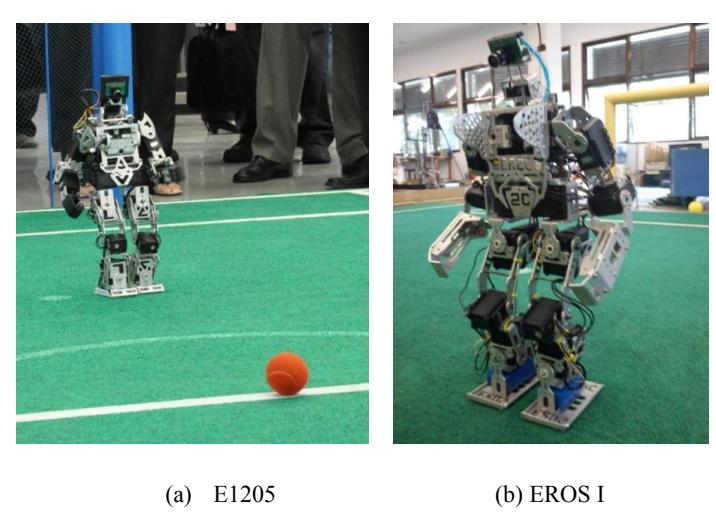
EROS (EEPIS Robot Soccer) which is also known as E-1205 is a humanoid robot which has an ability to walk and move like humans do. EROS is a platform developed by the ER2C (EEPIS Robotic Research Center) laboratory in EEPIS. E-1205 is the first humanoid robot developed to participate in humanoid robot soccer in the Indonesian Smart Robot Championship or KRCI. In that championship, E-1205 won the first winner for the best design category. The robot is 45cm tall and weighs 3 kg. Its joint is 20 Degree-of-Freedom (DOF) by using DC servo motor and distributed control. The system of the balance movement is equipped with accelerometer and gyroscope sensor. CMU cam II is used as vision sensor for tracking the position of the ball and the goal gather. E1205 can locate the ball while walking, dribbling the ball to the opponent's area, and kick the ball to the opponent's goal gather.
EROS is one of humanoid platforms which is the new development of E1205. This robot is developed to improve the ability the former robot and will be contested in Humanoid Soccer League Mexico 2012. The difference of EROS from E1205 is on the robot's mechanical design, the actuator type of each joint, the electronic system design, the addition of TCP/IP based communication system. EROS uses vision sensor camera HD webcam, and 20 DOF joint controlled by DC servo motor through multi drop communication. The communication system of the robot uses WiFi 802.11 g and is equipped with gyro and accelerometer sensor for the movement balance. The dimension of EROS is 45 cm and 3,5 Kg. Recently, the development of EROS emphasizes on world modeling to support the strategy used during the fight in the Robocup 2012.
2 Research
Research on EROS has entered its second year. In the first phase of the development, the research was intended to generate a robot which could move like humans do by observing some nowadays kinds of humanoid robot like HUBO, KHR, and Bioloid. The researchers include three major of fields covering vision system, motion control, and strategy.
In the first phase, the research was emphasized on the vision system and motion control. On the vision system, the research was conducted to detect and track ball movement. The problem appeared was noise from the lighting and the interference of other light like ultraviolet (UV) from the surroundings. To decrease the dependency on the light, the research was done to find the combination of color-based segmentation and shape-based segmentation.
In the first year, the research on the motion control became the main target because the robot had to be able to walk. The research was conducted using simple technique by sequencing the movement poses stored in look-up table. The sequences were loaded based on the required movement-function. The result of this implementation was that the robot could walk. However, the movement was still stiff or unstable that made it easy to fall when it lifted its left or right foot to walk. In the development of EROS 1, the research was intended to get dynamic and more stable movement. The pose feedback was used in the motion control system to acquire balance. The stability was measured by defining the Zero Moment Point (ZMP). When the robot is moving, it causes the moving weight point in the foot step area. When a pose is constructed, the gravity center of the robot's pose can be found. When the foot step forward, each joint in the robot adjusts to acquire ZMP so that the robot can hold on one needed pose.
3 Hardware
The mechanic design of EROS is made of aluminum and has 20 DOF (Degree-of-Freedom). There are 6 joints in each leg, 3 joints in each arm, and 2 joints in the neck. Of 20 joints, 18 joints are moved using Dynamixel AX-18 which is controlled through TTL multi drop serial communication. 2 Joints in the neck are moved using micro servo motor-DC, and is controlled by the main CPU through digital I/O.
4 Electronic
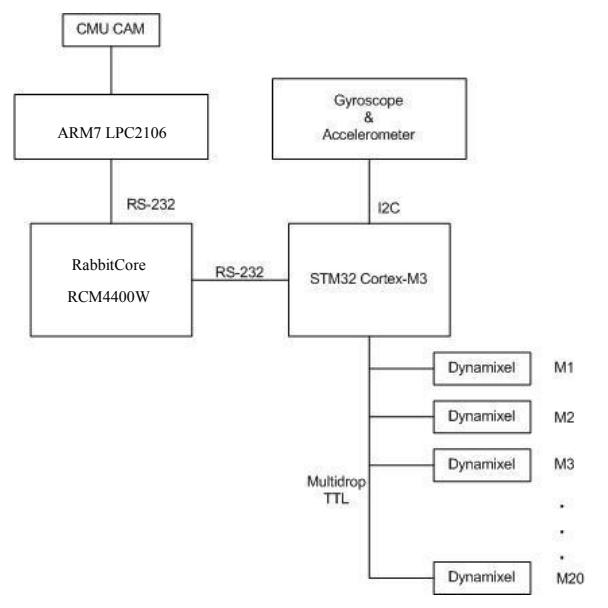
The electronic system in EROS consists of three CPU boards. One CPU for controlling ARM STM32 based servo movement, main Rabbit processer RCM based CPU, and CMU CAM 2 based CPU. The three CPUs communicate through each RS-232 port in the main CPU. The main CPU is equipped with WiFi 802.11b communication system used for communicating with referee box system. 2 batteries-lithium polymer 11.6 volt 1100 mAH is used as the robot power supply, and is able to support power as long as 30 minutes. The scheme of the connection among CPUs is shown in Fig.2.
The main CPU works to compute all functions for used in the competition. This CPU is a Rabbit microprocessor 4000 coming with WiFi communication. It has 1MB RAM and storage media SD 64 GB. It uses four serial communication ports. Two of them are for communicating with CMU CAM2 CPU and a CPU controlling motor joint movement.
CMU CAM2 as vision sensor is set on the head of the robot, and is controlled by ARM STM32 microprocessor based CPU. The storage media is SD card memory and 512KB RAM. This CPU computes the image processing acquired from the camera capture. The results are sent through RS-232 port to main CPU. Servo motor in the neck is controlled or moved by this CPU through digital I/O.
5 Software
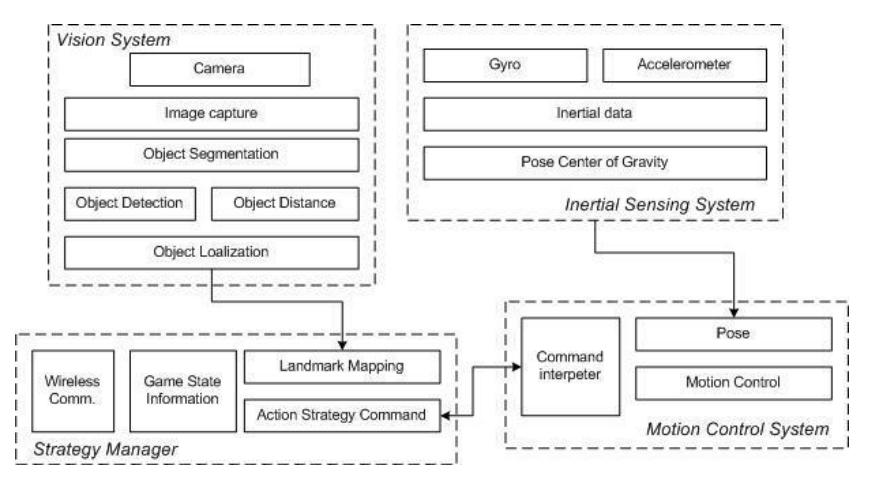
The software in the all CPU is constructed using C programming language. This is based on the standard of development tool of each CPU. Two CPUs control the lowlevel part and one CPU controls two other CPUs based on the behavior taken in a condition during the competition. Figure 3 shows the architecture EROS software globally. There are three big parts; sensor, strategy, and motion control.
The sensor part functions to gather data from the sensor. The data resulted from the censoring is computed and stored in the memory. This process will be done over and over while waiting for the data request from the computation result from the main CPU. In the sensor part, it consists of two parts; robot pose rendering and vision perceptions. The computation of robot-pose sensor results the data of robot's body elevation toward normal axis. Vision perception results data of distance and ball direction from the robot, the object position which is its entity in the competition area. The objects includes the field border, penalty spot, own goal gather and opponent's goal gather, landmark poles, and opponent robots.
Motion control is a part functioning to control the actuator. This part works by receiving orders from main CPU. The order sent is basic movement of football playing like step forward, turn left and right, move left and right, and stand back after falling. The other orders are the combination of some movements like dribbling ball, kicking ball, and avoiding opponents. The order of dribbling the ball is a combination of some movements; forward, turn, and move.
The strategy part is the main part of the robot software. This part communicates with box referee to obtain information of the match state. After obtaining the state information, this part works to do world modeling by mapping object properties in the field. The results of the mapping are the position of opponent's goal gather, landmark poles, and the field border. The results of this mapping are computed to acquire the position of the robot itself and to decide what action to be executed.
6 Vision
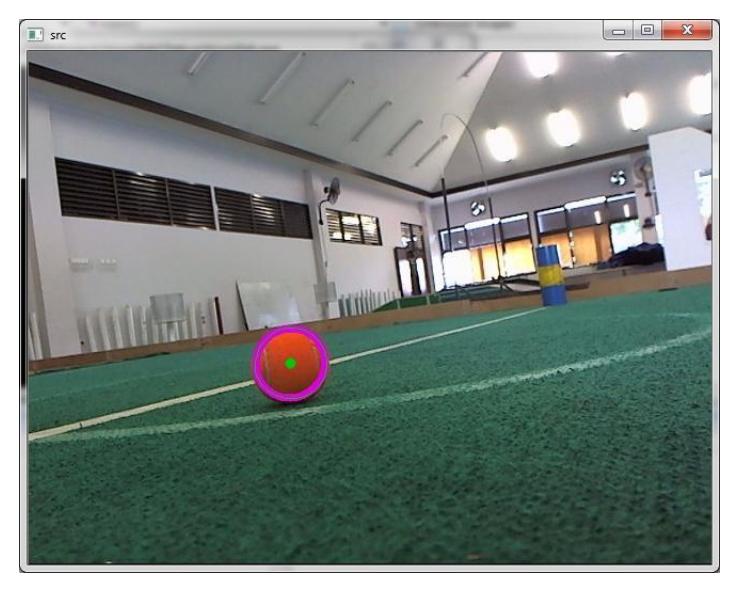
The usage of camera for processing images is influenced by the lighting condition. According to what was experienced in Indonesian Humanoid Soccer League, it was found that there is UV disturbance from the lighting surrounding the field. This was disturbing the image segmentation process which is color based. Thus, the vision system of EROS I is developed to solve this problem. Every time the robot is in a new area, the first process to accomplish is color calibration. To recognize an object, the vision system is developed to compute some steps including; segmenting, locating, identifying, and recognizing. The truth in the field is that there are many other colors found in the field which are almost the same as the field's property.
The first step must be done by vision system is to define the colors of the competition's properties like the ball, landmark poles, goal gather and the opponent robot. This is because in every place the color value becomes different. After it is done successfully, the color value becomes reference for image processing. When the image is captured by the camera, the colors in the picture are RGB and then they are converted to HSV. Preprocessing by implementing filtering is conducted so that noises are eliminated. The result of pre-processing is classified based on the color reference. By defining a number of classification indexes as many as the number of reference color, segmented images can be acquired.
After the images are segmented, it needs to locate each segment to detect the objectin-search. When each object as the result of segmentation is detected as an object of field properties, the system will compute the distance between the robot and the detected objects. This result is used to generate world model. In the other part of this system, when what is needed is to detect ball, the next process is tracking ball movement. This is so that the robot does not lose target. Tracking is done by tracking pixels area surrounding the ball. When it is obtained, the ball is moved to the left. Tracking pixels is done only in the left side of the ball in the picture. This is to speed up the computation process.
7 Conclusion
Robot EROS I is the new development of E1205 which can solve the problem appearing during the competition and other conditions during the trial. Until recently, the research is continuing to improve vision system, and robot movement. Vision system is developed so that it is able to recognize objects well. The robot movement is developed to get the movement like humans'. The result of robot EROS development is expected that it can walk well when playing soccer.
References
- Miomir Vukobratovic, Branislav Borovac, "Zero-Moment Point -- Thirty Five Years of Its Life", International Journal of Humanoid Robotics, Vol. 1, No. 1 (2004), World Scientific Publishing Company, pp.157-173
- M. Friedmann, J. Kiener, S. Petters, D. Thomas, O. von Stryk.: Versatile, highquality motions and behavior control of humanoid soccer robots. Proceedings of the Workshop on Humanoid Soccer Robots of the 2006 IEEE-RAS International Conference on Humanoid Robots, pp. 9-16 ISBN: 88-900426-2-1, Genoa, Italy, December 4, 2006.
- Jan Carsten Carstensen, Stefan Krupop, Reinhard Gerndt. : Robotic Legs Parameters for a human-like Performance. The 6th Workshop on Humanoid Soccer Robots @ Humanoids Conference, Bled (Slovenia), October 2011.
- Indra Adji Sulistijono, One Setiaji, Inzar Salfikar and Naoyuki Kubota, Fuzzy Walking and Turning Tap Movement for Humanoid Soccer Robot EFuRIO (in English), Proceeding (CD ROM) of The 2010 IEEE World Congress on Computational Intelligence (WCCI 2010) (FUZZ-IEEE 2010 Section), Barcelona, Spain, Jul 18-23, 2010, pp.1755-1760
- Indra Adji Sulistijono, Son Kuswadi, One Setiaji, Naoyuki Kubota, Fuzzy Control of Vision System for Humanoid Soccer Robot EFuRIO (in English), Proceedings (CD ROM) of the 2011 IFSA (International Fuzzy Systems Association) World Congress, Surabaya, Indonesia, Jun 21-25, 2011, pp.FC.203.1-6
- Indra Adji Sulistijono, A. Fuady, F. Rusian, Achmad Subhan Kh. and Naoyuki Kubota, Ball Direction Prediction and Motion Optimization Using Behavior Based Coordination for Humanoid Soccer Robot Goalkeeper EFuRIO (The manuscript was send to the 2012 IEEE World Congress on Computational Intelligence (WCCI 2012) (CEC 2012 Section) at Jan 17, 2012)