The NUbots Team Description Paper 2012
David Budden, Stephan K. Chalup, Shannon Fenn, Robert A.R. King, Alexandre Mendes, Steven P. Nicklin, Jed Reitveld, Josiah Walker
Newcastle Robotics Laboratory School of Electrical Engineering & Computer Science Faculty of Engineering and Built Environment The University of Newcastle, Callaghan 2308, Australia
http://robots.newcastle.edu.au
Abstract The NUbots team, from The University of Newcastle, Australia, has had a strong record of success in the RoboCup Standard Platform League since first entering in 2002. This year we are attempting to make a transition into the RoboCup Humanoid Kid-Size League. This paper summarizes the history of the team, describes the roles and research of the team members, gives an overview of the NUbot robots, and addresses relevant research projects within the University.
1 Introduction
The NUbots team, from the University of Newcastle, Australia, competed in the Four Legged League from 2002-2007, and subsequently the Standard Platform league since 2008. The NUbots have had a strong record of successes, twice achieving a first place; in 2006 in Bremen, Germany, and, again in 2008 as part of the NUManoid team in Suzhou, China.
The central goal of the NUbots is to be a high performance competitive robot soccer team at RoboCup. The vision of the research projects associated with the NUbot team is to develop and program robots that can support humans not only for routine, challenging, or dangerous tasks, but also to improve quality of life through personal assistance and coaching. Our mission is to contribute to a responsible development and application of robotics. Some of our projects therefore emphasize anthropocentric and biocybernetic aspects in robotics research [5]. This includes new aspects of human robot interaction and perception. The Newcastle Robotics Lab hosts several postgraduate and undergraduate projects that are associated with the NUbots.
The following sections describe the history of the team, the roles and research of the team members and addresses associated research projects and relevant aspects of the study and research environment of the University of Newcastle, Australia.
2 Commitment to RoboCup 2012
The Nubots commit to participation at RoboCup 2012 upon successful qualification. We are also commit to provide a person with sufficient knowledge of the rules available as referee during the competition.
3 History of the NUbots participation at RoboCup
The University of Newcastle's RoboCup initiative started in 2001. After the introduction of new robotics and machine learning related courses and projects two undergraduate students participated in RoboCup Junior in Seattle and won the world title.
After their return the NUbots team was founded which from then on has participated in the following international competitions of the standard platform league, formerly Sony Four-Legged League. The team has a strong history of competition and success, obtaining many top three placements and winning the RoboCup SPL/Four-Legged League title on two previous occasions.
During the previous two years a effort has been made to allow an easy transition of our code base between different hardware platforms[15]. The majority of modules previously used on the NAO robot in the SPL are now used on the Darwin robot.
4 Background of the NUbots' Team Members
- A/Prof. Stephan Chalup coordinates the Newcastle Robotics Lab. He is an Associate Professor in Computer Science and Software Engineering. He is one of the initiators of the University of Newcastle's RoboCup activities since 2001. His research area is machine learning and anthropocentric robotics.
- Dr. Alexandre Mendes supervises the Newcastle Robotics Lab. He is a Senior Lecturer in Computer Science and Software Engineering. He joined the group in September 2011 and his research areas are algorithms and optimisation.
- Dr. Robert King is a Lecturer in Statistics at the University of Newcastle with particular interests in flexibly-shaped distributions, statistical computing and Bayesian knowledge updating. He joined the NUbots in 2004.
- Steven Nicklin is studying for a Doctor of Philosophy. Steven has been working on localisation and modelling of the robot. His PhD is on localisation systems.
- Jed Rietveld is is a 5th year Computer Engineering and Computer Science undergraduate working on the robots motions.
- David Budden is a 5th year Computer Engineering and Computer Science undergraduate doing a final year project on colour-based vision systems.
- Shannon Fenn is a 5th year Computer Engineering and Computer Science undergraduate doing a final year project on shape-based vision systems.
- Josiah Walker is studying for a Doctorate of Philosophy in Computer Science on Neuro-dynamic programming and robotics. He works on behaviour and movement of the robot.
There are several other students, research assistants, and academics who are members or associates of the Newcastle Robotics Laboratory and the Interdisciplinary Machine Learning Research Group (IMLRG) in Newcastle, Australia. Details are linked to the relevant webpages at www.robots.newcastle.edu.au.
5 Hardware and Software Overview
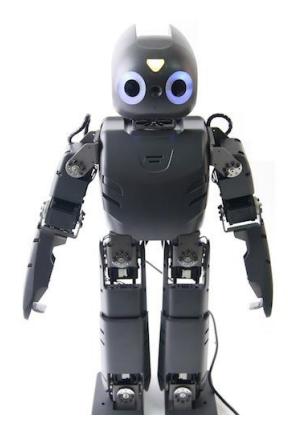
The NUbots use the DARWIN-OP robot seen in Figure 1. Currently these robots are of the standard design. However some minor modifications are planned.
The teams major research focus is on the software systems of the robot. A large majority of our software is developed in-house and is made freely available from [10]. Our software platform is designed to work on multiple robotic platforms, and all of the individual modules have been designed with this in mind. The sensors and actuators are accessed using a standard format, regardless of the robot running the software[15].
The software is broken into a number of modules. The primary modules are: vision, localisation, behaviour, and motion. An overview of our software structure can be seen in Figure 2. The research areas applied to each of these modules are described in the following section.
![Fig. 2. An overview of the software framework, and the transfer of information between the hardware and software modules via the blackboard[15].](/tdps/soccer_humanoid_kid__2012__NUbots/_page_3_Figure_1.jpeg)
6 Research Areas
Robot Vision: Vision is one of the major research areas associated with the Newcastle Robotics Lab. Several subtopics have been investigated including object recognition, horizon determination, edge detection, and colour classification using ellipse fitting, convex optimization and kernel machines. Publications are available e.g. from [8, 17, 18, 2, 4, 7, 3]. We are currently looking to improve our vision by utilising both colour and shape based recognition of robots.
Localisation and Kalman Filters: Research on the topic of localisation focused on Bayesian approaches to robot localisation including Kalman Filter and particle filter based methods. We are particularly interested in further modifications of the Kalman Filter to handle non-ideal information from vision, incorporate increased information from multiple agents, and effectively utilise non-unique objects. Furthermore we are also interested in the use of machine learning to improve the models used by localisation. For information about our current approach see [9].
Development of the Robot Bear: In a collaborative effort with the company Tribotix and colleagues in design a bear-like robot was developed [1]. It is a high quality robot with metal gears, substantial processing power and a range of sophisticated sensors. Control concepts for this platform are currently implemented as part of a Masters project.
Biped Robot Locomotion: We have previously improved existing walk engines by modifying the joint stiffnesses, or controller gains, [11–13]. The stiffnesses are selected through an iterative process to maximise the cost of transport. Walk improvements have been primarily done via optimisation techniques [14, 16] We also investigate the application of Support Vector Machines and Neural Networks to proprioception data for sensing perturbations during pseudo quiet stance. The use of spiking neural networks has also been trialled in this context [19, 20]
Reinforcement Learning and Affective Computing: We investigate the feasibility of reinforcement learning or neurodynamic programming for applications such as motor control and music composition. Concepts for affective computing are developed in multidisciplinary projects in collaboration with the areas of architecture and cognitive science.
Manifold Learning: In several projects we investigate the application of nonlinear dimensionality reduction methods in order to achieve a better understanding and more precise and efficient processing of high-dimensional visual and acoustic data. [6, 21, 22, ?].
7 Related Research Concentrations
The Interdisciplinary Machine Learning Research Group (IMLRG) investigates different aspects of machine learning and data mining in theory, experiments and applications. Particular emphasis is put on interdisciplinary projects. The IMLRG's research areas include: Dimensionality reduction, vision processing, acoustics, robotics control and learning, neurocomputing, evolutionary computation, reinforcement learning, and kernel methods.
Links to publications can be found at the NUbots' webpage
http://robots.newcastle.edu.au/
References
- S. K. Chalup, M. Dickinson, R. Fisher, R. H. Middleton, M. J. Quinlan, and P. Turner. Proposal of a kit-style robot as the new standard platform for the fourlegged league. In Australasian Conference on Robotics and Automation (ACRA) 2006., 2006.
- S.K. Chalup, N. Henderson, M.J. Ostwald, and L. Wiklendt. A method for cityscape analysis by determining the fractal dimension of its skyline. In AN-ZAScA 2008., 2008.
- S.K. Chalup, N. Henderson, M.J. Ostwald, and L. Wiklendt. A computational approach to fractal analysis of a cityscape's skyline. Architectural Science Review, 2009.
- S.K. Chalup, K. Hong, and M.J. Ostwald. A face-house paradigm for architectural scene analysis. In CSTST 2008 ACM, 2008.
- S.K. Chalup and M. J. Ostwald. Anthropocentric biocybernetic computing for analysing the architectural design of house fa¸cades and cityscapes. Design Principles and Practices: An International Journal, 3(5):65–80, 2009.
- Stephan K. Chalup, Riley Clement, Joshua Marshall, Chris Tucker, and Michael J. Ostwald. Representations of streetscape perceptions through manifold learning in the space of hough arrays. In 2007 IEEE Symposium on Artificial Life, 2007.
- N. Henderson, R. King, , and S.K. Chalup. An automated colour calibration system using multivariate gaussian mixtures to segment hsi colour space. In Proceedings of the 2008 Australasian Conference on Robotics and Automation, 2008.
- N. Henderson, R. King, , and R.H. Middleton. An application of gaussian mixtures: Colour segmenting for the four legged league using hsi colour space. In RoboCup Symposium, Atlanta, July 2007. Lecture Notes in Computer Science, 2007.
- Naomi Henderson, Steven P. Nicklin, Aaron Wong, Jason Kulk, Stephan K. Chalup, and Robert King. The 2009 nubots team report. Technical report, School of Electrical Engineering and Computer Science, The University of Newcastle, Australia., 2009.
- J. Kulk, S. Nicklin, A. Wong, S. Bhatia, S. Fenn, D. Budden, J.Walker, and J. Reitveld. Nubots robocup code repository. https://github.com/nubots/robocup, January 2012.
- J.A. Kulk and J.S. Welsh. A low power walk for the nao robot. In Proceedings of the 2008 Australasian Conference on Robotics and Automation (ACRA'2008)., 2008.
- J.A. Kulk and J.S. Welsh. Autonomous optimisation of joint stiffnesses over the entire gait cycle for the nao robot. In Proceedings of the 2010 International Symposium on Robotics and Intelligent Sensors., 2010.
- Jason Kulk and James Welsh. Perturbation sensing using proprioception for humanoid robots. In Proceedings of the IEEE Conference on Robotics and Automation, 2010.
- Jason Kulk and James Welsh. Evaluation of walk optimisation techniques for the nao robot. In IEEE-RAS International Conference on Humanoid Robots, 2011.
- Jason Kulk and James Welsh. A nuplatform for software on articulated mobile robots. In 1st International ISoLA Workshop on Software Aspects of Robotic Systems, 2011.
- Jason Kulk and James Welsh. Using redundant fitness functions to improve optimisers for humanoid walking. In IEEE-RAS International Conference on Humanoid Robots, 2011.
- S.P Nicklin, R. Fisher, and R.H. Middleton. Rolling shutter image compensation. In Robocup Symposium 2006, 2007.
- M.J. Quinlan, S.P. Nicklin, N. Henderson, Fisher R., F. Knorn, S.K. Chalup, R.H. Middleton, and R. King. The 2006 nubots team report. Technical report, School of Electrical Engineering and Computer Science, The University of Newcastle, Australia, 2006.
- L. Wiklendt, S.K. Chalup, and R.H.. Middleton. A small spiking neural network with lqr control applied to the acrobot. Neural Computing and Applications, 17, 2008.
- L. Wiklendt, S.K. Chalup, and M.M. Seron. Simulated 3d biped walking with and evolution-strategy tuned spiking neural network. Neural Network World, 19:235– 246, 2009.
- A. Wong and S.K. Chalup. Towards visualisation of sound-scapes through dimensionality reduction. In 2008 IEEE World Congress on Computational Intelligence (WCCI),, 2008.
- Aaron S. W. Wong, Stephan K. Chalup, Shashank Bhatia, Arash Jalalian, Jason Kulk, and Michael J. Ostwald. Humanoid robots for modelling and analysing visual gaze dynamics of pedestrians moving in urban space. In R. Hyde, S. Hayman, and D. Cabrera, editors, From principles to practice in architectural science. Anzasca 2011, 45th Annual Conference of the Australian and New Zealand Architectural Science Association., 2011.
- A.S.W. Wong and S.K. Chalup. Sound-scapes for robot localisation through dimensionality reduction. In Proceedings of the 2008 Australasian Conference on Robotics and Automation (ACRA'2008)., 2008.