Team Description Paper for Team TH-MOS
Li Changshuo, Zhang Jiwen, Liu Li
Department of Precision Instrument and Mechanology, Tsinghua University, Beijing, China
Abstract This paper describes the design aspects of mechanical and electrical parts as well as the software components of a humanoid robot participating in the Kid-Size competition, Humanoid League of RoboCup. Research fields related to the built platform are concepts of mechanical design, gait generation, dynamic image processing, behavior control, and communication. An omnidirectional gait generating strategy is proposed and a fast vision processing method is implemented on the robot.
Introduction
RoboCup Humanoid League supplies a designated task as the standard for diversified biped platforms. Upon this, mechanical and electrical design evolves every year to cope with remaining problems. Humanoid teams focus on both stability of locomotion and artificial intelligence. These research fields extend as several parts as online motion planning with real-time adaptation and stability, precise and robust object identification with vision system, decision making ability in a rapid changing environment, and inter-robot communication for cooperating [1].
The team TH-MOS from Tsinghua University joined the league since 2006, and had developed several kid-sized humanoids since then. The research focused mainly on online gait generation for omnidirection walking, cognition-motion compliance, and cooperation based on multi robots. The newly designed MOS-Lite and MOS-Strong has reached the tasks to some extent. A short view of the hardware and software concepts is as follows.
Mechanical Designs and Power Supply
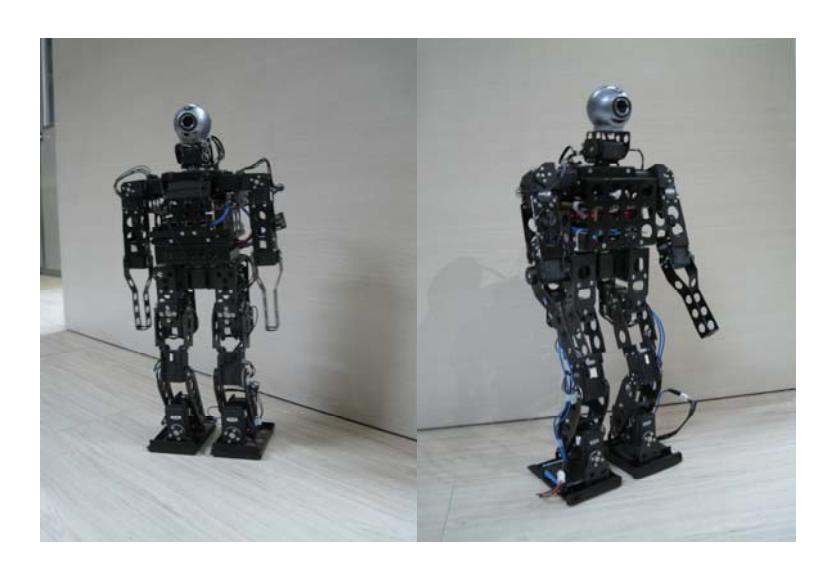
The skeleton of both MOS-Lite and MOS-Strong is mainly constructed with aluminum alloy to reduce weight and keep rigidity. And actuators are all servos diversified in Torque and Speed. For robot flexibility, 6 DOF is allocated in each leg, 2 among which constitute ankle joint(roll, pitch), 1 in knee joint(pitch) and 3 in hip joint(roll, pitch, yaw) intersecting at one point, for such configuration in hip simplifies forward and inverse kinematics[2]. One joint is in waist (yaw) for upper body turning when kicking ball or getting-up actions; there are 3 DOF in each arm, sufficient for getting up, and two in neck for camera navigation. All these DOF allow flexible movement and the working ranges are enough for any common and special actions, and thus fulfill the locomotion request. Fig. 1 shows the outline of MOS-Strong and MOS-Lite. Both robots have a similar kinematical design, but differ in size, weight, mass distribution and servo motor used.
Besides DOF configuration, parameters of different parts like leg length and ankle height vary a lot and play an essential role in locomotion. We derived these disciplines from gait generating algorithm, which is simulated upon the method described in 4.1.
Control System and Sensors
We devise the robots in concept of distributed system with 2 controllers, named locomotion layer and decision-making layer. MOS-Strong and MOS-Lite are equipped with an ARM-based motion controller, clocked at 100MHz as its locomotion layer. It is interfaced with RS485 converter and semi duplex TTL to control all the servos. A/D converters read data series from dual-axis accelerator and gyros. SRAM and flash expansion facilitates this layer to store as many as gait origination. The high speed fix point core allows density of calculation to execute online gait generation and modulation.
The decision-making layer is an X86 industry embedded computer with an operating system of Linux, which streams frames from USB webcam, executes behavior process, and responds to commands outside the play filed. Two layers communicate with each other through RS232 at a baud rate of 115200. Details about the robot system are listed in Table 1.
Technical Data of Robots
| Type | MOS-Lite | MOS-Strong | ||
|---|---|---|---|---|
| Servos | RX28 | AX12 | RX64 | RX28 |
| Torque[Kg.cm] | 28.3 | 16.5 | 64.4 | 28.3 |
| Speed[sec/60°] | 0.167 | 0.196 | 0.188 | 0.167 |
| Sensors: | ||||
| Camera | Logitech QuickCam 5000 | Logitech QuickCam 5000 | ||
| Resolution | 640×480 | 640×480 | ||
| Color space | YUV | YUV | ||
| Frame rate [fps] | 30 | 30 | ||
| Accelerometer | 2 axes | 2 axes | ||
| Gyro | 2 axes | 2 axes | ||
| Degree of freedom | 21 | 21 | ||
| Height [mm]: | 576 | 583 | ||
| Weight [g]: | 3025 | 5341 | ||
| Walking Speed[m/s] | 0.24 | 0.20 |
Algorithms
Robot for RoboCup competition is an autonomous agent; functions can conclude as gait planning and modulation, vision processing, decision-making or behavior, communication and information share.
Online Generated Omnidirectional Gait
The gait of most bipedal robots is controlled by precomputed trajectories, however, in the robot soccer game, a dynamic environment forces the robot to adapt their walking direction, speed and rotation to the changes [4]. A robot has to approach any point and module himself toward a preferred direction while avoid any collapse with obstacles on path. Based on predefined walking styles, complex path planning algorithm is needed. The generated series of gait can be eliminated when surrounding varies to some extent.
Our goal is capsulate the biped robot into an omnidirectional moving platform in the view of the mounted camera on head, and making gait parameterized with 3 parameters: offset in forward and sidle direction and another rotation direction around z axis.
Several walking strategies have been developed, most of which are based on the Three-Dimensional Linear Inverted Pendulum [5]. Firstly, foot trajectory is directly deduced from the foot planner from the gait command. Second, the center of pressure trajectory is defined based on ZMP discipline. COM trajectory is simply related to that of COP assuming the robot as a three-dimensional linear inverted pendulum [6][7][8]. Third, inverse kinematics generates joint trajectories based on the former foot and COM trajectories. An analysis resolution of inverse kinematics can be derived from the specific hip configuration of MOS-Strong and MOS-Lite, which ensured the 3 joints intersected on a single point. [2] had issued the details of this method.
In our research, multiple formulas describing the trajectories are sampled, normalized, and saved in motion control board, and thus both of trajectory type and gain can be adjusted offline, and leaves joint trajectories generated online. An accelerating and decelerating algorithm is also developed to cope with a sudden change of walking speed command from behavior.
Vision Processing
The multicolor image segmentation is the most important part in vision processing. To be robust enough to deal with the complex environment of robotic soccer, the vision processing does not only make use of traditional algorithms to deal with the multicolor image, but also uses a very fast segmentation algorithm.
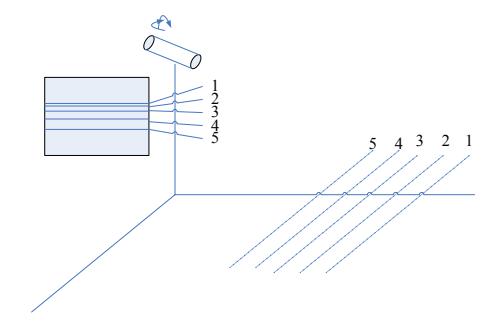
In MOS-Strong and MOS-Lite, In order to balance the processing speed and recognition precision, we introduce a changing scan step over pixels rather than a progressive scan step from pixel to pixel. The step length is related to distance from the scan line in Cartesian coordinates reflected to image based on pin-hole model. The scan line generation can be illustrated by Fig. 2.
Behavior
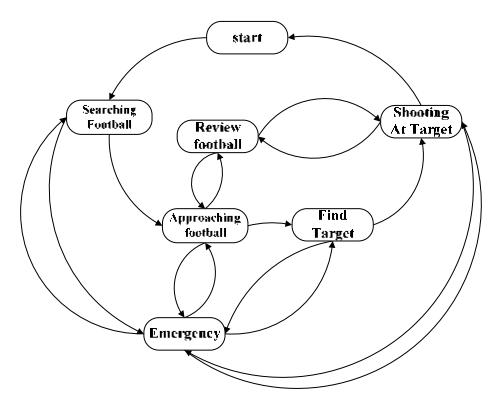
Behavior module is constructed with finite state machine, considering the endless changing environment while playing football. Basic states include start state, searching football, searching shooting target, walking toward football, shooting at target, and emergency when falling. Vision information and robot posture feed back join to supply resources for state adjustment, making the robot perform according to various circumstances. Fig. 3 shows the example of state flow of penalty kick strategy.
Communication
Communication includes information share between different robots and instruction and feed back among robots and human machine interface. It depends on WLAN in hardware; a network platform aimed at gap-less information, especially synthesis of environment fuzzy description is on research based on MOS, for efficient information share will make cooperation possible within a team. Robots in humanoid league do not depend on a central controller off board. On the contrary, they make decisions themselves. Shared information, including decision path, description of playfield and ball, perform as other sensors of a robot. Cooperation in such system needs further development.
Conclusions
In this paper, improved humanoid robots, MOS-Strong and MOS-Lite are investigated in specification. We also proposed an omnidirectional gait generation method; speed and precision balanced object reorganization algorithm is developed and put to use in MOS robots. Communication and cooperation is realized by means of WLAN. Multi-robots system cooperation with independent decision-making agent will be further developed based on the platform.
Commitment
Team TH-MOS will definitely participate in the RoboCup 2012 Humanoid League competition and make a team member with sufficient knowledge of the rules available as referee during the competition, if we are selected and qualified.
References
- M Friedmann, J Kiener, H Sakamoto. Versatile, high-quality motions and behavior control of humanoid soccer robots [A]. Proceedings Workshop on Humanoid Soccer Robots of the 2006 IEEE-RAS International Conference on Humanoid Robots [C]. Genoa, Italy, 2006. 9-16.
- Colin Graf, Alexander Hartl, Thomas Rofer, Tim Laue. A Robust Closed-Loop Gait for the Standard Platform League Humanoid [A]. Proceedings of the 4th Workshop on Humanoid Soccer Robots in conjunction with the 2009 IEEE-RAS International Conference on Humanoid Robots [C]. Paris, France, 2009: 30-37.
- Dorian Scholz, Martin Friedmann, Oskar von Stryk. Fast, Robust and Versatile Humanoid Robot Locomotion with Minimal Sensor Input [A]. Proceedings 4th Workshop on Humanoid Soccer Robots at the 2009 IEEE-RAS international Conference on Humanoid Robots[C]. Paris, 2009 to appear.
- Sven Behnke. Online Trajectory Generation for Omnidirectional Biped Walking [A]. Proceedings of the 2006 IEEE International Conference on Robotics and Automation [C]. Florida, 2006. 1597-1603.
- S Kajita, F Kanehiro, K Kaneko, K Fujiwara, K Harada, K Yokoi, H Hirukawa. Biped Walking Pattern Generation by Using Preview Control of Zero-Moment Point [A]. IEEE International Conference on Robotics and Automation [C]. 2003: 1620-1626.
- David Gouaillier, Cyrille Collete, Chris Kilner. Omni-directional Closed-loop Walk for NAO [A], 2010 IEEE-RAS International Conference on Humanoid Robots[C]. Nashville, TN, USA, 2010: 448-454.
- J J Alcaraz-Jimenez, D Herrero-Perez, H Martinez-Barbera. Motion Planning for Omnidirectional Dynamic Gait in Humanoid Soccer Robots [J]. Journal of Physical Agents, 2011, 5(1): 25-34.
- Johannes Strom, George Slavov, Eric Shown. Omnidirectional Walking using ZMP and Preview Control for the NAO Humanoid Robot [M]. RoboCup 2009: Robot Soccer World Cup XIII. Springer, 2009. 378-389.