Humanoid Soccer Robot Design by TKU Team for Humanoid League of RoboCup 2012
Ching-Chang Wong, Yueh-Yang Hu, Hsiang-Min Chan, I-Hsiang Tseng, Li-Feng Chen, Hao-Chia Chung
Department of Electrical Engineering, Tamkang University Tamsui, New Taipei City, Taiwan
Abstract A humanoid soccer robot named HIWIN MAN and designed by the TKU team with HIWIN Company to attend the humanoid league of RoboCup 2012 is described. A platform for the study of biped walking control is designed and implemented. First, a mechanical structure with 23 DOF (degrees of freedom) for this humanoid robot is described. The architecture and electronic components for system are also presented, webcam, gyro and accelerometer can help robot to obtain the information from the environment, communicate with other robots by wireless network. In order to design the robot locomotion control, a human-machine interface is implemented to study the locomotion control design of biped robot. From the practical experiments, HIWIN MAN can be a soccer robot to decide some actions such as get up from a fall, find a ball, walk to an appropriate position, and kick a ball autonomously.
1. Introduction
The robot soccer games are used to encourage the researches on the robotics and artificial intelligence. Two international robot soccer associations, RoboCup and FIRA advance this research and hold some international competitions and symposiums. The goal of RoboCup is "By the year 2050, develop a team of fully autonomous humanoid robots to win against the human world cup champion team." In the humanoid league, many technology issues and scientific areas must be integrated to implement the biped robot, such as mechanics, electronics, control, computer science, and semiconductor. Besides, the research technologies of biped walking control, autonomous motion, direction judgment, kicking and shooting ball will be applied [1-5]. A humanoid soccer robot named HIWIN MAN and designed by the TKU team to attend the humanoid league of RoboCup 2012 is presented. In order to let HIWIN MAN can play a soccer game autonomously, three basic skills are designed and implemented on it: environment perception, move ability, and artificial intelligence. In order to let HIWIN MAN have a high ability of environmental detection, a webcam, a gyro and an accelerometer are equipped on the body of HIWIN MAN to obtain the information of the environment so that HIWIN MAN can decide an appropriate action. In order to communicate with the other robot, the robot has wireless network device. All functions of HIWIN MAN are implemented by two boards, TKU Board and FPGA Board. TKU Board can process the data obtained from the image sensor. It can also process the high level artificial intelligence. FPGA Board is a center of actions, it makes robot move and keep balance. HIWIN MAN is designed as a soccer player so that it can get up from a fall, walk, turn, and shoot the ball autonomously.
2. Structure of Humanoid Robot HIWIN MAN
A structure of the humanoid robot HIWIN MAN is described in this section. HIWIN MAN is developed for realizing and analyzing the human movement and behaviors. One of the most important difference between the human body and the robotic body is the human body is flexible while the robotic body is rigid. The human body can absorb the disturbance, such as the reaction force from ground. Robot soccer game is a great opportunity to verify the ability of HIWIN MAN. The robot must play a soccer game autonomously. In order to play the soccer game, three basic skills are designed and implemented on it: environment perception, move ability, and artificial intelligence. Table 1 shows the specification of HIWIN MAN. The details of hardware and software designed will be presented in following sections.
Table 1. Specifications of the TWNHR-VI
| Specifications | ||||
|---|---|---|---|---|
| Name | HIWIN MAN | |||
| Height | 59 cm | |||
| Weight | 4.5 kg | |||
| Walking Speed | Top Speed: 30cm/sec, | |||
| Average Speed: 15cm/sec | ||||
| Mechanism System | ||||
| Number of DOF | Actuator Torque (kg/cm) | Actuator Speed (sec/60°) | ||
| Head | Neck | 2 | 16.5 (AX-12) | 0.196 |
| Trunk | Waist | 3 | 37.7(RX-28) | 0.126 |
| Legs | Hip | 2 | 64.4(RX-64)/ 37.7(RX-28) | 0.188/0.126 |
| Ankle | 2 | |||
| Knee | 1 | |||
| Arms | Shoulder | 2 | 18(AX-18)/ 37.7(RX-28) | 0.196/0.126 |
| Elbow | 1 | |||
| Wrist | 1 | |||
| Total | 23 | |||
| Electronic System | ||||
| Part | Device | Specification | ||
| Webcam | Microsoft LifeCam Cinema | 320x240 resolution | ||
| Sensors | Accelerometer | RM-G144 | 3-axis | |
| Gyro | ITG-3200 | 300 degree/sec | ||
| Processor | TKICBoard | Intel Pineview-D510 Processors | 45nm process | |
| FPGA | T3C40-V6 | EP3C40F484C8 |
3. Mechanism Architecture
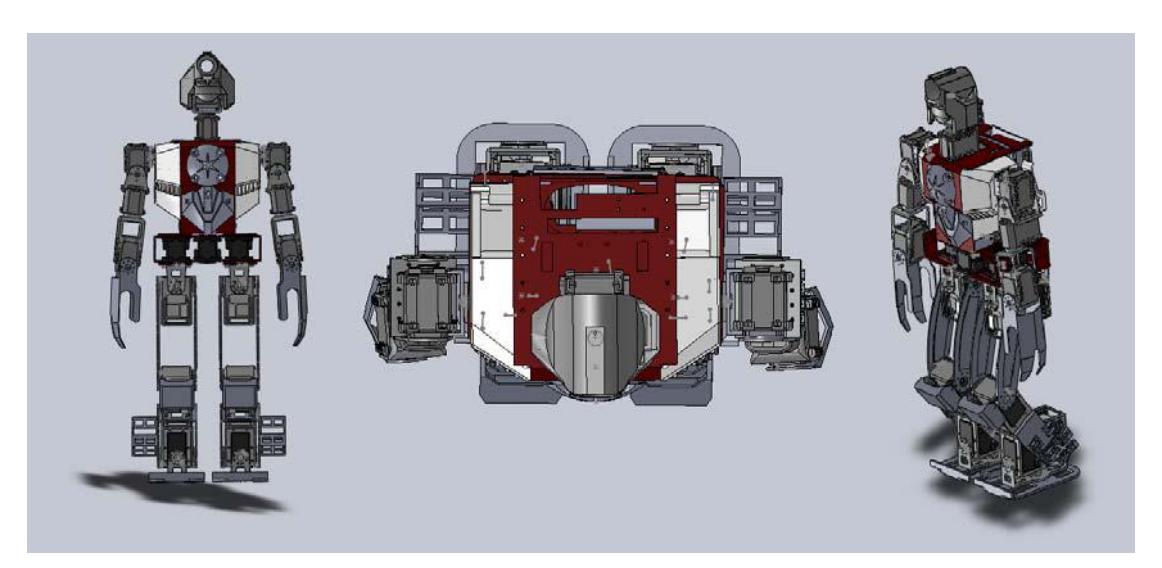
A humanoid soccer robot named HIWIN MAN and designed by the TKU team with Hiwin Company to attend the humanoid league of RoboCup 2012 is described. A platform for the study of biped walking plan and balancing control is designed and implemented. First, This humanoid robot is described with 23 DOF(degrees of freedom). Second, it can obtain the information from the environment by architecture and electronic components webcam, gyro and accelerometer. Third, robot can communicate with other robots by wireless network. In order to design the robot locomotion control, a human-machine interface is implemented to study the locomotion control design of biped robot. From the practical experiments, HIWIN MAN can be a soccer robot to decide some actions to get up from a fall, find a ball, walk to an appropriate position, and kick a ball autonomously. The mechanical design and joints configuration of this robot are described in Fig. 1, where 23 DOF are implemented in the robot.
4. Electronic System
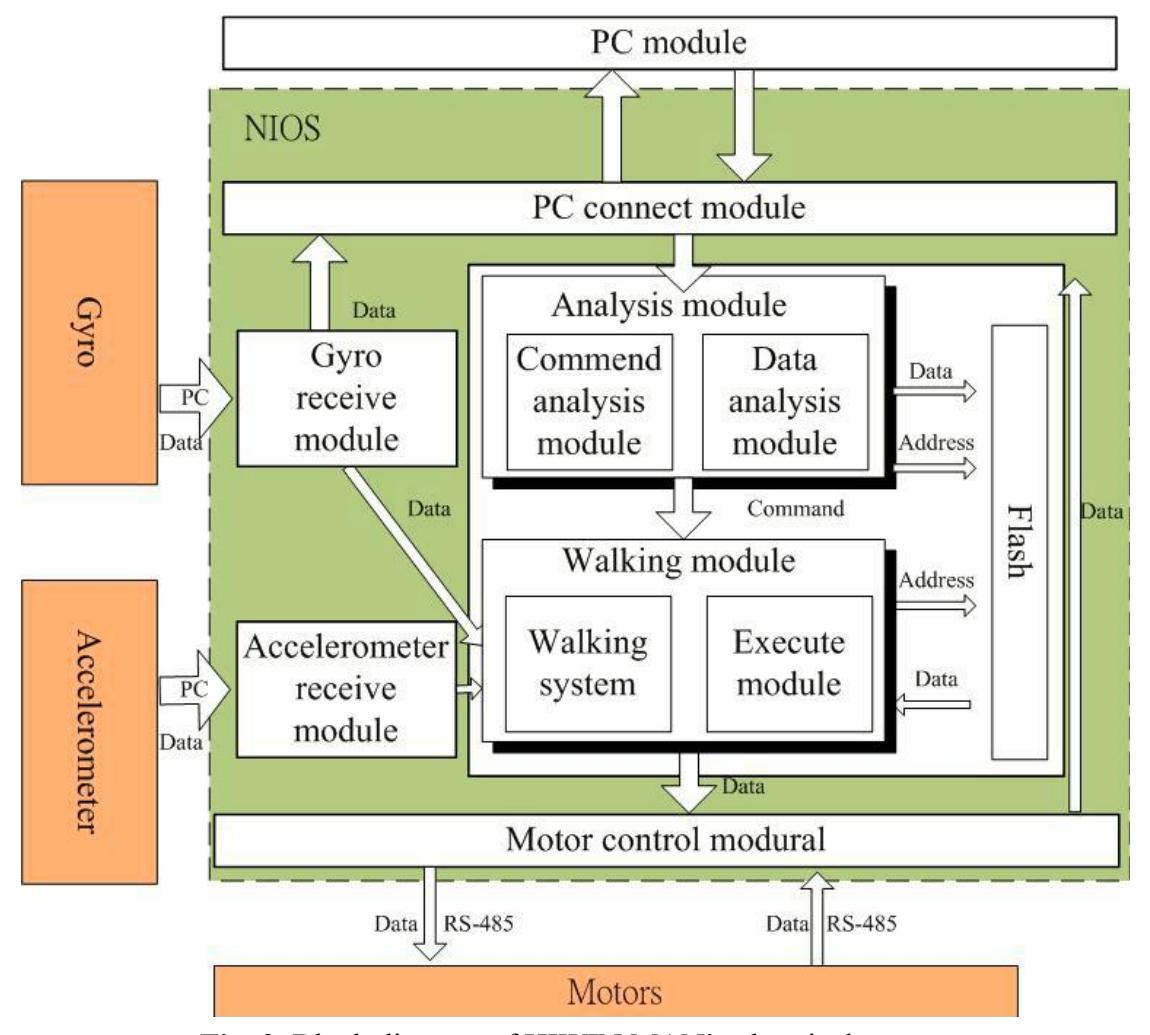
In the electronic system design of the robot, the block diagram of electrical system for HIWIN MAN is described in Fig. 2. NIOS II is a centre process of the robot, it control 23 motors and receive data from gray and accelerometer, it also can connect with TKU Board. TKU Board which contains CPU and full function computer is used to build the system of the humanoid robot. TKU Board has an Intel Pineview-D510 Processors, 45nm process with 2G DDR2 667 RAM. Many functions are implemented on TKU Board chip to process the image and control the robot.
5. Human-Machine Interface
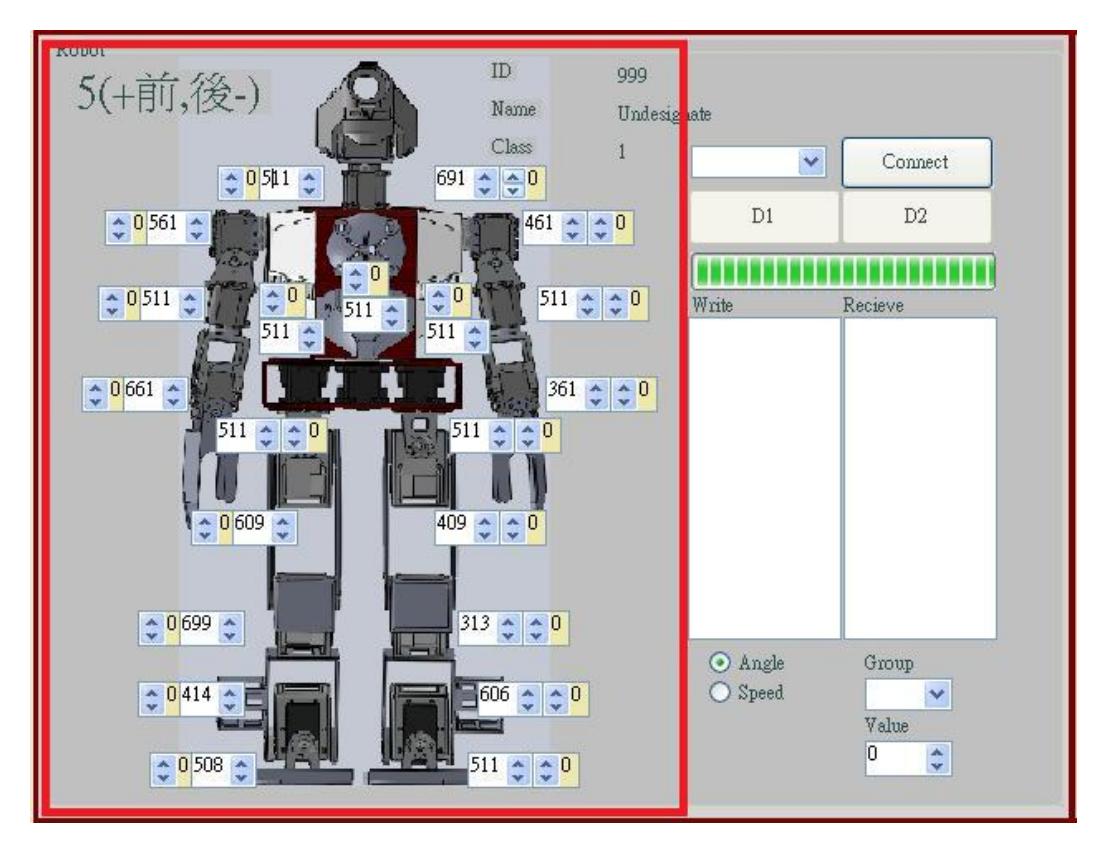
A human-machine window interface as shown in Fig. 3 is designed and implemented by Visual Studio 2008. This human-machine interface is designed as a convenient development platform to shorten the development time of the locomotion control design. Besides, the interface also provides a real-time motion design module.
6. Experiment results
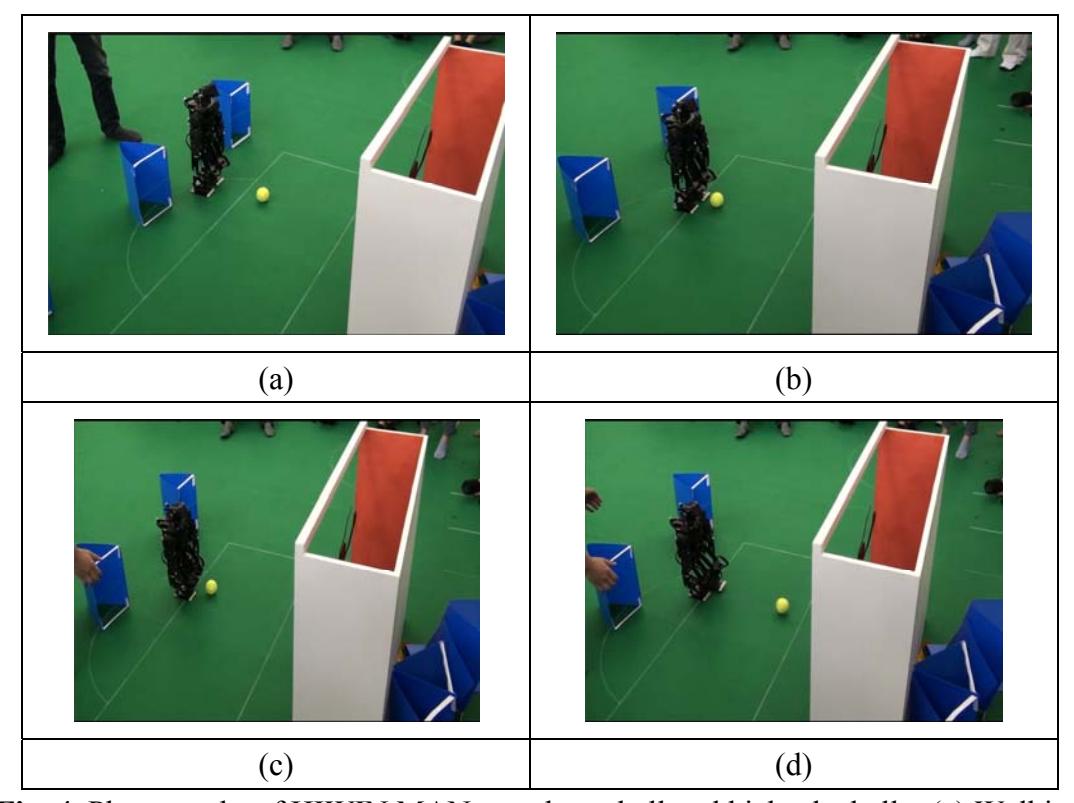
FMAN's ability. Four pictures are shown in Fig. 4. There are four situations for the robot: (a) Find the ball. (b) Walk toward the ball. (c) Kick the ball to the goal. (d) Goal.
7. Conclusion
A design and implemented method of a humanoid soccer robot named HIWIN MAN is presented. A mechanical structure with 23 DOF is designed and implemented so that HIWIN MAN can get up from fall, walk forward and backward, turn right and left, and kick the ball. A webcam, a gyro, an accelerometer, and a wireless network are equipped on the body of HIWIN MAN to obtain the information of the environment and communicate with the other robots so that it can decide an appropriate action behavior. A platform with a human-machine interface is implemented. We can view the motion of HIWIN MAN at any direction from the window interface. Based on the platform, we can simulate the motion of HIWIN MAN so that the locomotion control design of the biped robot is fast and efficiency.
Team TKU has been attended RoboCup for many years from 2005 to 2011, team TKU with HIWIN MAN humanoid robot performed very well in technical challenge and official games. We would like to keep participate RoboCup, and improve our robot more intelligent and human-like. Look forward to attend RoboCup 2012 in Mexico.
Acknowledgment
This research was supported in part by the HIWIN Corporation in Taiwan.
References
[1] C.C. Wong, K.H. Huang, Y.Y. Hu, H.M. Chan, H.C. Chen, C.H. Hung, C.C. Jiang and W.N. Hsu, "Humanoid Soccer Robot Design by TKU Team for Humanoid League of RoboCup 2011," RoboCup International Symposium 2011, 2011. [2] Q. Huang, K. Li and Y. Nakamura, "Humanoid Walk Control with Feedforward Dynamic Pattern and Feedback Sensory Reflection," IEEE International Symposium on Computational intelligence in Robotics and Automation, pp. 29-34, 2001. [3] T. Sugihara, Y. Nakamura and H. Inoue, "Real time Humanoid Motion Generation through ZMP Manipulation based on Inverted Pendulum Control," IEEE International Conference on Robotics and Automation, pp. 1404-1409, 2002. [4] T. Furuta, "Design and Construction of a Series of Compact Humanoid Robots and Development of Biped Walk Control Strategies," IEEE International Conference on Robotics and Autonomous Systems. (2001) 65-88. [5] M. Vukobratovic, A. A. Frank and Juricic, D, "On the Stability of Biped Locomotion," IEEE Transactions on Biomedical Engineering, pp. 25-36, 1970.