WF Wolves KidSize Team Description RoboCup 2012
Jan Carstensen, Stefan Krupop, Tobias Bolze, Reinhard Gerndt
Ostfalia University of Applied Sciences, Department of Computer Sciences, Am Exer 2, 38302 Wolfenbüttel, Germany
Abstract This paper details the current state of the hardware and software design of the WF Wolves robots, used for soccer competitions in 2012. The development of this model started in 2008. Based on the performances of the last years it has been improved to the current state. The WF Wolves robots use the wCK 1111 servos. With 20 joints, stereo vision and custom designed and optimized electrical systems the robots rank in the small and lightweight category of the league. Optimized computer vision and abstract behaviors, initially developed in the Mixed Reality League, are the key components to the current robot generation. The current state of the systems and current developments will be presented in this paper.
1 Introduction
Humanoid robot soccer imposes a series of challenges. It involves developing an architecture to support all the functionality needed in terms of walking, kicking and such, a suitable control structure and fast and lightweight algorithms to fulfill the requirements given by the soccer tournament and the technical challenges. WF Wolves have been participating in international RoboCup since the year 2007 and in a number of local and national robotic events. In 2008 and 2010 the WF Wolves won the world championship in the Mixed Reality League. Developing a custom control architecture for stereo vision and embedded computing are two major aspects of the teams work. For 2012 a number of changes have been introduced, as we will address in the following sections.
2 Research Overview
This section describes the four main research and development objectives of the current year.
Embedded Control
The WF Wolves work with specialized DSP modules and custom-made boards to implement high-level control, vision and artificial intelligence functionality. Using a standard Blackfin dual-core processor module, peripheral and interfacing circuitry is specifically designed for small humanoid robots. [1] The architecture resembles human structures with all high level functionality concentrated in the head. The WF wolves approach thus considerably differs from a number of other systems with ITX boards or fit PCs, located in the body.
Stereo Vision
The vision system is the most important sensor used in the humanoid kid size league. A stereo vision system allows for measuring distances for undefined object sizes. This comes at the price of having to process twice as many images. To compensate this, the algorithms for stereo vision need to be even faster and implementation more efficient. Improving a stereo based vision system currently is one of our main goals.[1] [2]
Simulation
Due to wear, cost of testing on real robots is relatively high. Also developing learning algorithms only advances slowly, if done with real robots. Therefore, the group is working on a simulation environment for its robots. Currently of the major aspects is to validate the simulation, finding ways to deal with the difference between simulation and reality and to minimize this gap. This research helps to deploy results from simulated agents onto the physical robots.[3] [4]
Kick optimization
The kick performance was identified as one of the major deficits of the WF Wolves robots. Therefore, kicking abilities have been addressed a significant research area. Identifying parameters of the kick movement and optimizing kick behavior, the kick distance for the existing robots could be increased by 200%. A new robot leg structure, based on the wCK servos, was designed and implemented as an engineering sample that showed increased kick distance of up to 600%, which is close to the theoretical optimum. [5] The mechanical parts are currently in production. Robots will be equipped with the new leg in February and March.
3 Hardware
3.1 Electrical System
The electrical system is custom made and designed specifically for a kid-size class humanoid robot. Boards are designed as light and small as possible. Two different control boards are used, a main processor for high-level control, vision and AI and a body controller for controlling the servos and generating the walking pattern.
Main Processor
The main processor, located in the robots head, is an Analog Devices Blackfin BF-561 dual-core DSP processor, running at 500 MHz. The module is equipped with 64 MB of SDRAM and 8 MB of flash. The DSP processor architecture features two 16-bit MACs, two 40-bit ALUs and four 8-bit video ALUs for efficient signal and image processing. With multiple DMA channels the image data can be transferred simultaneously from both camera ports into SDRAM. The dual-core module was especially selected with respect to stereo vision. The main processor module is equipped with programming and communication interfaces, like an USB WLAN stick for inter-robot communication and communication with the game control. [6]
Body Controller
The body controller is based on an AT91SAM7X256 ARM7 microcontroller. It controls movement of the servos. It independently generates motion patterns, e.g. for walking or plays prepared motion patterns, e.g. for getting up. Generated motion patterns can be parameterized by inertial measurement data to stabilize the gait. The body controller is controlled by the main processor via a standard serial connection. The processor runs at 50 MHz. [7]
Inertial Measurement Unit
The robots are equipped with a 9 Degrees of Freedom inertial measurement unit consisting of a 3 axis gyroscope, a 3 axis accelerometer and a 3 axis magnetometer, which provide sensor data for stabilizing the motions and improving the interpretation of vision data.
Visual Sensor
The robots use two 2 megapixel cameras attached directly to the main processing board. Both cameras are OV2460 CMOS cameras using embedded compression engines to output a number of formats ranging from RGB to YUV. Besides that, the camera offers automatic exposure control, white balance and black-level calibration and corrects lens distortion. [8]
Power Supply
The power for the robot's servos and the processing unit is supplied by a 3-cell lithium polymer battery.
3.2 Mechanical System
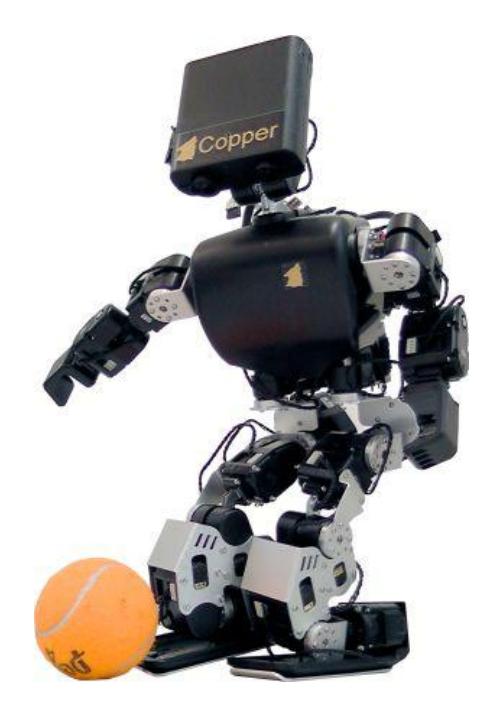
The WF Wolves robot as shown in figure 1 consists of 20 servo actuators. The design is based on mimicking humans. Because the main objective is to play soccer, the legs are further developed than the arms and the torso. The positioning of the control boards is done by mimicking humans as well. The main controller is based inside the head and has two cameras attached for a human-like stereo vision. The second controller is placed in the back and handles walking and reflex like controls. The robot uses servo types wCK 1111 and wCK 1108 from RoboBuilder, which use a potentiometer for position feedback. [9]
WF Wolves 2012
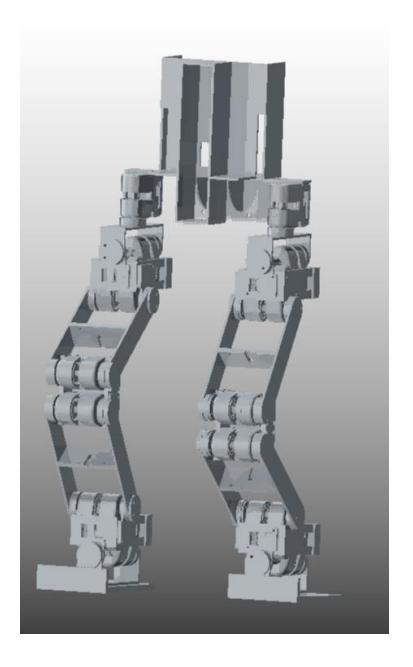
The WF Wolves developed a new leg to furthermore improve the performance of the robots as shown in figure 2. The new leg features a number of improvements: The position of the hip servos allows more flexible kick motions and improves the agility of the robot. The double knee configuration increases the speed and stability of walking. [5]
4 Software
Embedded Linux
The high-level controls running on the DSP are being supported by an embedded Linux. This operating system is providing a considerable amount of OS functionality, e.g. wireless communication, memory management and file systems. Using the embedded Linux, it is possible to mange a variety of different ports, control the cameras and access the micro SD card used for storage. Some of the drivers, especially for the cameras, were modified to fulfill all necessary requirements.
Vision
Using a stereo vision system comes with a few advantages, but also disadvantages. The main advantage, estimating the distance to an object without knowing it's exact size, does currently not give much benefit to the teams, so it is not widely used throughout the humanoid league. Since in many scenarios in the near future of the humanoid kid size the object will not be defined in size, it will become more and more important to use human-like stereo vision approaches.
A speed optimized blob-finding algorithm is used for first processing the captured image. Each detected object has a number of filters applied to it to make sure all objects are classified correctly. This process is computed on each core simultaneously, afterwards the disparity is calculated to estimate the distances. [2] [10]
Behavior
With experience in modeling team behavior in an environment where the robots are not allowed to communicate with each other, most of the strategies used do not depend on inter-robot communication. This is reflects the unstable wireless LAN at many past tournaments. Using a framework initially developed in the Mixed Reality League, very abstract behaviors are possible.
5 Robot Control
Key-frame Motions
Even though key-frame motions prove to be the inferior control method, some motions are too complex to be easily generated. The WF Wolves robots therefore use the key-frame motions for goalkeeper motions, kicks and getting up motions.
Omnidirectional Walk Engine
For all other motions such as walking forward, backwards, sideways and turning an omnidirectional walking engine is used, calculating the servo positions in real time. This allows controlling the body using high level commands instead of combining a predefined set of key-frame motions. It also allows incorporating sensor data for stabilization. Besides this, it is sufficiently abstract to allow running the same behavior on different robots without the need of sophisticated calibration. [7]
6 Conclusion
The main advances of the WF Wolves platform for 2012 are improved walking abilities with higher speed and stability and significantly improved maneuverability. Kick performance has been improved. Further improvements are expected from the new mechanical leg design that is planned to be deployed in February. The team WF Wolves is looking forward to participate in the RoboCup 2012 in Mexico. We will be happy to provide a team member as referee or operator. Many team members are briefed to fulfill all duties required for the tournament and have previous experience at local, national or international level. Also the WF Wolves will be happy to continue their effort to support the humanoid league wherever possible.
References
- Michalik, S.: Entwurf eines Stereo-Bildverarbeitungssystems im Roboterfuball. Bachelorthesis, Ostfalia - University of applied Sciences (2010)
- Carstensen, J.: Computer vision a probabilistic and modular approach. Bachelorthesis, Ostfalia - University of applied Sciences (2011)
- Pawlowski, A.: Visualisierung und Simulation von Fuballrobotern mit einer 3D-Render-Engine. Masterthesis, Ostfalia - University of applied Sciences (2011)
- Zheng, W.: 3D-Simulation einies humanoiden Roboters. Bachelorthesis, Ostfalia University of applied Sciences (2010)
- Jan Carstensen, Stefan Krupop, R.G.: Robotic legs parameters for a human-like performance. (2011)
- Gerndt, R., Michalik, S., Krupop, S.: Embedded vision system for robotics and industrial automation. In: Industrial Informatics (INDIN), 2011 9th IEEE International Conference on. (2011) 895 –899
- Michalik, S.: Dynamisches laufen von humanoiden robotern. Bachelorthesis, Ostfalia - University of applied Sciences (2010)
- OmniVision Technologies Inc.: Ov2640 datasheet (2007)
- Robobuilder: (Intelligent Modular Robot wCK series Users's Manual)
- Neu, C., Eichelberger, M.: Goal detection for humanoid soccer players localization. Bachelorthesis, Ostfalia - University of applied Sciences (2011)