Falconbots RoboCup 2013 Humanoid KidSize Team Description Paper
Diego Mauricio Reyes Hernández, Guillermo Iván Prisco Pérez, David Ulisses Arenas Aguilar, Israel Tiburcio Alvarado, Alma Juárez Ramírez
Departamento de Investigación; Instituto Tecnológico Superior de San Martín Texmelucan, México
http://www.itssmt.edu.mx/PAGINA%20FALCONBOTS/PAGINA%20TEC/INDEX.html · http://www.robocup.org/ · http://www.robotis.com/xe/
Abstract This paper presents the organization and architecture of equipment of cocker playing. We describe the RoboCup KidSize humanoid robots to be used by the team Falconbots in the RoboCup 2013 competition to be held in Eindhoven the Netherlands. For this edition of the competition, we will present three different robot architectures. The first of them is based on the Bioloid robot, the second one on three Darwin-OP, and the third one on Robonova-1.
1 Introduction
The Tec San Martin Texmelucan offers students the opportunity to learn and develop humanoids robots with the capacity of walking, dancing and even playing a soccer match in an autonomous way. This is possible because the Institution has commercial humanoid robots such as Robonova-1, Bioloid and Darwin-OP. In addition, there is a great variety of sensors like Tilt, Vision sensors, Accelerometer axes, Gyroscope axes; Compass and computers model ROBOARD RB-110.
Due to the successful participation in several national and Latin American tournaments, for example; Mexican Tournaments of Robotic and Latin American Tournaments of Robotic, we decided to participate in this important event, RoboCup.
The Team Falconbots Tec San Martin is a team that started working with humanoid robots in 2010. Falconbots' first participation at an official RoboCup event was the Mexican Open RoboCup 2011, obtaining the third place out of seven participants. After that, Falconbots participated at RoboCup 2011 in Istanbul, Turkey where they won one of their three matches. Later, they participated in the Mexican Open RoboCup 2012 winning the tournament championship. In the same year, they participated in the RoboCup 2012 in Mexico City. In this competition, they played 5 matches of which they won one match, tied two matches and lost 2 matches. In these two last participations, the team participated in collaboration with the Mobile Robotics and Automated Systems Lab, Universidad La Salle, using its vision system.
The team has published in the V and VI WorkShop of the Mexican Association Robotics, publishing articles such as "Arquitectura de los robot humanoides FALCONBOTS" and "Control de robot humanoide con libreria DXL-SDK de robotis y deteccion de colores y formas con Open."
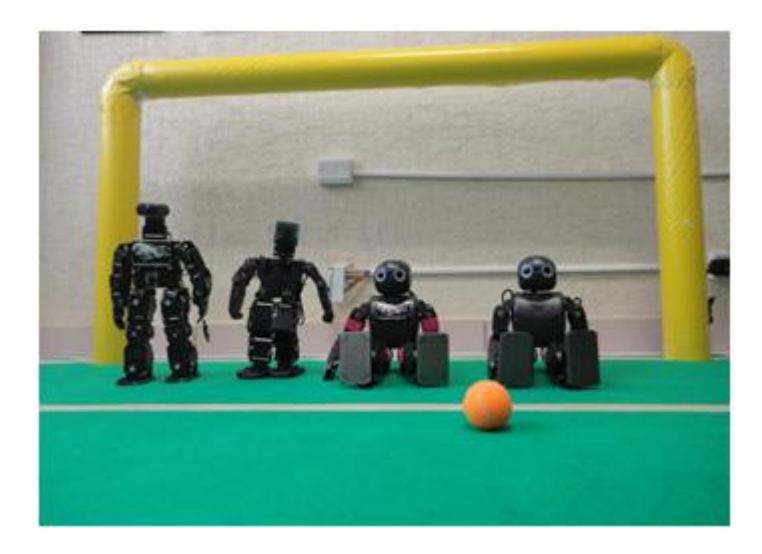
2 Vision and Localization Systems
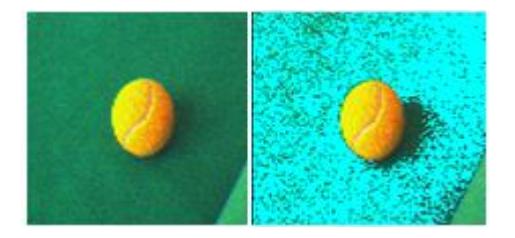
One of the challenges that we had to face was that our vision system converted video from RGB to HSV to segment the color afterwards. This algorithm had disadvantages since it used many processing resources. This was even more evident when applying the Hough transform to detect lines and circles. This problem was solved due to the incorporation of a more efficient algorithm in this edition of the RoboCup. In this algorithm, we get video in YUV model and we applied the segmentation of the color directly which is very efficient for the computer of the Darwin-OP, these algorithms are designed with the library OpenCV. In order to make it function with our robots, we linked the framework of the Darwin-OP with OpenCV, completely eliminating the vision system of the framework of the Darwin.
Our new vision system segments and binarizes the colors orange, white, green and yellow perfectly. Currently, we are working on detecting the lines of the field by using the Hough transform which will also be useful to locate the robots.
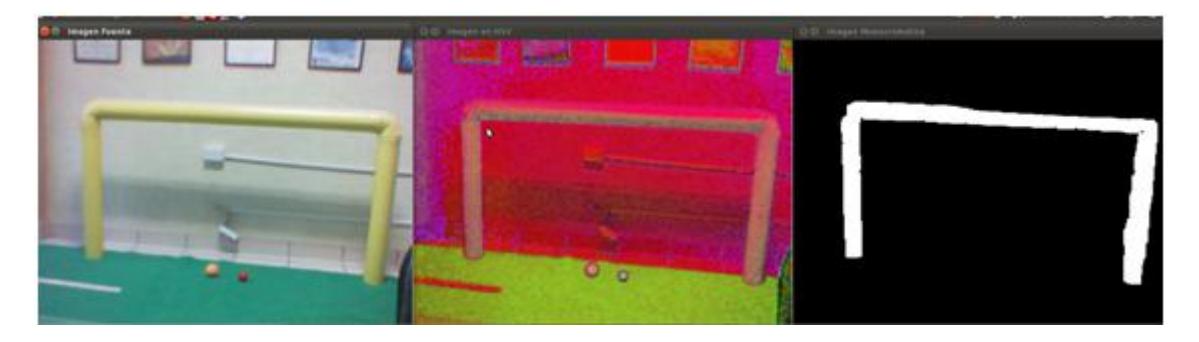
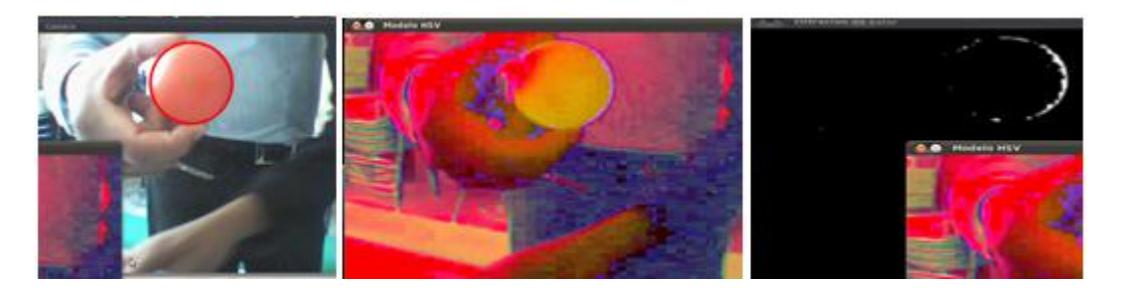
The current system of location is performed by using the method of triangulation detecting the goal boxes and the beacons. We are also working on the implementation of location through the Monte Carlo method and Kalman filters which is mainly based on a probabilistic state of the positions and route of each robot. While implementing this last method, we are working carefully on reducing the type of combinations in order to avoid the saturation of the pc of the robot.
In this edition, we are currently using the GameController which was not used in Robocup 2011. In addition, we are working on the development of algorithms of cooperation between agents. We are using a method of centralized control where the robot goalie can indicate the other robots the position of the goal box mainly and we sometimes indicate the position of the ball in the field so that they can find it easily.
Our algorithms function in computers in any of our three arquitectures that were presented in the specifications document which describes a Darwin-OP, a Robonova-1 and a bioloid.
We also use the cinematic of the Darwin's framework at its highest speed and in a stable way. Moreover, we are creating new movements to turn left and right, and to get a stronger kick than it was last year. We are also creating different kicks that go from 0° to 90°.
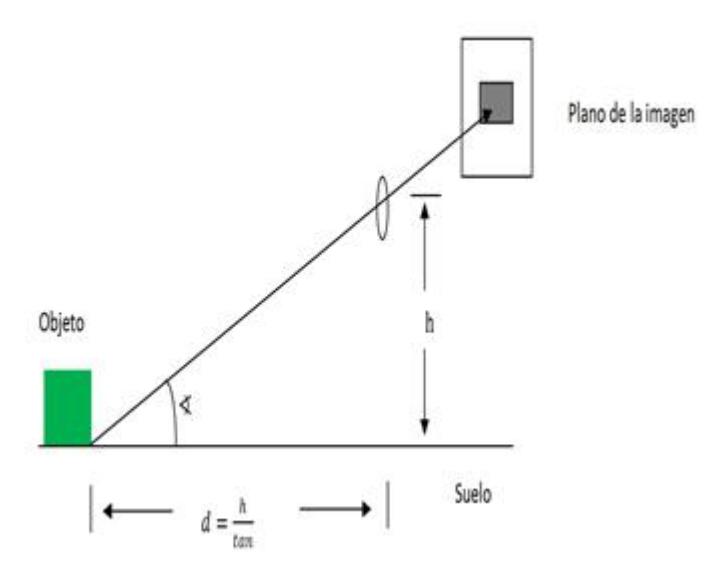
For getting information about the deepness of the ball, which is mainly based on a process of triangulation from two or more images (see figure 3). The camera height h, the angle α that is formed because of the lens and the ball position are known. This angle is formed because of the inclination degree of the servo tilt. These values help us to determine the precise distance of the ball.
$$\frac{h}{\sin \alpha} = \frac{d}{\sin(90 - \alpha)}$$
$$d = h \frac{\sin(90 - \alpha)}{\sin \alpha} \sin\left(\frac{\pi}{2} - \alpha = \cos \alpha\right)$$
$$= h \frac{\cos \alpha}{\sin \alpha} = \frac{h}{\tan \alpha}$$
$$d = \frac{h}{\tan}$$
Artificial Intelligence
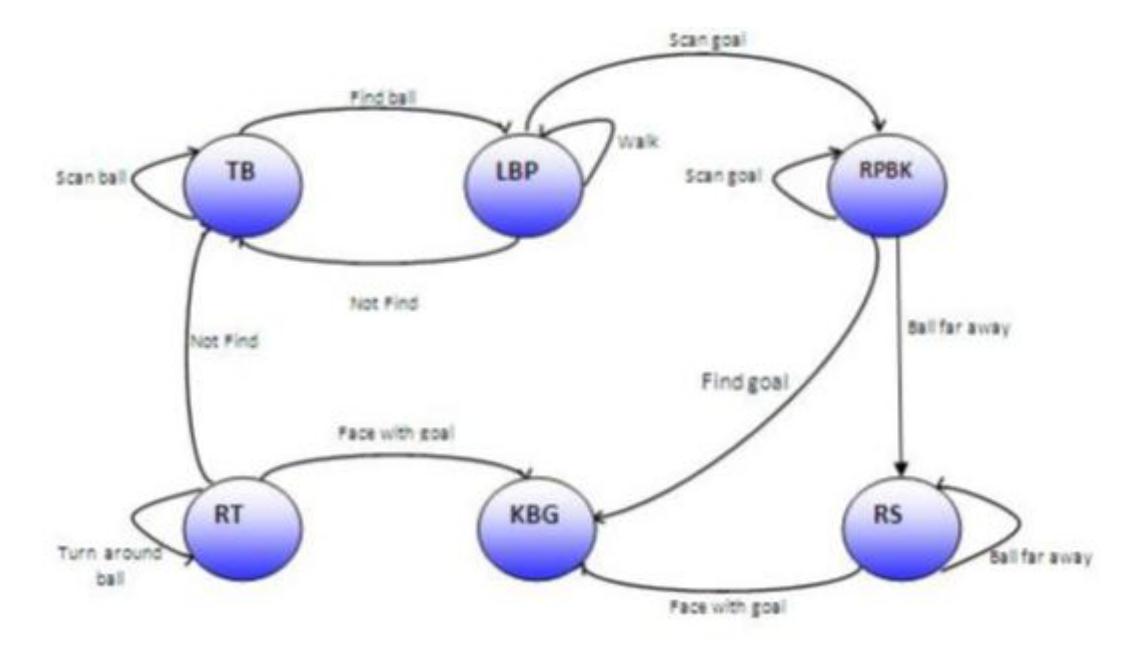
This section describes the robot's intelligence, which is based on a finite-states machine. This consists of a robot model of behavior. This model consists of a finite quantity of possible states. In addition, the system can change of state when a specific action is performed. This kind of change is known as transition. Therefore, the condition of transition has to be performed so that there can be a change of state. Likewise, the action of the current state has also to be performed.
List of states
- Track Ball (TB).
- Location of Ball Position (LBP).
- Robot Turn (RT).
- Robot Positioning at the Ball for Kicking (RPBK).
- Robot Slide (RS).
- Kicking the Ball towards the Goal (KBG).
Conclusions and further research
It is planned to create a library that can function in any architecture of humanoid robots. We are currently working in the creation of a new humanoid robot to participate in the category AdultZise which will function with the library that we intend to create. Even though we are a young team, we are glad and eager to participate in RoboCup every year. Our goal is to continue contributing to the development of research in the field of humanoid robots to achieve the RoboCup's objective which is to make robots play against humans in 2050.
ACKNOWLEDGEMENTS
Apart from the efforts of ourselves, the success of any project depends largely on the encouragement and support of many others. I take this opportunity to express my gratitude to the principal of our Institution, MC. F. Luis Torreblanca Coello who has been instrumental in the development of this project.
Humanoid League Technical Committee
January 25th, 2013
I am writing to express my full commitment, as leader of the team Falconbots, to participate in the 2013 edition of the RoboCup World championship to take place in Eindhoven the Netherlands on june 24th-30.
I also express the full commitment of the team to provide at least one team member with sufficient knowledge of the rules to act as referee during the competition.
Regards
Ing. Diego Mauricio Reyes Hernández Profesor Investigador del Instituto Tecnológico Superior de San Martín Texmelucan Puebla, México, (248) 1111132 ext 118 [email protected]

References
Reyes Hernandez D.M˙ Franco Perez, E., Barbosa Segura, J., Sanchez Rodriguez, J.V., Suarez Romero, A., Mendez Lara, H.G.: Falconbots RoboCup 2011 Humanoid KidSize team description paper. In: RoboCup World Championship, Istanbul, Turkey, RoboCup Federation (July 2011)
Luis F Lupian, Alberto Romay, Andres Espinola, Diego Marquez and Diego M Reyes: Cyberlords+Falconbots RoboCup 2012 Humanoid KidSize team description Paper: In RoboCup World championship, Mexico City, RoboCup Federation (June 2012)
Craig, John J: Introduction to Robotics: Mechanics and Control (3rd Edition). Prentice Hall International, (2003)
Nilsson, N.: Problem-Solving Methods in Artificial Intelligence. McGraw-Hill, New York (1971)
Nilsson, N.: Principles of Artificial Intelligence. Morgan Kaufmann. San Francisco (1980)
Robocop Humanoid League Competition., http://www.robocup.org/
Robotis., http://www.robotis.com/xe/