WF Wolves KidSize Team Description RoboCup 2013
Jan Carstensen, Stefan Krupop, Tobias Bolze, Frank Stiddien, Oliver Krebs, Reinhard Gerndt
Ostfalia University of Applied Sciences, Department of Computer Sciences, Am Exer 2, 38302 Wolfenb¨uttel, Germany
Abstract This paper details the current state of the hardware and software design of the WF Wolves robots, used for soccer competitions in 2013. The platform used in 2013 is entirely new. The Software architecture and most of the modules have completely changed. The mechanical design is based on the DARwIn-OP mechanical design but was modified to fit together with our own electrical design — together greatly improving the performance since last year. The current state of the systems and current developments will be presented in this paper.
1 Introduction
Humanoid robot soccer imposes a series of challenges. It involves developing an architecture to support all the functionality needed in terms of walking, kicking and such, a suitable control structure and fast and lightweight algorithms to fulfill the requirements given by the soccer tournament and the technical challenges. WF Wolves have been participating in international RoboCup since the year 2007 and in a number of local and national robotic events. In 2008 and 2010 the WF Wolves won the world championship in the Mixed Reality League. Since 2009 the WF Wolves participate in Humanoid League Kid Size. Until 2012 we developed and improved our first platform. This year we are introducing a new approach in Hardware and Software.
2 Research Overview
This section describes the main research and development objectives of the current year.
Colourtableless Vision
Since last year we are focusing on a more robust vision system. One major step is to get rid of the many configuration parameters, in particular to get rid of the color table based vision approach and focus on gradients and histogram based thresholds. The main focus is to get a vision system which will provide reliable results without the need to configure the system, and to be more robust to light changes such as daylight.
Vision Validation
Because some of the new algorithms are probabilistic it is not entirely sure that they will provide the same result for each picture. To validate the vision system we are working on an automated test to check if the expected results match the actual results.
Improved Walking Engine
Improving the walk engine to get an even more stable walk is on one our priorities. Since the walk is working pretty good so far, the main objectives are to prevent the servo actuators from overheating after a few minutes in play and to reduce servo damage, which can be caused by falling and too abrupt motions.
Kick Engine
Since the kick performance was a major priority last year we are now focusing on the optimization of the kicks. Omni-directional kicks and shortening the time it takes to prepare a kick are at the center of attention.
3 Hardware
(section introduction)
3.1 Electrical System
The electrical system is custom made and designed specifically for a kid-size class humanoid robot. Boards are designed as light and small as possible. Two different control boards are used, a main processor for high-level control, vision and AI and a body controller for controlling the servos and generating the walking pattern.
Main Processor As a main processor we switched from a DSP based architecture towards an Intel Atom Z530 CPU with 1.6 GHz. Our Boards have either 1 or 2 GB DDR2 Ram and come with USB, RS232 and WLAN on board. The controller is located in the torso of the robot.
Body Controller The body controller is based on an AT91SAM7X256 ARM7 micro controller. It controls movement of the servos. It independently generates motion patterns, e.g. for walking or plays prepared motion patterns, e.g. for getting up. Generated motion patterns can be parameterized by inertial measurement data to stabilize the gait. The body controller is controlled by the main processor via a USB connection. The processor runs at 50 MHz. [1]
Inertial Measurement Unit The robots are equipped with a 9 Degrees of Freedom inertial measurement unit consisting of a 3 axis gyroscope, a 3 axis accelerometer and a 3 axis magnetometer, which provide sensor data for stabilizing the motions and improving the interpretation of vision data.
Visual Sensor Currently two different Camera systems are used. One new camera is the DFM 42BUC03-ML, a very small and extremely light weight device. As an alternative we use a Microsoft Lifecam HD-3000. Both Cameras run at a 320 * 288 resolution and supply a YCbCr422 format images.
Power Supply The power for the robot's servos and the processing unit is supplied by a 3-cell lithium polymer battery. Main Processor and Body controller have their own local voltage regulators.
3.2 Mechanical System
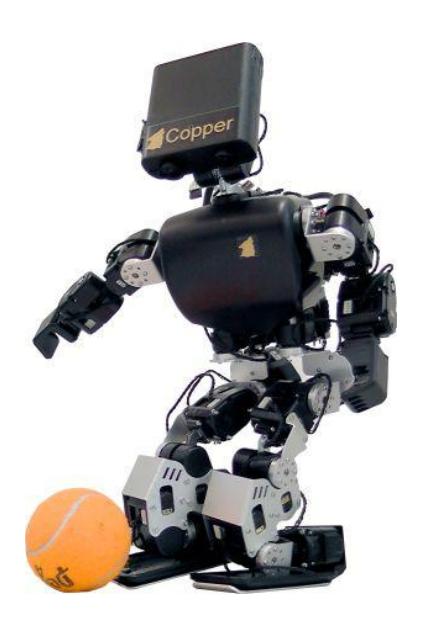
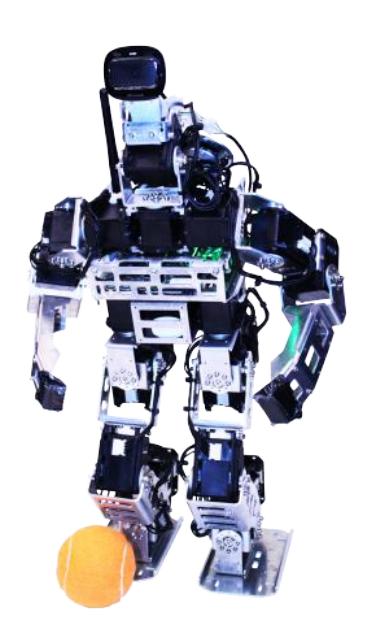
The mechanical design is based on the DARwIn-OP, but was altered to fit our custom electronic components and to work with both RX-28 and MX-28 Servos mixed together. The metal parts where built in our university's mechanical workshop. No plastic body covers are used.

4 Software
(section introduction)
Framework
The framework used in 2013 was inspired by the Framework used by the Team Berlin United. It has a blackboard based architecture. The System is divided into Modules. The order in which the modules are executed is not scripted or hard coded, but rather a thread pool is used in combination with a scheduler to automatically determine the module execution order.
Vision
In 2013 a new approach for our Vision system has been implemented. Not relying on color tables has greatly increased the robustness of the Vision system. Besides this the system now is structured in modules allowing the behavior to select which algorithms to use. This results in speed optimization, because not every picture has to be scanned for e.g. lines if the model is accurate enough. [2] The modularity allows us to introduce filters and manage them more efficient making the false detection rate manageable and the system better adoptable to unforeseen events and tasks. [3] Working with automated tests in vision validation has greatly increased the performance making our vision system well tested and reliably working.
Modeling
Since both goals are now colored yellow, the importance of a good localization has risen even more. The WF Wolves use a particle filter and try to break the symmetry problem by using odometry, team synchronization and the use of the magnetometer of the IMU.
Behavior
With experience in modeling team behavior in an environment where the robots are not allowed to communicate with each other, most of the strategies used do not depend on inter-robot communication. This reflects the unstable wireless LAN at many past tournaments. Using a framework initially developed in the Mixed Reality League, very abstract behaviors are possible.
5 Robot Control
(section introduction)
Key-frame Motions
Even though key-frame motions prove to be the inferior control method, some motions are too complex to be easily generated. The WF Wolves robots therefore use the key-frame motions for goalkeeper motions, kicks and getting up motions.
Omni-directional Walk Engine
For all other motions such as walking forward, backwards, sideways and turning an omni-directional walking engine is used, calculating the servo positions in real time. This allows controlling the body using high level commands instead of combining a predefined set of keyframe motions. It also allows incorporating sensor data for stabilization. Besides this, it is sufficiently abstract to allow running the same behavior on different robots without the need of sophisticated calibration. [1]
6 Conclusion
The main advances of the WF Wolves platform for 2013 are improved walking abilities with higher speed and stability and significantly improved manoeuvrability. Kick performance has been improved. Upgrading to the Dynamixel Servo family has done a great deal to mechanical stability, pairing with the new software architecture has greatly improved the performance. The team WF Wolves is looking forward to participate in the RoboCup 2013 in Eindhoven . We will be happy to provide a team member as referee or operator. Many team members are briefed to fulfil all duties required for the tournament and have previous experience at local, national or international level. Also the WF Wolves will be happy to continue their effort to support the humanoid league wherever possible.
References
- Michalik, S.: Dynamisches laufen von humanoiden robotern. Bachelorthesis, Ostfalia - University of applied Sciences (2010)
- Carstensen, J.: Computer vision a probabilistic and modular approach. Bachelorthesis, Ostfalia - University of applied Sciences (2011)
- Neu, C., Eichelberger, M.: Goal detection for humanoid soccer players localization. Bachelorthesis, Ostfalia - University of applied Sciences (2011)