ZJUDancer Team Description Paper Humanoid Kid-Size League of Robocup 2013
Liu He, Yu Ling, Zhou Chunlin, Xiong Rong
State Key Lab. of Industrial Control Technology, Zhejiang University, Hangzhou, China
Abstract This document describes the RoboCup Humanoid League team ZJUDancer from Zhejiang University, China, as required by the qualification procedure for the competition to be held in Eindhoven, the Netherlands from 24th through 30th June 2013. Full details of our robots including mechanical design, electrical design, sensors and software design are described. With the improved robots, we hope we could get a much better result in 2013.
Statement of Commitment
The ZJUDancer commits to participate in RoboCup 2013 in Eindhoven and to provide a referee knowledgable of the rules of the Humanoid League.
1 Introduction
The robots developed by ZJUDancer for RoboCup 2013 are fully autonomous humanoid robots which play different parts as a team in the football game. During the past few years, we won the champions of RoboCup China Open 2007, 2009, 2010, 2011 and 2012, and advanced to quarter-finals in Robocup 2009 Graz , Robocup 2010 Singapore and Robocup 2011 Istanbul.
| Team Name | ZJUDancer |
|---|---|
| Number of DOF | 20 |
| Height | 58cm |
| Width | 26cm |
| Weight | 4kg |
Table 1. General Specifications of the robot
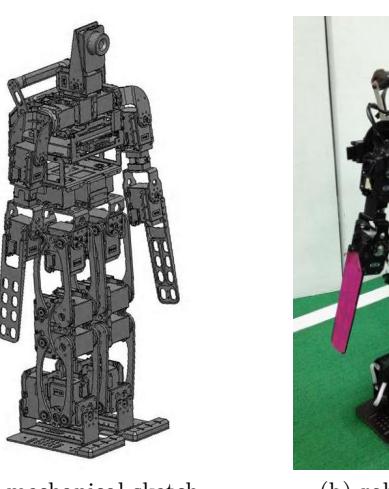
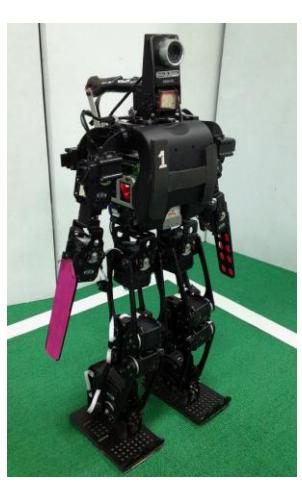
In Robocup 2012 Mexico City, ZJUDancer reached the 4th place in Humanoid League Kid-Size(3 vs. 3 games). This year, lots of efforts has been made to improve the hardware and the software of our robot system. The photograph of our robot is shown in Fig.1(b).
Table. 1 shows the general specifications of our robots. Three players from ZJUDancer named Wukong, Bajie and Shaseng are fully autonomous humanoid soccer robots. Each robot is fixed to the size and weight limitations of the competition and connected by wireless networks. Referee's directions could be sent to the robot through the network. More details will be introduced in the following sections.
2 Mechanical Specifications
The robot from ZJUDancer has 2 legs, 2 arms, 1 trunk and 1 head. The actuators we selected are Dynamixel RX-28 and RX-64. Each robot is driven by 20 servo motors: 6 per leg, 3 in each arm and 2 in the head. The six leg-servos allow for flexible leg movements. Three orthogonal servos constitute the 3-DOF hip joint. Two orthogonal servos form the 2-DOF ankle joint. One servo drives the knee joint. The motor distribution is different but the DOF is the same. Table. 2 shows the details. The robot's mechanical sketch could be seen in Figure. 1(a).
For using the new main controller and making the robot thinner, the robot's torso is re-designed. The PCB board and the main controller are placed horizontally. And the battery is placed on the bottom. In addition, in order to protect the motors of the shoulder joints, new mechanical components are designed. In accordance with the rules, the handle is designed at the shoulder of the robot. That make it more convenient while handler picks up the robot during the game.
| Part | Rotation Axis | Actuator |
|---|---|---|
| Neck | Yaw, Pitch | RX-28, RX-28 |
| Shoulder | Roll, Pitch | RX-28, RX-28 |
| Arm | Pitch | RX-28 |
| Hip | Roll, Yaw | RX-64, RX-28 |
| Knee | Pitch, Pitch | RX-64, RX-64 |
| Ankle | Pitch, Roll | RX-64, RX-64 |
| Total DOF | 20 |
Table 2. Motor types and Distributions of DOF
3 Electrical Specifications
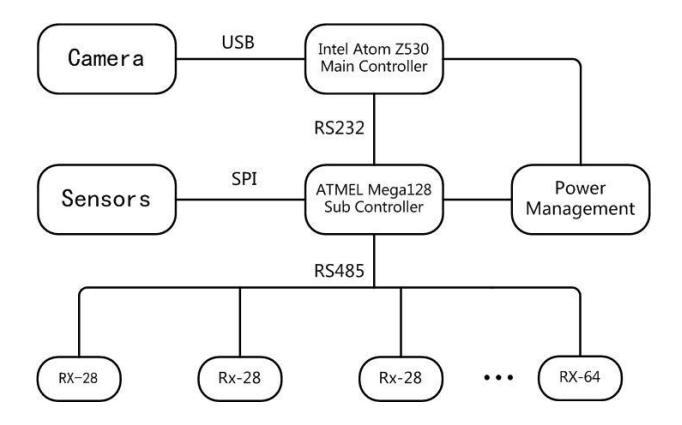
Our electrical controllers are the motor controller and the camera controller, specifications of which could be seen in Table.3. The camera controller works as the main controller processing image identification, location, strategies selection and communications. The movement and balance maintaining are implemented by the motor controller which executes the movement direction from the main controller. The total electrical architecture could be seen in Figure.2.
Comparing with the last year's electrical connection, the new controller has less power consumption. And we re-selected the batteries' model. The circuit boards are designed according to the mechanical structure. All of these make the hardware more stable.
| Camera Controller | Motor Controller | |
|---|---|---|
| CPU | Intel Atom Z530 | ATMEL Mega128 |
| FLASH | 4GB | 128KB |
| RAM | 1GB | 64KB |
| OS | Linux | None |
Table 3. Electrical Architecture of our robot
4 Sensor Specifications
There are 4 types of sensors equipped on our robot, which are image sensors, gyroscopes, accelerometers, and potentiometers.
- Image sensor. We upgraded robot's camera from Philips SPC900NC to Philips SPC1000NC last year. This kind of camera has a more wide view and it helps improve the efficiency of perception.
- Gyroscopes. Gyroscopes are equipped in the chest of our humanoid robot. It returns the angular velocity for the trunk of humanoid robot and helps to keep the balance of humanoid robot. After the re-design, the gyroscope remained at the center of the chest, but upside down for easy installation.
- Accelerometers. This sensor detects the gravity vector when the robot is static. The main applications of this sensor is that it could be used to recognize whether humanoid robot is standing or lying down. The autonomously getting up from tipping over is depend on this sensor. On the other hand, the dynamic attitude estimate from the fusion of gyros and accelerometers is under research.
- Potentiometer. This sensor detects the rotation angle of the actuator. With this sensor, the robot recognizes the current angular position of the joint. This sensor is controlled by actuator controller.
5 Software Architecture
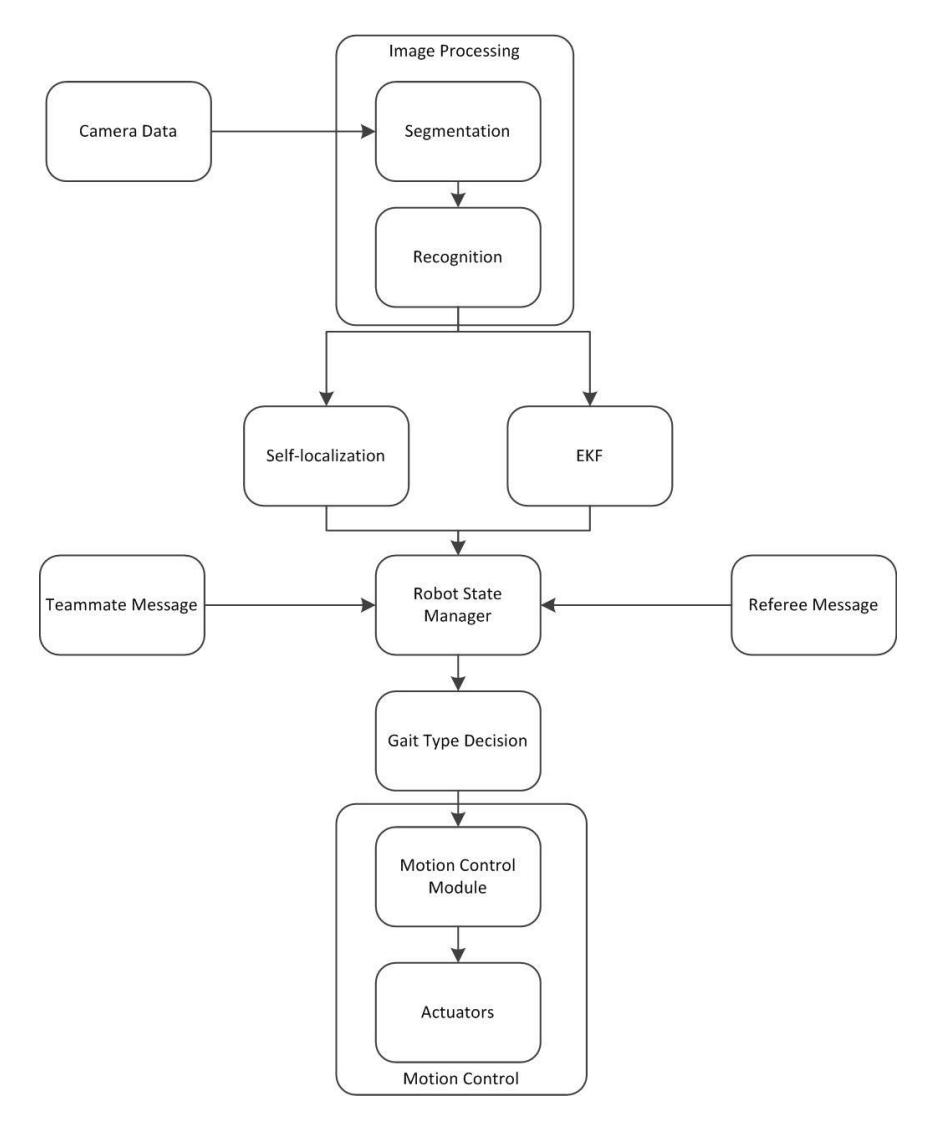
The vision module is mostly based on color segmentation and the central circle is recognized by regression of white points after line-scanning for the white pixels.
After processing the image, particle filter with sensor resetting [3] [4] is used to do the self-localization for robots. Besides, EKF is used to estimate the objects' position. Hierarchical finite state machine is designed to manage the robot's states. The whole software architecture can be seen in Figure.3.
6 Conclusion
In this paper, we present the specifications of our robot that has two controllers and 20 DOFs. ZJUDancer has made a great progress in both hardware and software during the last year and looks forward to making a new breakthrough in RoboCup 2013. We'd like to share our experience and have a good match with all the teams.
References
- Li Shen: ZJUDancer Team Description Paper (2012)
- Du Xinfeng: Fast recognition and precise localization of humanoid soccer robot vision system. Journal of Zhejiang University (Engineering Science). Vol. 43 No. 11, 1975–1981 (2009)
- S. Lenser and M. Veloso: Sensor resetting localization for poorly modeled mobile robots. In Int. Conf. on Robotics and Automation (ICRA). (2000)
- J. S. Gutmann and D. Fox: An experimental comparison of localization methods continued. IEEE/RSJ International Conference on Intelligent Robots and System. vol. 1, no. 1, pp. 454–459.
- User's Manual for Dynamixel RX-28 (2007)
- User's Manual for Dynamixel RX-64 (2006)
- W.Richard Stevens, Stephen A. Rago: Advanced Programming in the UNIX Environment. 2nd Edition. (2005)