Plymouth Humanoids RoboCup 2014 Team Description Paper
Stephen Roberts, Horatio Garton, Aashish Santana, Clare Simpson, Alex Smith, Phil F. Culverhouse, Guido Bugmann, George Terzakis
Centre for Robotics and Neural Systems (CRNS), School of Computing and Mathematics, Faculty of Science and Technology, Plymouth University, Plymouth, UK
www.plymouth.ac.uk/robotfootball
Abstract Plymouth Humanoids is a long running robot football team with history in many events, with RoboCup being the newest entry. This year will be Plymouth University's third year competing in the kid size humanoids league. The robots have been improved upon from previous years participation by continuing hardware and software development. The key improvements mentioned in this team description paper include; a new body kit and electronic hardware, full forward and inverse kinematics, gimbal system, robot to robot communication, and team strategy. These improvements will help the robots compete at a much higher level in RoboCup 2014.
1 Introduction
Plymouth University have been in robot football competitions since 1997, competing in Mirosot events at FIRA RoboWorld Cup. In 2007 the team used its first bipedal robot, a modified Bioloid robot, and changed the team name to Plymouth Humanoids. Since changing to humanoid robots the team has done well at marathon and sprint events at FIRA RoboWorld Cup, winning numerous trophies including gold medals and setting world records. In 2012 Plymouth Humanoids entered its first kid size RoboCup competition, coming 16th and being the first team from the United Kingdom to compete. Plymouth Humanoids placed 23rd competing for the second time in Eindhoven, 2013. In preparation for this year a new robot has been designed, named Drake.
Drake has been designed and built by students, researchers and engineering lecturers at Plymouth University. The Drake robots have new cameras, servos and embedded computers. Plymouth develops its own servo controller board, Tartarus, and its own IMU, Themis. Both are designed with the latest microcontrollers, and Themis uses state of the art high precision MEMS gyros and accelerometers.
The team is made up of two senior lecturers who manage the team, three research assistants who work full time on developing the robots, a technician who takes care of the teaching robots, and a group of undergraduate robotics students. Five members will be attending RoboCup 2014: The research assistants, one senior lecturer and our robotics technician, who has already attended RoboCup in 2013 and 2012; she has proven to be an excellent referee in past competitions and is committed to fulfilling the role again in 2014.
1.1 Background
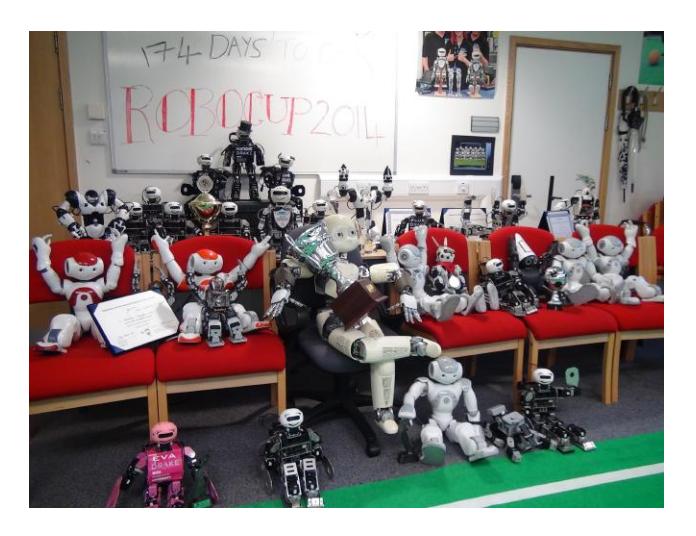
Plymouth Humanoids has a large team of humanoid robots, with eleven for teaching, five for competition and one for outreach. All of the robots are built to the same RoboCup specification, making code production easily portable. The aim is that everyone interested in robot football has the opportunity to participate. Figure 1 has all the humanoid robots at Plymouth University.
The robots are a essential tool for teaching embedded systems, real time microcontrollers and vision detection. The laboratories concentrate on using the micro-controllers and programing on the ODROID-X2 embedded processor. This provides learning opportunities in gait and higher level strategies, through practical application. Students participate in marathon and obstacle avoidance competitions following FIRA competition rules. Plymouth Humanoids have a "female" outreach robot, "Eva Drake", who attends several events every week, promoting robotics courses at Plymouth University. Currently EVA is involved in a government led STEM project called Engineering Education Scheme. Plymouth Humanoids are collaborating with Plymouth High School for girls to produce a new head and loudspeaker system for EVA.
2 Hardware Development
Research this year has led to major improvements to the hardware design, most noticeably a complete body kit re-design. Along with this new design, the robots now use Robotis MX-28 servos and received updated electronics to make the most of new technology.
2.1 Drake Body Kit
Following the continuing trend of RoboCup the robot is now 41 cm tall and more robust. The body kit is made completely of aluminium which provides additional strength without additional weight, compared to previous plastic body parts. The whole robot upper body is designed from one main piece, adding to the core structural strength. Drawing from experience in teaching and competition it has been designed to be easily maintained and managed. Along with robustness comes functionality; all servo rotations are designed to be in a line, aiding kinematics.
Plymouth Humanoids are experimenting with new feet design to increase grip as well as stability. This includes attempting a silicon foot design inspired from collaboration with Nanyang Polytechnic, Singapore, who are Plymouth's main rival in the sprint event at FIRA competitions [3]. The goal of this foot is to greatly increase the foot grip of the robot by having the base of the foot designed much like a sports shoe. Additionally, experimentation with a flat metal plate with heavy-duty, non-slip fabric on the base, aims to improved stability due to a firm foot surface.
2.2 MX Servos
Previous robot designs utilised the RX series of servos from Robotis, which offer excellent torque-to-weight ratio. However, the new Drake design is driven by the MX servo series, which offer a four-fold increase in encoder resolution, at the cost of a slight reduction in maximum torque output. Distance-to-object calculation is evaluated using trigonometric rules, based on the angle and height of the camera relative to the ground; therefore, improved encoder resolution has resulted in improved kinematics and more accurate distance to ball, goal and other robot players.
2.3 ODROID and Camera
The Quad core ARM processor is based on the 1.7GHz Exynos4412 Prime module [2] that is used to run Linaro distribution of Ubuntu 12.04 and an updated version of the Plymouth Humanoids robot framework [1]. This board manages all vision processing, communications (through a USB WiFi dongle) and strategic behaviour. This board was chosen over the previous dual-core Trimslice-H board as the core-count has doubled, 2GB RAM uses eMMC-cards instead of SD-cards and was of a similar size. The increase in cores was integral to accommodate an increasingly multi-threaded framework.
The Logitech C615 is a simple and flexible USB webcam that requires minimal resources and is easy to set-up in the Linux operating system. The cameras field of view is 74° and has built in zoom functionality, with a maximum resolution of 1080p. Images are scaled to 432x240 resolution, to ensure a frame rate of 20fps.
2.4 Tartarus and Themis
Further development of the electronic hardware has been done in order to improve on functionality. The Tartarus board is a real time servo microcontroller, designed and built at Plymouth University. Revision 2 of the Tartarus board has the support to separate RS485 busses halving the servo command update time, from 20ms to 10ms. The new design adds additional features including; additional connectors, buttons, SPI support, and on-board voltage regulation.
Last year the robot used a custom designed and built IMU board with Silicon Sensors inertia sensors [1]. This year Silicon Sensors have provided their Orion chips, a new model of gyroscopes and accelerometers. The new design of the Themis (IMU board) makes the most of these sensors to aid in balance and localization when playing football.
3 Software Development
The Plymouth robot-framework efficiently supports a multi-tasking, multi-threading shared memory multi-processor configuration [1]. The system has been updated to better handle the real-time processing and localisation. The motion controller is now 3D kinematics based rather than pose based.
3.1 Gimbal and Localization
The gimbal is designed to keep track of the robots 3D orientation in space using quaternion mathematics. In the past if the robot falls over this can disorientate a robot only tracking gyro yaw. With a gimbal system, even when the robot falls, it can track the robots orientation. Quaternions are a number system that describes three dimensional rotations used mostly for placing polygons in 3D graphics [7]. They differ from Euler angles or rotation matrices in that they do not suffer from gimbal lock, which occurs when the two of the three axes of a gimbal are parallel. For the robots this would occur when the robot is flat on its face or back, for this reason the gimbal that the robot uses are calculated using quaternions.
The gimbal processing is a constant integration of rotation in quaternion form. Additionally to aid with accuracy, an accelerometer feedback system uses the direction of gravity to help stabilize the gimbal. All of this computation is handled by the Atmel Xmega micro-controller on the Themis. This calculation is performed more than 3000 times a second. The information is then requested by the Tarturas board through the TTL bus, every 20ms gait cycle.
The robot takes its gimbal information, feedback from servo, and vision to predict its position using a Monte Carlo algorithm. This includes distance to goal posts done using vision and gimbal information. Odometry is used from servo and gimbal feedback to perform the update or movement phase of the robot. This is necessary because the robot is not looking at the goal all the time. Together the robot can predict its position on the football pitch, which is then used for game strategy and team play.
3.2 Kinematic Gait and Poses
In the past, the robots used a two dimensional kinematic model of the legs, this limited the development of gait design. The legs now use a three dimensional kinematic model including roll, pitch and yaw of each foot. Currently, research is going into developing a new gait by modelling the robot as a linear inverted pendulum [4]. This will make the robot smoother and faster in its walking style and therefore help with the vision system in the robot.
The new kinematics allow for the robot to have kicks, and other pose based motions based on the position of the robot when its in its gait position; this prevents jerking motions when going into poses, which can make the robot fall. The kinematics model allows the development of a kick that balances the robot on one foot, and have more swing in the kicking foot. The kick distance previously was approximately 1.5m, it has now been increased to up to 4.5m. Another kick is being developed that allows the robot to kick in a direction that is not directly forward, this will save time on the ball approach because the robot will not have to be lined up perfectly to face the goal. The IMU will be used to add additional feedback to the gait and poses to make the robot more stable.
3.3 Robot Communication and Game Strategy
The communication capabilities of the robots have improved significantly from the previous year. In the past, the system was simply able to receive input via UDP from the Referee box and nothing more. The system is now capable of one-to-one and one-to-many communications between the team of robots via the UDP protocol.
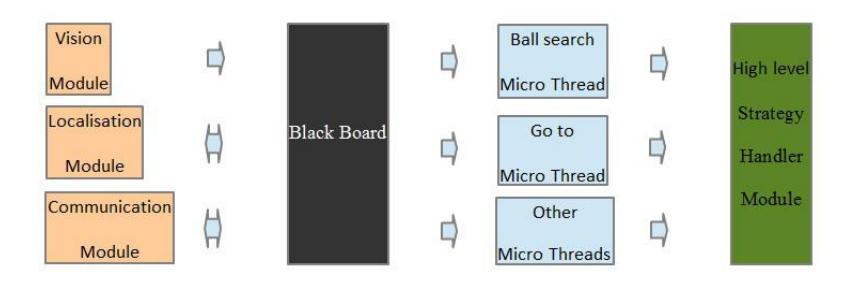
This allows for much more complex strategies and improved functionality through information sharing. These actions can be broken to two main categories passive behaviours and commands. Commands can be anything from commanding another robot to go to a location on the pitch or requesting a robot to change roles. Passive behaviours are usually done in a collective manner using the blackboard (further explained below) which is an array of key information about each robot.
3.4 Strategy Planning
The strategy planning module is made up of two components, a black-board and multiple micro threads. The black-board is a structured memory location that holds the current status of each robot and object location data relative to each robot. The micro-threads are threads that require minimal processing that continually check values within the black-board for certain conditions. For example if the black-board no longer has a distance to ball value then the search thread would request the robot to begin the ball search routine. Since the threads are asynchronous, multiple behaviours could be requested simultaneously but a hierarchy selection process is used to service the request in a logical order (there is no point in going to a ball if the ball has not been found yet). A visual representation of this system is shown below in figure 2.
3.5 Collision Avoidance
Game play in the current kid size robot football is marred by frequent robotrobot collisions. The standard league uses Nao robots, where ultrasound is used to provide a crude distance measure to targets directly in front of the robots. Kid size robots do not have ultrasound and hence any collision avoidance must be done using purely visual methods. Plymouth Humanoids now have a basic visual technique, using optic flow that allows each robot to gauge if it is close to another robot. It can then take avoiding action to move around the robot. The Plymouth Robot Framework uses OpenCV library functions to process live camera video feed. Features are extracted from consecutive frames and analysed for optic flow using goodFeaturesToTrack() [6]. Flow vectors are calculated [5] with the function calcOpticalFlowPyrLK() and those not predicted to give a collision with the robot are rejected. A Centre of Mass calculation is completed and tracked over time to give an estimate of time to collision. The executive controller in the robot then decides if avoiding action is needed. Currently the robot must presently be static for these calculations to be robust.
4 Rule Changes
The pitch being bigger is an issue for the Plymouth Humanoids robots. The robot is a small robot compared to other robots and has not got a powerful kick. The new kick being developed that requires the robot to balance on one leg increases the maximum kick length to up to 4.5 metres. This is responsible for the change of the foot to be more rigid. Also the new kick has been designed to work on the larger size ball that has been introduced this year.
Having more robots on the pitch now means that if they are all running the same code then they could all run towards the ball and knock each other over. Communication between the robots is added so that only one robot will approach the ball at a time. The robots will have shared data about the position of the robot on the pitch and how far away it is to the ball, so as a team they can make decisions.
Because the goals are larger this year the goalie can protect less than half the goal, so the goalie robot is going to side step to the side of the goal that it thinks the ball is on.
5 Conclusion
Plymouth Humanoid's is a dedicated full time team, consisting of member who have in depth knowledge in various robotics fields. The research carried out by this team has led to improvements in both software and hardware, and manifests in the form of better communication, strategic planning, localisation, kinematic control and gait. These factors come together to not only create a more capable robot, but a more capable robot team. Plymouth Humanoids is a veteran team that relishes the chance to compete in, and learn from RoboCup in Brazil.
References
- Griffiths, A., Simpson, C., Eastham, P., Culverhouse, P., Bugmann, G., Yang, C.: Plymouth Humanoids Team Description Paper for RoboCup 2013. In: RoboCup 2013, Eindhoven (2013)
- Hardkernel,: ODROID X2, Available at http://hardkernel.com/main/products/ prdt_info.php?g_code=G135235611947&tab_idx=2. Last accessed 30/1/2014.
- Hieng, L., Lim, S.: Red Atom Foot Design. NanYang Polytechnic, Singapore, (2013, September)
- Kajita, S., Kanehiro, F., Kaneko, K., Yok, K., Hiruka, H.: The 3D Linear Inverted Pendulem Model: A simple modeling for a biped walking pattern generation. International Conference on Intelligent Robots and Systems, National Institute of Advanced Industrial Science and Technology, Tsukuba Ibaraki. Available at <http://www.cs.cmu.edu/~hgeyer/Teaching/R16-899B/ Papers/KajiitaEA01IEEE_ICIRS.pdf>. Accessed: 30th Janurary 2014.
- Lucas, B., and Kanade, T.: An Iterative Image Registration Technique with an Application to Stereo Vision, Proc. of 7th International Joint Conference on Artificial Intelligence. (IJCAI), pp. 674-679. (1981)
- Shi, J. and Tomasi, J.: Good Features to Track. Proceedings of the IEEE Conference on Computer Vision and Pattern Recognition, pages 593-600. (1994)
- Vince, J.: Quaternions for Computer Graphics. 1st. ed. London: Springer. (2011)