WF Wolves – Humanoid Kid Size Team Description for RoboCup 2014
Ann-Katrin Hannemann, Frank Stiddien, Minda Xia, Oliver Krebs, Reinhard Gerndt, Stefan Krupop, Tobias Bolze, Tom Lorenz
Ostfalia University of Applied Sciences – Computer Science Department Wolfenbüttel, Germany
Abstract This Team Description Paper describes the humanoid robot team WF Wolves with the current state of the robots. The used hardware, separating out mechanical from electrical systems, and the developed software are specified in detail. It also points out the fields of research, changes to previous year and planned revisions. With this paper the team WF Wolves applies for qualification in RoboCup 2014.
1. Introduction
WF Wolves participate in RoboCup for more than six years now and have shown improvements over the years. In 2008 and 2010 we won the world championship in the Mixed Reality League. Since 2009 we participate in the Humanoid League and had modified our first platform over the years. Our new platform based on Darwin-OP was introduced in 2013, together with a new software framework. The new hard- and software resulted in winning the German Open 2013 and a good ranking in world championship in Eindhoven.
Due to the rule changes and the roadmap for the next years, team WF Wolves plans to build a bigger robot, which could participate in teen size as well. If we can manage it, we want to have one or two of these new robots ready for the next competitions.
2. Research Overview
Our present main research interests are an improved vision, self-localization and world modeling, communication between robots and dynamic role changing as well as an advanced behavior for kicking. Besides we research on series elastic actuators to further improve the hardware.
Improved Vision
The reworked image processing for competitions in 2013 has demonstrated better results than the years before. Nevertheless we try to abandon all color dependencies and instead work with different filters, like borders, sizes and detecting shapes, as well as probabilities and Bayes networks. Furthermore we are working on recognition of robots and other obstacles.
Localization and World Modeling
Playing soccer with strategy and team play demands orientation and knowledge of the robot's actual position on the field. Therefore we included a self-localization based on filters for recursive state estimation. This offers quicker computing times than comparable approaches like Sequential Monte Carlo methods. In addition to the goal poles the center circle, the penalty points and the line crossings are used for determining the orientation. With the help of the position of these static features in the environment multiple hypotheses are constructed. The most likely one of these is used for the estimated position. [1]
Communication and Dynamic Roles
Based on the "Mixed team communication protocol" of the team FUmanoids [2] we want to integrate communication between the robots via the wireless network. The protocol implicates, that we have dynamic role changing during the game, so the robot decides with the information of the other robots the role to take: Striker, supporter or defender.
Advanced Behavior
With the kick engine we developed in previous period, we have the potential to execute omnidirectional kicks. This advantage was not used until now because we did not adapt the behavior respectively. As we want to profit from our kick engine, we develop on an optimized behavior that uses various directions and lengths for the kicks.
Series Elastic Actuator
The design of the robot actuators used so far is very static and servos can be destroyed by strong jerks. So we research actuators that are more elastic and offer advantages in humanoid movements. We tested actuators modified with springs, which could improve walking. [3] If we gain our goals, we want to have at least one robot with these series elastic actuators in the next games.
3.1 Mechanical System
The mechanical design is based on the DARwIn-OP, but was altered to fit our custom electronic components and to work with both Dynamixel RX-28 and MX-28 servos mixed together. The metal parts where built in our university's mechanical workshop. To make getting up easier, we use printed plastic covers for the hands.
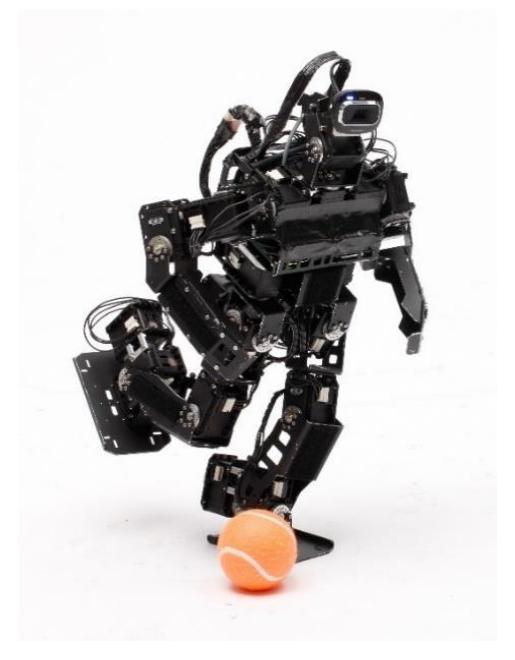
Da-v1n
The mechanical design is based on the DARwIn-OP, but was altered to fit our custom electronic components and to work with both Dynamixel RX-28 and MX-28 servos mixed together. The metal parts where built in our university's mechanical workshop. To make getting up easier, we use printed plastic covers for the hands.
New Robot
As a result of the new rules and the published roadmap for the future, we plan to build a bigger robot platform, whose body height is in the overlap of kid-size and teen-size allowed robot heights, which means around 85 cm.
3.2 Electrical System
The electrical system is custom made and designed specifically for a kid-size class humanoid robot. Two of the three different boards were particularly designed. A mini PC board with a standard processor is used for high-level control, vision and behavior. Besides the robots have a body board for controlling the servos and generating the movements. For power management and user control our third board is integrated in the system. The boards are located in the torso of the robot.
Main Board
As a main processor we use an Intel Atom running at 1.6 or 2.0 GHz. Our mini PC boards have either 1 or 2 GB DDR2 RAM and come with USB, RS232 and wireless LAN on board. For enhancing processing power and better expandability we consider using an Intel NUC with Core i3 or i5 instead.
Body Board
The body controller is based on an Atmel AT91SAM7X256 microprocessor, which runs at 96 MHz. It controls movement of the servos and generates motion patterns for walking and kicking or plays prepared key-frame motions, e.g. for getting up. To stabilize the robot the motions can be parameterized by inertial measurement data. The body controller communicates with the main board via an USB connection.
Inertial Measurement Unit
The robots are equipped with a 9 degrees of freedom inertial measurement unit consisting of a 3 axis gyroscope, a 3 axis accelerometer and a 3 axis magnetometer. While gyroscope and accelerometer provide sensor data for stabilizing the motions, the magnetometer is not used, because the output is too noisy because of the nearby servo actuators.
Visual Sensor
Currently we use a Microsoft LifeCam HD-3000. The camera runs up to a 1280 x 720 resolution at 30 fps and supplies YCbCr422 format images. As an improved alternative, with the possibility of stereoscopic vision, we consider to use an IDS uEye LE instead.
Power Supply
The power for the robot is supplied by a 3-cell lithium polymer battery with 2500 mAh. To provide different required voltages, we use a separate board with voltage regulators, which can be powered additionally by an external supply. This board can also switch the power for the servos via a transistor, so the servo power can be controlled by the body controller. Additionaly, the main board and body board have their own local regulators.
Framework
Our high-level framework was inspired by the framework used by the team FUmanoids. It has a blackboard based architecture and divides the system into modules and representations. A thread pool is used in combination with a scheduler to automatically determine the module execution order on the basis of the dependencies.
Vision
A new approach for our image processing was introduced in 2013, which has greatly increased the robustness of object detection. The new system is structured in modules allowing the behavior to select which algorithms to use. This results in speed optimization, because not every picture has to be scanned for e.g. lines if the model is accurate enough. [4] The modularity allowed us to introduce filters and manage them more efficient, making the false detection rate manageable and the system better adoptable to unforeseen events and tasks. [5] Working with automated tests in vision validation has greatly increased the performance making our vision system well tested and reliably working. New filters for object detection allow the vision to work less dependent on colors.
Behavior
Upgrading the behavior with variable roles and advanced kicking is one of the main areas of research. So far we avoided complex inter-robot communication because of the mostly unstable network connection at the tournaments. But for effective team play it is necessary to include the exchange of data, therefore we decided to use a small protocol. Constitutive on this communication and a reworked behavior we can adapt roles and strategies we initially developed in the Mixed Reality League.
Key-frame Motions
Even though static motions prove to be the inferior control method, some motions are too complex to be easily generated. Our robots therefore use predefined key-frame motions e.g. for goalkeeper motions and getting up.
Walk Engine
For locomotion, such as walking forward, backwards, sideways and turning, an omnidirectional walk engine is used, calculating the servo positions in real time. This allows controlling the body using high level commands instead of combining a predefined set of key-frame motions. It also allows incorporating sensor data for stabilization. Besides this, it is sufficiently abstract to allow running the same behavior on different robots without the need of sophisticated calibration. [6]
Kick Engine
Since previous year we use a kick engine that was developed by us. This allows the robots to kick in nearly every direction depending on the ball position. With two vectors, one for the ball and one for the target, the engine calculates the required movements to be done in real time. [7] At the German Open and in Eindhoven last year we showed kicks that reached three meters and more.
5. Conclusions
Our new platform has presented prosperous results previous year and with the outlined improvements it will do again. Some team members have previous experience at national or international level and can provide as a referee with good knowledge of the rules. WF Wolves is looking forward to participate in the RoboCup 2014 competitions in João Pessoa.
References
- Otte, S.: Where am I? What's going on? World Modelling using Multi-Hypothesis Kalman Filters for Humanoid Soccer Robots. Masterthesis, Freie Universität Berlin, Fachbereich Mathematik und Informatik, 2012.
- FUmanoids, Mixed Team Communication protocol, 2014. Available online at https://github.com/fumanoids/mitecom.
- Martins, L. T.; Gerndt, R.; Guerra, R. S.: Series Elastic Actuator and Its Application For Humanoid Platform. In: First Brazilian Workshop on Service Robotics, Santa Maria, 2013.
- Carstensen, J.: Computer vision a probabilistic and modular approach. Bachelorthesis, Ostfalia - University of applied Sciences, 2011.
- Neu, C.; Eichelberger, M.: Goal detection for humanoid soccer players localization. Bachelorthesis, Ostfalia - University of applied Sciences, 2011.
- Michalik, S.: Dynamisches Laufen von humanoiden Robotern. Bachelorthesis, Ostfalia - University of applied Sciences, 2010.
- Krebs, O.; Gerndt, R.: Dynamic Ball Kicking for Humanoid Robots. In: First Brazilian Workshop on Service Robotics, Santa Maria, 2013.