EROS TEAM
Ahmad Subhan Khalilullah, Iwan Kurniato W, Dimas Pristovani, Pratomo Adhi Nugroho, Saifuddin Zuhri, Naufal Suryanto, Rizki Taufik, Luthfi Aminulloh, Hasbulloh Qohar
EEPIS Robotic Research Center (ER2C) Politeknik Elektronika Negeri Surabaya (PENS)
Abstract In this paper we explain about the results achieved in the development of humanoid robots EROS (EEPIS Robot Soccer) for the humanoid league RoboCup 2015. Changes in the new rules of the game include the size and color of the ball that follows the standard FIFA No. 1, the goal is a white color, and the use of artificial grass as a field to play. By implementing a few methods for vision systems and kinematic obtained identification capabilities ball to a maximum distance of 1.5m and a height poses walking robot with a 3cm higher walking speed of 30cm / sec. We also discuss the results that have been achieved as a consideration for further development.
1 Introduction
RoboCup 2015 provides direction and challenges for research and development of humanoid robots that are listed in the official rules. The part that is being developed is a vision system to recognize 50% of white colored balls with a combination of color patterns, which refers to the standard ball FIFA No. 1. Not only ball that has a white color, the goal, and the line in the field is also white. Segmentation and identification of each object are the stages, which are also developed as a unity in the vision system. In this research we developed pattern recognition with a white background color in order to identify balls and other objects. Development on the mechanical part is intended to allow the robot can walk on artificial grass. Kinematic parameters were improvised on the pose and gait in order to generate stable walking pattern during play. On the other hand, this game involves a number of robots in the field that presents the research challenges in the inter-robot coordination system.
The results of the development has been done in the previous year is shown with the achievements on the 4th at the RoboCup 2014 in Brazil. This is an improvement and progress in the development of research that has been carried out compared with the two previous years. We conduct an evaluation during the competition based on the results that have been achieved. In the perception of the image, the robot sometimes can not cope with external light interference from camera flash exposure because the filters are not able to have the data from the captured image. It often happens during the game and could be the next challenge for the system to be better. Robot EROS also experienced many disadvantages in terms of coordination between the robot players. Part coordination system sometimes locks on one condition. This condition causes the individual player mode is active and the robot will play alone. In the last game against a team BASET, EROS robot mechanical decreased physical performance and the CPU is overheating. This resulted in some sections to be non-active and the system does not work.
This paper is composed of sections that describe our previous work in the next section. then followed by a section that describes the system that is under development progress. final section contains a discussion of the development that followed the statement of willingness to participate in the RoboCup 2015.
2 Previous Work
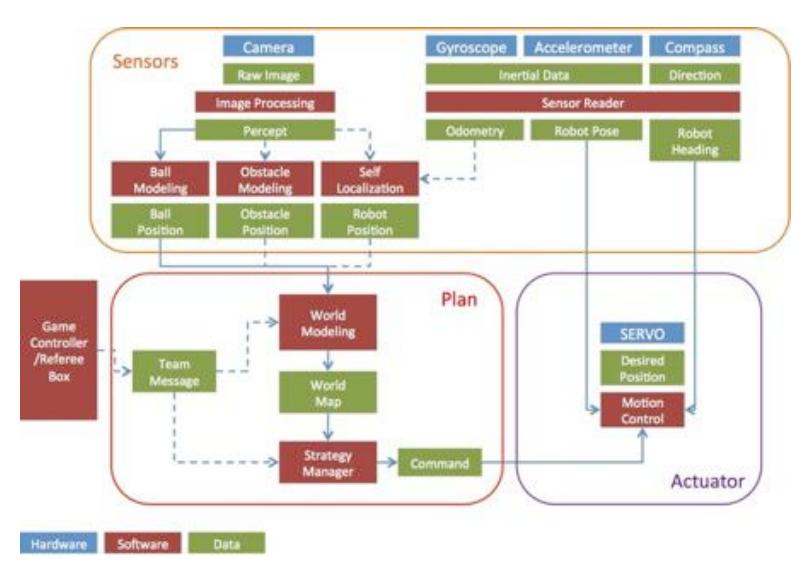
Overall system consists of three parts, which are shown in Figure 1. The first is the part that serves to perceive objects in the field, the second is the identification and modeling of the field environment, and actuators combined with inertial sensor system [7].
Robot is 52cm high with 22 DOF, height of posture while walking ranged from 40- 45 cm. Stability control when walking with implementing new patterns in trajectory generation walking [2]. At the soles of the feet is equipped with sensors to detect the landing soles of the feet. Detector is intended to provide a trigger to the controller poses to generate new patterns of trajectory.
Part of communication between the robots is configured as a client-server. Each robot has a communication system that function as a client and server [7]. In one condition, there is only one server is active while the others in the standby position. Other robots function as a client and connect to the server. Client sends position information, the distance between the robot with objects, and the mission is executed at the time. This system has a shortage of not being able to anticipate the occurrence of deadlocks when getting interference on the camera system while the robot is on a mission.
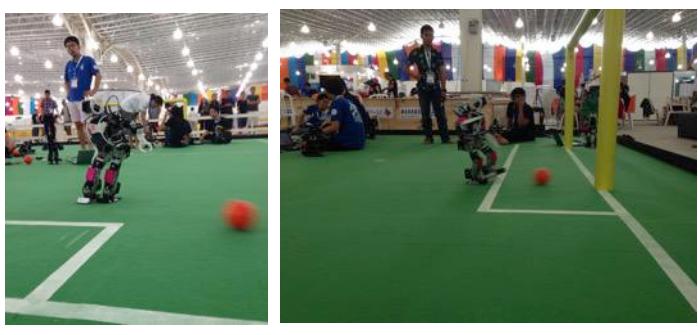
The situation around the field in RoboCup 2014 as illustrated in Figure 2. There are many objects that have the same color with the ball. in addition there is also the audience that uses the camera to turn on the lights flash. This situation gives disturbance to the view that the robot is on a mission. While robotic vision loss to a target object, the server performs a rotation assignment to other robots. Rotate assignments with the same two robots in a long time lead a system of coordination experience deadlocks. This condition makes the two robots look like hesitant to take the ball.
Object mapping in the field simultaneously obtained from the initial map creation shape of a football field and the accumulated distance-moving robot. Data inertial sensor readings are transformed into displacement distance is calculated in each robot. Each object in the field calibrated to obtain the conversion value of the number of pixels becomes units of meters high as the goal, the distance between the goal with the center line of the field.
3 Mechanical, Electronics, and Kinematic System
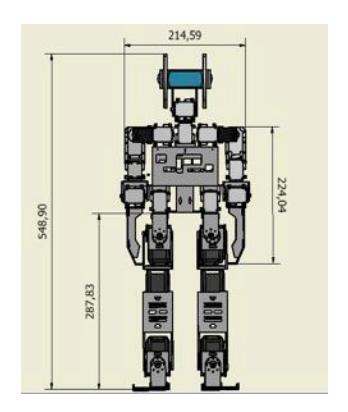
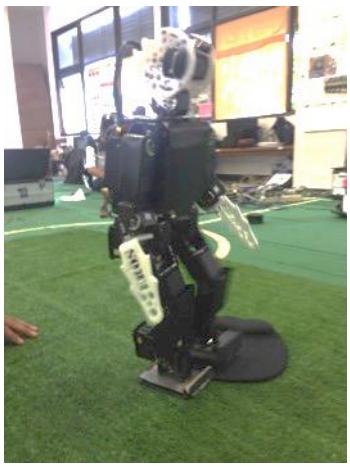
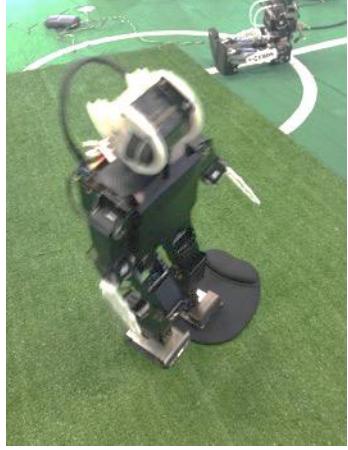
In overall size, the physical dimensions of the robot does not change compared to the dimensions of the robot 2014[7]. Mechanical configuration and dimensions are shown in Figure 3.
The height of the robot body when walking is higher than the previous pose. The major change is in the posture of the foot. This change aims to adjust the height proportional part with a larger ball size. Figure 3b shows the changes, which pose high when walking robot at higher around 3 CM, and shapes poses while walking becomes more strapping as human poses.
Timing control trajectory on a walking robot changed to obtain the stability of the shape of the current pose [7]. The default timing is the reference model used to walking. Interval timing is shorter because of changes pose a higher leg. This interval value becomes the input controller to generate trajectory shape when getting an uneven floor.
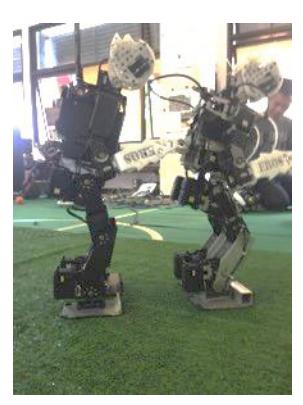
The robot is able to walk on artificial grass and also maintain stability when getting an uneven floor as shown on figure 4. The development is being done now is the stability of walking at the same speed as before, which is currently running speed decreased 6cm / s of speed running previously.
4 Inter-Robot Communication System
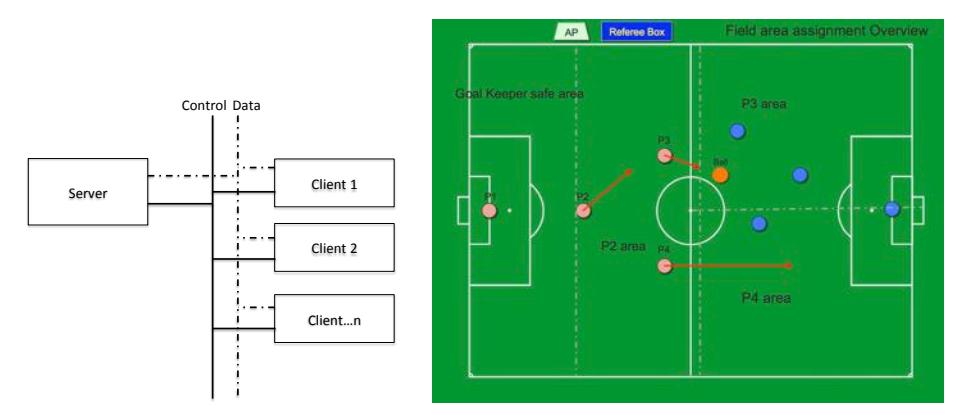
Communication between players robot using a wireless network TCP / IP 802.11G which is configured as a client-server [7]. As shown in figure 5 one robot serves as a server while the other is as a client. This section describes the methods of coordination between the robot in a client-server configuration and transition mechanism server roles.
Coordination model in the game is the assignment of sectoral field. P1 as the goalkeeper has the sector around the goal, P2 has a duty in the area P2, and so on as shown in figure 5. Robot P2 serves as an active server and taskmaster to the P1, P3, and P4. Assignment rules defined in a strategy definition. The task given to the players other than the P2 has the highest priority to run. P2 obtain information from the players about the status of implementation of tasks or missions that time. P2 perform the assignment to the next player when the mission is complete run or execution has exceeded the specified time limit.
Defined mission includes moving towards the opposing goal, pass the ball, dribble, and kick into the goal. P3 and P4 can be assigned to all the missions defined. This implementation is intended to support the further development of artificial intelligence in the strategy game. How the strategy can be dynamically changed during play.
5 Vision System
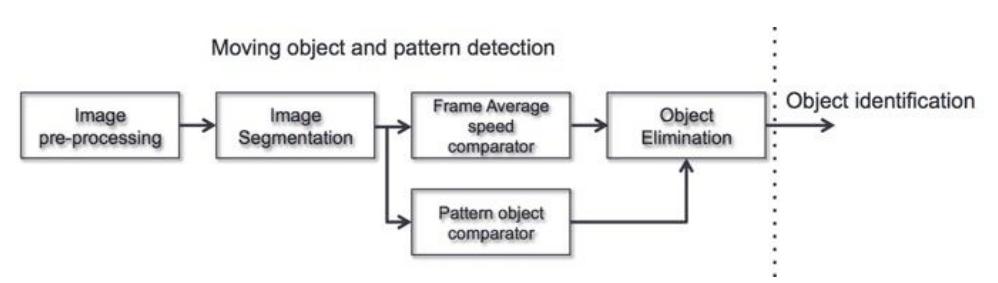
Almost all of the objects that are in the field have a white base color, ball, the entire goals, and the field lines, unless the field is a green color. The ball was identified as a moving object. This feature is used as the initial reference to find the ball. In addition to moving objects, the ball can be identified from the physical shape of a circle. The robot moves around the object pose captured by the camera on the robot looks like a move. This object is eliminated by obtaining the object displacement speed compared to the speed of the image frame. An object is declared as an object that does not move when the object displacement speed equal to the speed of image frames.
Object identification process is shown in Figure 6. The ball is identified as a moving object or a moving pattern, the rest are other objects. Other objects identified by comparing the similarity with the template image of the goal, and the field lines.
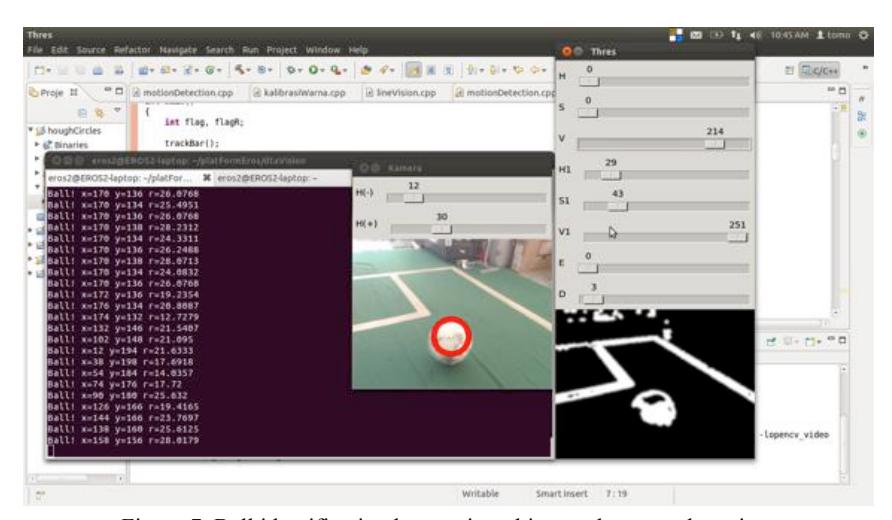
The vision system is able to identify objects such as balls, goal, and the goal line. Test results obtained success moving the ball identification is obtained at a distance of under 1.5m. Improvements continue to be done to get the maximum distance farther. As a discussion we consider to combine field mapping system that has been done before by dividing the area of the field becomes several potential fields.
6 Conclusion
The development has been done on the robot pose EROS covers for robots, vision systems, and coordination. Pose higher around 3cm with an average walking speed 30 cm/sec. The results of identification by implementing the moving object detection and pattern moves on the vision system is able to identify the white ball within a maximum of 1.5m. With the results obtained at this time, the robots EROS already have a basic ability to play football with the rules of the game in 2015. Further development is to improve the ability to take the ball without having to knock down the opponent robot. In addition, the development of artificial intelligence systems in the game as a control strategy for the coordinator and the other players. We hope that what has been achieved to meet the qualification requirements of RoboCup 2015.
7 Statement of Willingness
Based on the results of the development we have done, we are hoping to qualify for RoboCup 2015. We hereby declare the ability when administered the opportunity to participate and will be very happy to be present to participate in the Robocup 2015 competition in Brazil. We delegate an official member Mr. Endra Pitowarno as a representative for duty as a match referee and other tasks assigned by the committee.
References
- https://www.robocuphumanoid.org, last accessed February 2015.
- Ill-Woo Park, Jung-Yup Kim, and Jun-Ho Oh, Online Biped Walking Pattern Generation for Humanoid Robot KHR-3(KAIST Humanoid Robot – 3: HUBO), in Proc. IEEE Int.Conf. on Robotics & Automation, pp. 398-403, 2006.
- James F. Kurose, Keith W. Ross, Computer Networking: A Top-Down Approach, Pearson Education; International ed of 6th revised ed edition, May 2012.
- M. Friedmann et al. Darmstadt Dribblers. Team Description Paper for Humanoid KidSize League of RoboCup 2010. Workshop Robocup Singapore 2010.
- Azhar Aulia Saputra, A. Harist A.,Ahmad Subhan KH, EROS Team Description for Humanoid Kidsize League for RoboCup 2012, EEPIS Robotic Research Center, 2012.
- Azhar Aulia Saputra, Ardiansyah A., Ahmad Subhan KH, EROS Team Description for Humanoid Kidsize League for RoboCup 2013, EEPIS Robotic Research Center, 2013.
- Achmad Subhan KH, Ardiansyah A, Dimas Pristovani, EROS Team Description Paper for Humanoid Kidsize League for Robocup 2014
- Azhar Aulia S, A. Subhan KH. Ali Husein A., Dynamic Control and Online Pattern Generation on Humanoid Robot EROS (EEPIS Robot Soccer), Dipl. Eng. Final project 2013, EEPIS Robotic Research Center, 2014.
- G.R. Bradski and J. Davis, "Motion Segmentation and Pose Recognition with Motion History Gradients".
- S. Balsaraf and U. Joshi, "Implementation of Motion detection and Tracking based on Mathematical Morphology", International Journal of Computer Applications (0975 - 0887), vol. 80, no 15, October, 2013.
- Y. Sheikh, O. Javed and T. Kanade, "Background Substraction for Freely Moving Cameras", Robotics Institute, Carnegie Mellon University, Pittsburgh.