FALCONBOTS TEAM Team Description Paper for Humanoid KidSize League of Robocup 2015
Julio C. Juárez, Alberto A. Sánchez, Alejandro Vázquez, Norberto García, Vicente Minero
Workshop Robotic Applications (TARP) Instituto Tecnológico Superior de San Martín Texmelucan (ITSSMT) C. Barranca de Pesos S/N, San Lucas Atoyatenco, C.P. 74120, San Martín Texmelucan, Puebla, México
http://www.itssmt.edu.mx/PARP/parp.html
Abstract This paper described the investigations realized for the Robocup Humanoid Kidsize league's participation. Also it described the advance getting of the investigation about FALCONBOT ONE of our platform. A few history about FALCONBOTS team and our investigations, like the interest of our investigations. Describe the develop of a new humanoid robot model based in the DARwIn platform free. Also different operation's algorithms of our humanoid platform. The principal interest of the area is to develop algorithms of stable walking and navigations techniques to know the exact location on the field.
1 Introduction
The objective of the Robocup international competition is to develop soccer robots for 2050 year; they can win a soccer game versus world champion FIFA. Therefore, we build a humanoid robot with the ability of controlling a ball and follow the FIFA´s rules. Above, for motiving us to conduct research in different areas like mechanic systems, electronic systems, artificial intelligence, artificial vision and Analysis of bipedal walking for participating in Robocup 2015 Hefei, China.
For this contest, we build three robots FALCONBOT ONE platform and we have two robots DARwIn OP platform, The FALCONBOT ONE, all of them have a height of 60 cm, with strong servomotors and 37 cm/s speed. Also, we develop a median kick for controlling the ball toward the goal and score the opponent field on the whole with robot coordination algorithms. The changes of the rules in recent competitions put us at a huge challenge; kick the opponent goal, which now is white, as well as the ball tracking which will be 50% white and 50% dark color, it is a great challenge. We use two recognition methods for opponent goal, this help to locate the robot in the game field, a magnetometer for robot orientation and analysis particle filter. The robot analyzes of data from the magnetometer and the particles of some goal.
Falconbots has participated for four years en Robocup and five years in the Robocup Mexican Open, important results obtained last year. This paper describe the information about the present research and the new robots, well as investigation of the years ago.
2 Hardware Design
2.1 DiMechanical Design
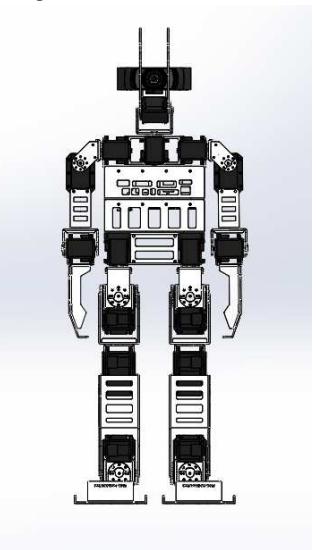
The FALCONBOT ONE platform is based in the DARwIn OP humanoid Robot design and the EROS team platform. The dimensions of the new FALCONBOT ONE platform are: 60 cm height
23 cm width
3.9 kg weight
22 Degrees Of Freedom (2 more than last year) 12 Dynamixel MX-28 T and 10 MX-64 T with 6.0 NxM, which allows the robot to walk faster and have better control to kick the ball
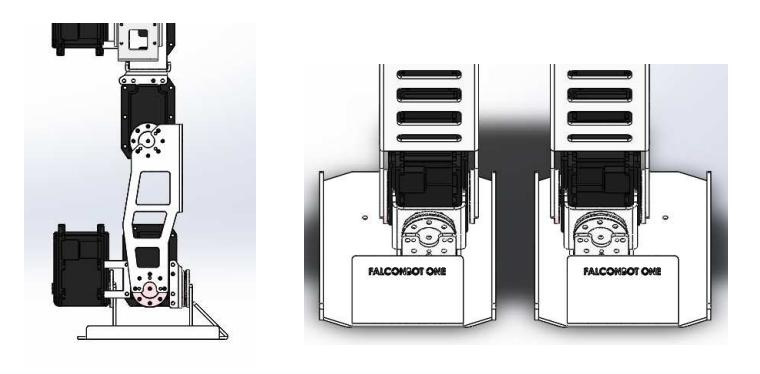
The robot uses tow DOF in the head, four DOF in each arm and six DOF in each leg, the mechanical structure shown in image 1
2.2 Electronic Design
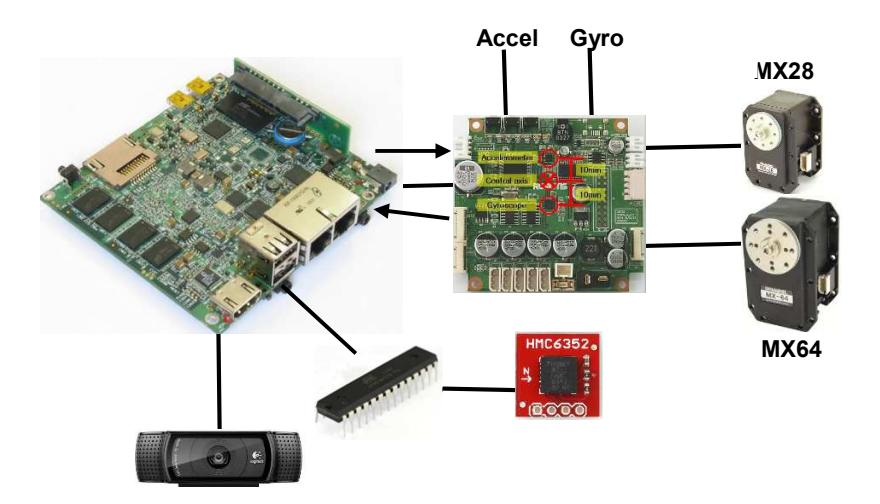
The humanoid robot's electronic design FALCONBOTS ONE has four principal elements: the main computer, subcontroller, sensor and actuators, all are communicated for the RS232 protocol. The main element is a fit pc2i, this computer has 2 GB of RAM and a intel microprocessor 2 Ghz. The computer is adapted fully for FALCONBOT ONE platform and it has energy supply of 12 v.
The subcontroller CM730 is used to for controlling the Dynamixel MX-28T servomotors communicated TTL way and Dynamixel MX-64 T to RS232 way with energy supply of 12 v, and 3200mAh.
The communications of the servomotors is through making of the master-slave Dynamixel protocol. This protocol allows the actions to send servomotors well as the configuration of the same
The actuators has a loop internal control, which allow locate them in the correct axis. The accelerometer and gyroscope sensors are used to know the inertial alterations robot at playtime.
The accelerometer is used to determinate if the robot has some alteration while is walking, in example, if some change is present at walk; the accelerometer determines if the acceleration was large, it determinate if the robot is about fall, when this situation is present a calculate is does to know what strong is the acceleration, it allow make a correction of the walk at side where the reads is so large, it's describe coming soon.
We use a HCM6352 magnetometer, which is communicate for I²C protocol, this protocol is synchronize with ATmega328 microcontoller's frequency. The data of sensor and the particulate filter algorithm are used to determinate of the orientation and locate of the robot in the field game.
In the image 3 it's show the electronic design diagram used for the FALCONBOT ONE platform
Robot Component System Specifications
| Robot Component System | Specification |
|---|---|
| Weight | 3.90 kg |
| Height | 60 cm |
| Degrees of Freedom | 22 total, Arm 4, leg 6 and neck 2 |
| Actuators | MX-64 and MX-28 |
| Camera | Logitech C929 |
| Main Processor | Fit-pc 2i 2.0 GHZ dual core Intel processor 2GB DDR3 Memory, SSD 40 GB. |
| Operating System | Linux Mint 13 Maya Mate |
| Battery | Li-Po 12 V 4500 mAh |
| Inertial Sensors | Magnetometer HMC6352, Accelerometer and gyroscope included in CM730 |
The FALCONBOT ONE platform is designed for Robotic Applications Program students contribute with some ideas useful to football game and well as other projects like face recognition, voice recognition and instructions follow.
3 Software Design
3.1 Artificial Vision System
The artificial vision system to play football has four big situations for the robot have perform well inside game field, the first is the ball recognition, second goal recognition, third mark of field and last one environment recognition to estimate the robot locate.
The ball recognition in our FALCONBOT ONE platform is based in the patrons recognition that describe the ball in the field and the colors extraction in the vision range of robot, once done this, the result is compare to the game field to find color patrons white with background green color. We use a SURF algorithm for the lineal patrons recognition and patrons circle or polygonal shapes, which interact with green and white colors
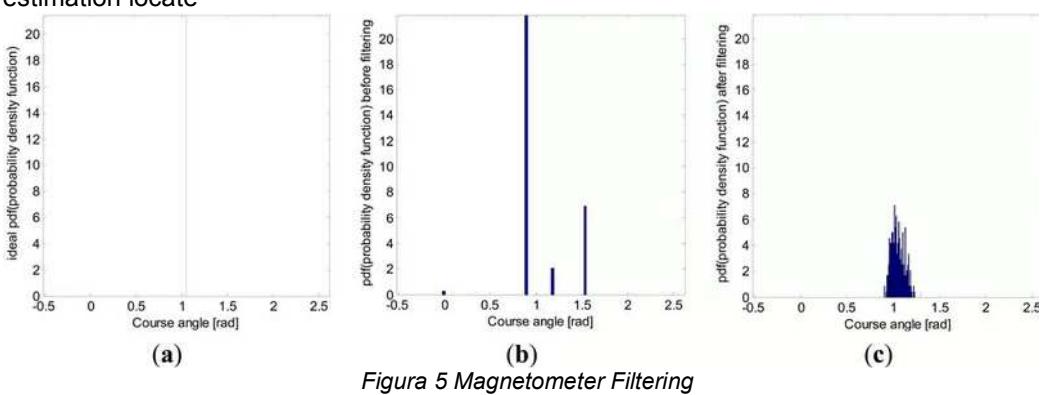
The goal recognition is determinate for tow factor, first is the tow white post recognition that is near to the green color of the field build a 90 degrees angle perpendicular at field. The second is the robot orientation with the data get of the magnetometer sensor, with this the robot recognized the opponent goal or him goal. The data is filtering to prevent errors.
3.2 Motion and kinematics
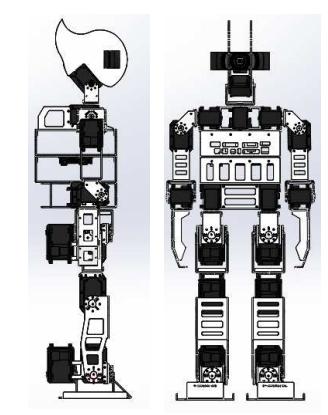
The humanoid robot FALCONBOT ONE uses the zero moment point method to walk, uses inverse kinematics and recuperation technics, the walk of the FALCONBOT ONE in artificial grass is excellent which is omnidirectional and is 37 cm/s speed this is possible for the uses the Dynamixel MX-64 T servomotor in the legs.
3.3 Localization
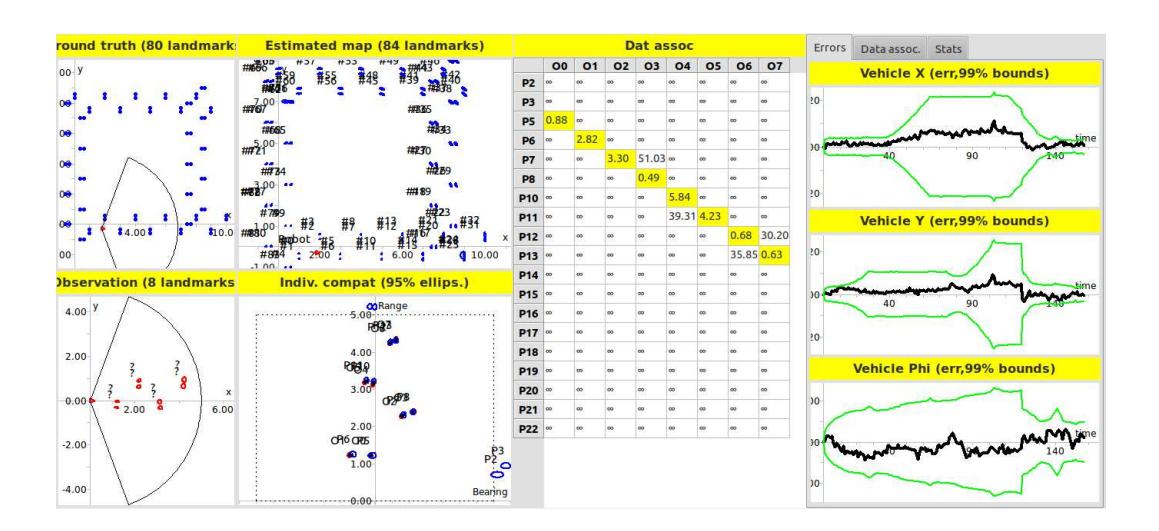
The localization system of FALCONBOT ONE is based in the uses of particle filter and data get of magnetometer. When the particle filter with the artificial vision system locate a white goal, the robot calculed the orientation with filtering data of the magnetometer using Kalman Filter, in this case the robot know is looking the opponent goal, the next is detect particles without uses in the first case to calcule distance to the goal. Well as the robot have an estimation locate
4 Conclutions
Along of 5 years of participation in Robocup contest, the FALCONBOTS team has get experience and competitively and knowledge of rules to participate as refrree, we hope a notable participation in Robocup 2015 through last result of our investigations. We will continue with the investigations in different area relationship to humanoid robotic, artificial vision and principally Robocup. The Robocup 2015 Hefei China promise be a very competitive event.
References
- http://www.robocuphumanoid.org , February 2015.
- Azhar Aulia Saputra, Ardiansyah A., Ahmad Subhan KH, EROS Team Description for Humanoid Kidsize League for RoboCup 2013, EEPIS Robotic Research Center, 2013.
- Durrant-Whyte, H.; Bailey, T. (2006). Simultaneous Localization and Mapping (SLAM): Part I The Essential Algorithms. Robotics and Automation Magazine 13 (2): 99– 110. doi:10.1109/MRA.2006.1638022. Retrieved 2008-04-08.
- Greg Welch. (2011). Kalman filter. 2015, de University of North Carolina at Chapel Hill Sitio web: http://www.cs.unc.edu/~welch/kalman/
- EEPIS Robotics Research Center (ER2C). (2014). DEVIATION DIRECTION COMPENSATION OF MAGNETIC FIELD EFFECT USING CIRCLE EQUATION METHOD ON ROBOT EROS (EEPIS ROBOSOCCER). INDONESIA: EEPIS Robot Soccer.
- E. Ayyappa. Normal human locomotion, part 1: Basic concepts and terminology. Journal of Prosthetics & Orthotics, 9(1):10{17, 1997.
- T. Katayama. Design of an optimal controller for a discrete-time system subject to previewable demand. International Journal of Control, Automation and Systems, 41(3):677{699, 1985.
- K. Ogata. Modern Control Engineering. Prentice Hall, Indianapolis, 5fth edition, 2010.
- B. Siciliano and O. Khatib. Springer Handbook of Robotics. Springer, New York, illustrated edition, 2008.
- M. Vukobratovic and J. Stepanenko. On the stability of anthropomorphic systems, mathematical biosciences. 15:1{37, 1972.