Team Description Paper
Yunxuan Li
Qiming College of Huazhong University of Science and Technology, Wuhan, Hubei, China
Abstract The passage is mainly about technique and achievements of the humanoid robot team of Huazhong University of Science and Technology (HFR).
Keywords: HFR, finite element analysis, space Euler Angle, characteristic clustering method, Online Gait, ZMP, machine learning.
1 Technique Description
Our team is divided into several research directions, which include the stability of circuit, the use of sensors, mechanic design, vision system, online gait and the maintenance of the robot system.
In the following we will introduce our technique explicitly in several different aspects:
1.1 Mechanic Design
Technology Introduction. We devote ourselves to constantly improving robot's structure. We use Creo2.0 to design digital prototype, to set up the quality attributes of the model and to simulate robots' motion. Besides, the engineering drawing is revised with the support of AutoCAD. To avoid a situation that any part is under heavy load, we make stress analysis of the parts of the robot before exporting engineering drawing.
The main parts of our robot are made by 5052 aluminum alloy sheet metal, which has excellent comprehensive mechanical properties. Besides, the waist of robot was made by carbon fiber board to support the structure of robot body.
Research Interests. At this stage, there are three research directions in the Mechanical Team: Kinematics analysis, Dynamics analysis and the finite element analysis. Kinematics analysis is based on three-dimensional modeling software and Simulink of MATLAB, both of which are combined to realize motion simulation. Dynamics analysis is based on ADAMS ( Automatic Dynamic Analysis of Mechanical Systems), which can carry out simulation analysis to the virtual mechanical system。 The finite element analysis is based on ANSYS, the professional software which can be used to analyze the stress and vibration of mechanical.
Researching in these three aspects, we hope our robots can get a systematic analysis and get stable on structure and properties as well as further optimization.
Improvements. Now we use Creo for robot designing and motion simulation. After the completion of the model, we use ANSYS to do the force analysis, which is called the finite element analysis, specifically. The position of battery is lowered from abdomen to leg to lower the center of gravity. To make the structure more powerful, RX-28 which constitutes the leg is replaced by MX-64.
Reference. We reference the Darwin model in some parts of our body such as legs. But we use more powerful dynamixels MX-64R so our robot can kick the ball farther.
1.2 Circuit Design
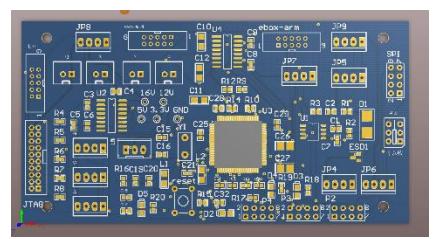
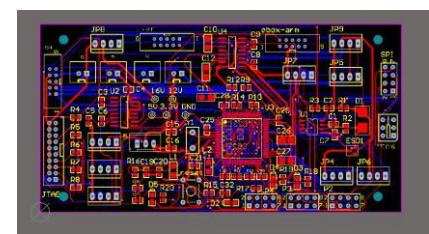
Scientific Aspects. The main controller we choose is PCM-3363.It has an integrated graphics controller contains a refresh of the 3rd generation graphics core with 224 MB shared memory. This feature makes PCM-3363 capable of handling complex and intense graphic processing, like searching the ball and making decisions.
We use TPS54527, a synchronous step-down swift converter, to power PCM3363. And TPS54540 is chosen to power servos. Besides, to bridge the communication between PCM3363 and servos, we use MAX232 and MAX485 to convert 232 level to 485 level.
Research Interests. With the improvement of the design requirement, we will be committed to achieving better electronic design.
A more reliable solution of power supply. We are struggling for supplying stable, low ripple and high efficiency power supply for every parts of the robot. Power section will have over-voltage and under-voltage protection circuit and is capable of detecting the remaining capacity of the battery.
A multi-functional circuit and better scalability circuit. We are struggling for building a reliable communication among robots by implementing communication circuit design. Finally, the debugging will be convenient and the usability of the robot will be improved.
Enhancements. In the last few years, our team used one type of DSP as main controller to compete with others in FIRA. As the complexity of algorithms, DSP was not suitable for our robot in the speed of computing. As a result, we choose PCM3363, which uses an Intel Atom N455/D525 processor.
In the powering section, LM2596 step-down converter was used last year. But it worked comparatively inefficiently and could not carry sufficient current to satisfy PCM3363. As a result, we choose TPS54527, which can carry 4A current at most and performs outstanding to convert 7.3V to 5V.
Reference. The powering section was supplied by webench of TI. We confirm the parameters of the circuit design in the powering section with the help of webench.
1.3 Sensors
Scientific Aspects. Our team process the data based on a PCM - 3363 PC control system and the sensor system. The sensor and host computer constitute the information feedback system and information processing system. Software platform is based on eclipse development environment, and the sensor system uses a 3 axis digital compass, an accelerometer, a gyroscope. The inertial sensor collects the robot's inertial attitude information. The digital compass collects space magnetic field data of the robot. The accelerometer collects space of the robot acceleration information. The gyroscope collects space rotation acceleration information. Then we use the posture analytical algorithm to earn the robot space Euler Angle (pitch, roll, and heading Angle).
Research Interests. Our main research direction is the embedded system (including RAM and Linux). We use it to analyze data that be collected from sensors. We are interested in collecting more sensor's feedback in order to help robot locate and adjust itself.
Enhancements. Our team has been based on architecture Cortex-M4 kernel hardware platform, to collect and analyze the sensor information. This season we try to use a host computer to collect and analyze the sensor information directly, and we success. So we save the cost and improve the working efficiency. (At the same time, we retain the architecture Cortex-M4 kernel based digital signal controller (DSC) STM32F407 as lower machine, processing sensor information).
Last year, our team collect and analyze the sensor's information by using Cortex-M4 kernel hardware platform. This year, we try to get these information with the help of PCM-3363. Eventually, we made it and it works efficiently.
1.4 Vision System
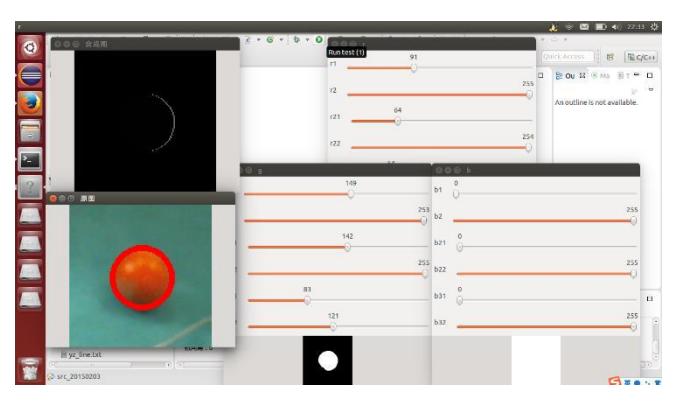
Visual system is an important part for the robot. Image partition and image recognition are two important parts of image processing. To realize the court partition of the image, we use the method of Sample Threshold Value, which is a characteristic clustering method. We use the HSV color space to set up a color database to implement the partition of object in images.
After analyzing the demands and characters of robot soccer vision system, it offers a quick method of object recognition based on dynamic windows. To improve visual tracing precision and environment adaptability, we have a method of robot-soccer visual tracing based on action-vision. The method validates the coherence of target action and command by vision. It can keep uninterrupted tracing in a visual blind area, and correct the target tracing errors. We have a new method of obtaining the central coordinates of ball, which is based on the model of distortion difference and the space analytic geometry theory. It is presented because the ball central points are sometimes difficult to obtain when we lose the target or enlarge the difference of the path of robot.
1.5 Gait Planning
Online Gait. Cooperated with the sensors' feedback technology, the Online Gait has developed our control system into a stable closed-loop surroundings, which can immensely improve the ability to resist multiple disturbances from inside to outside of the robot, enhancing the walking stability of our robots.
Our gait planning methods are mostly based on the ZMP (zero-moment point) theory.
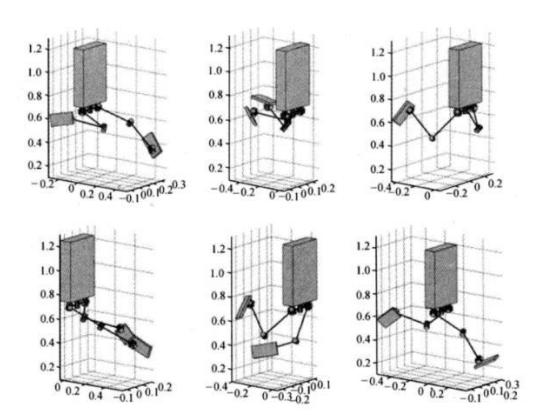
Foot trajectory is planned at first, then, we calculate the trace of the center of mass and the feet in order to keep the ZMP in the area of the support polygon. Finally, through the forward kinematics and inverse kinematics, the appropriate angles of every joint can be calculated, and the stable walking of biped robot is realized.
Research Interests. We are struggling for improving the stability and adaptation of existing algorithm. We are trying to apply the machine learning on our algorithm to achieve this goal.
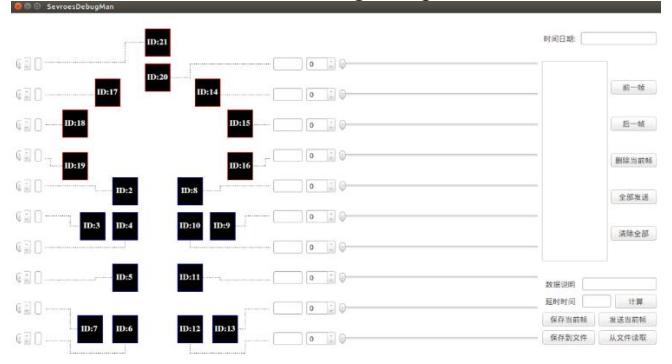
Enhancements. We apply a new online gait algorithm instead of the off-line gait and develop multi-functional debugging platforms in Windows and Linux.
Reference. Use the code of Darwin which was designed by the University of Pennsylvania for reference, and our team has made some improvements based on it.
2 Prior Performance in RoboCup Competitions
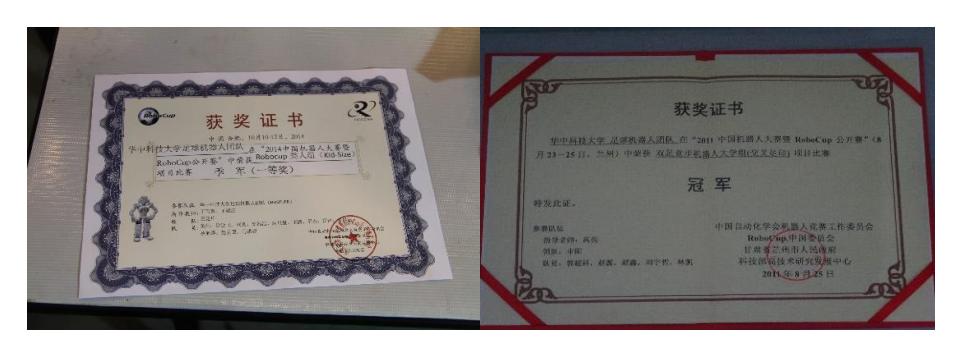
2011, took part in the RoboCup China open tournament for the first time and won our first champion in the competition event "Somersault".
2014, won the third place in the RoboCup China open tournament in the competition event "RoboCup 3v3" (humanoid league, Kidsize).