Robo-Erectus Jr-2015 KidSize Team Description Paper
Buck Sin Ng, Carlos A. Acosta Calderon, Changjiu Zhou
Advanced Robotics and Intelligent Control Centre, Singapore Polytechnic, 500 Dover Road, 139651, Singapore
Abstract This paper provides a brief description of Robo-Erectus Junior (REJr) that is set to participate in the KidSize category in the Humanoid League of Robocup 2015. REJr are a series of KidSize humanoid developed in the Advanced Robotics and Intelligent Control Centre (ARICC) of Singapore Polytechnic (SP). The latest version of the REJr humanoids are the Bv-MkIII+ and Bv-MkIV.
1 Introduction
Research and development work on biped robots started as early as 1996 by staff and students of Singapore Polytechnic. Subsequently, the work on biped robots was extended to humanoid robots through the establishment of the Robo-Erectus project (www.robo-erectus.org) in the Advanced Robotics and Intelligent Control Centre in 2002. The Robo-Erectus Humanoid Team is one of the pioneer soccer-playing humanoid robots in the RoboCup Humanoid League, having participated since the league inaugurated in 2002. Table 1 shows the team's performance since 2002.
Team performance from 2002 to 2013
| Competition Category | Result |
|---|---|
| RoboCup 2002 Humanoid Walk | 2nd Place |
| RoboCup 2003 Humanoid Free Style 1 | 1st Place |
| RoboCup 2004 Humanoid Walk | 2nd Place |
| RoboCup 2004 Humanoid Free Style 2 | 2nd Place |
| RoboCup 2004 Humanoid Kick H40 2 | 2nd Place |
| RoboCup 2004 Humanoid Kick H80 2 | 2nd Place |
| RoboCup 2007 Humanoid TeenSize | 4th Place |
| RoboCup 2008 Humanoid TeenSize | 4th Place |
| RoboCup 2010 Humanoid AdultSize 2 | 2nd Place |
| RoboCup 2011 Humanoid AdultSize 2 | 2nd Place |
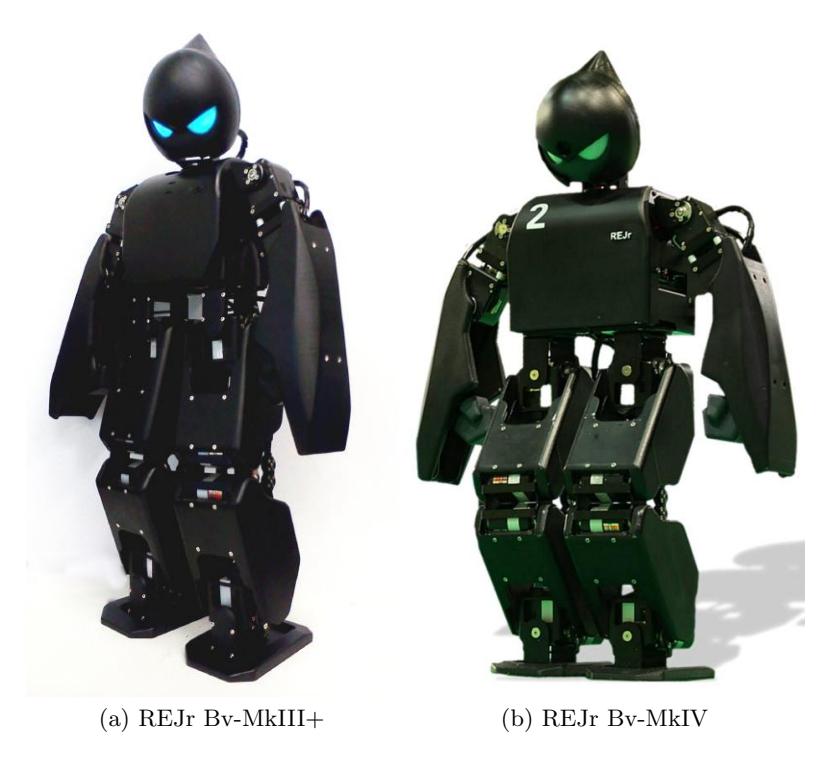
This paper is organized as follows. Section 2 briefly describe the previous work done on the robot where an overview of the hardware and software are presented. Following, in Section 3, the major improvement works done to adapt to the new rules for this year RoboCup are highlighted. Finally, in Section 4, the concluding remarks are presented.
2 Overview
In this section, an overview of the REJr is briefly presented based on previous accomplished work. More details of the work are available from our previous year team description papers.
2.1 Hardware Design
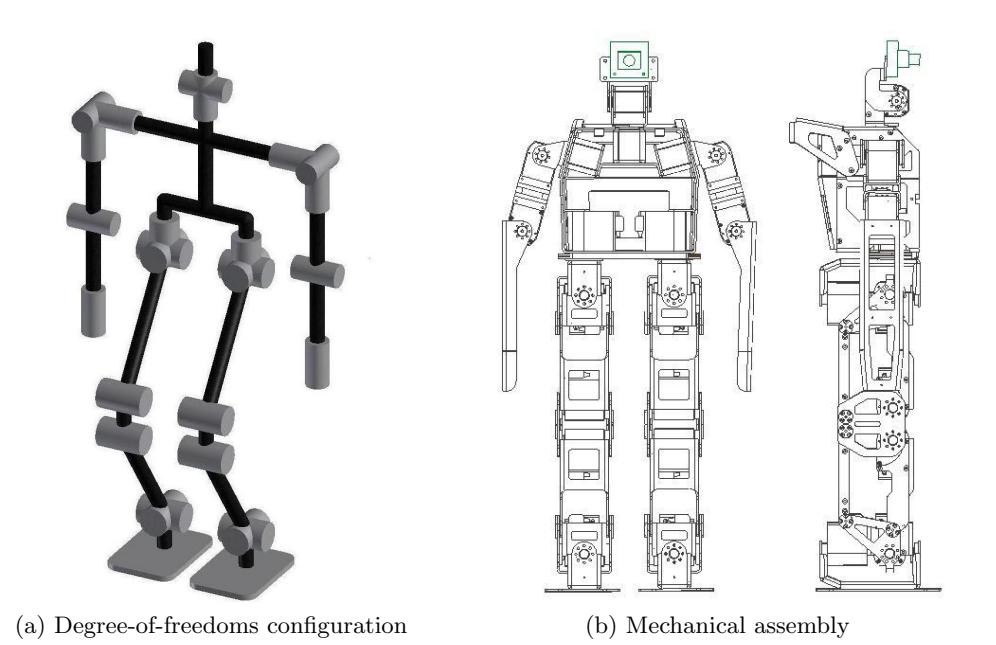
Mechanical The team have adopt the same mechanical hardware design (Fig. 2) since 2010. Minor modifications were made to the design with each new version. Notably of the REJr mechanical design is the utilization of the parallel double crank mechanism in the leg structure, which many RoboCup teams have adopted, for fast dynamic walk.
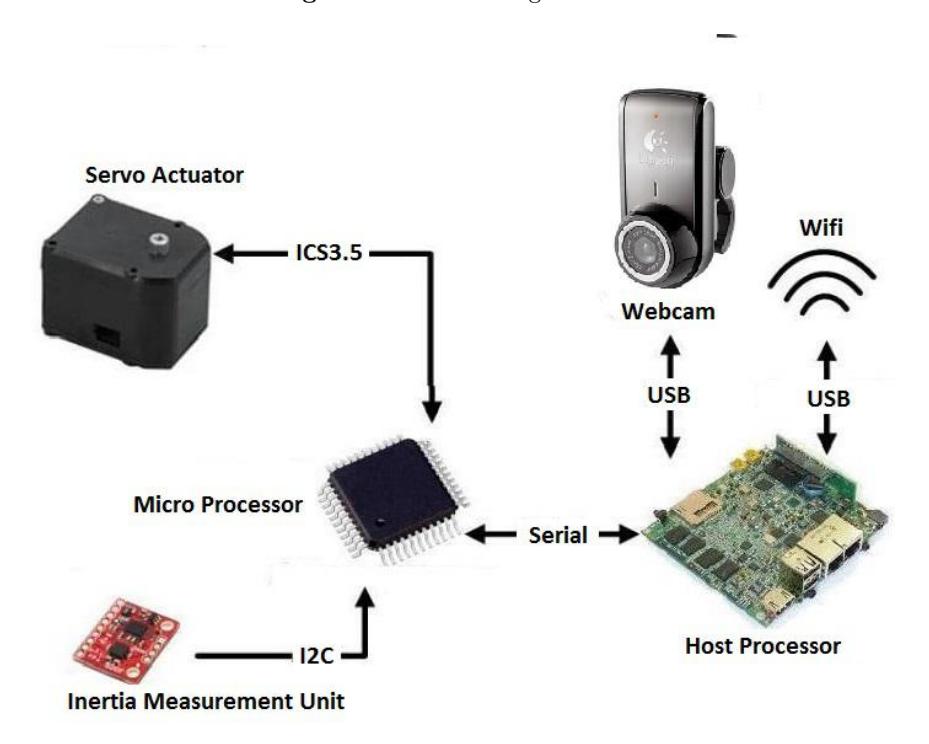
Electrical REJr uses a two processors system architecture for its electrical hardware (Fig. 3). A low level micro processor handles the servo actuator and inertia measurement unit whereas a high level host processor handles the web camera and wireless communication. The two processors execute the task of the humanoid independently and information exchange between the two processors is through serial communication.
2.2 Software Specifications
Locomotion Control REJr uses a decoupling approach for gait generation in locomotion implementation. Based on [1], the dynamic walk is decoupled into lateral walk-oscillations and omni-directional walking gait generation to reduce the complexity in implementation.
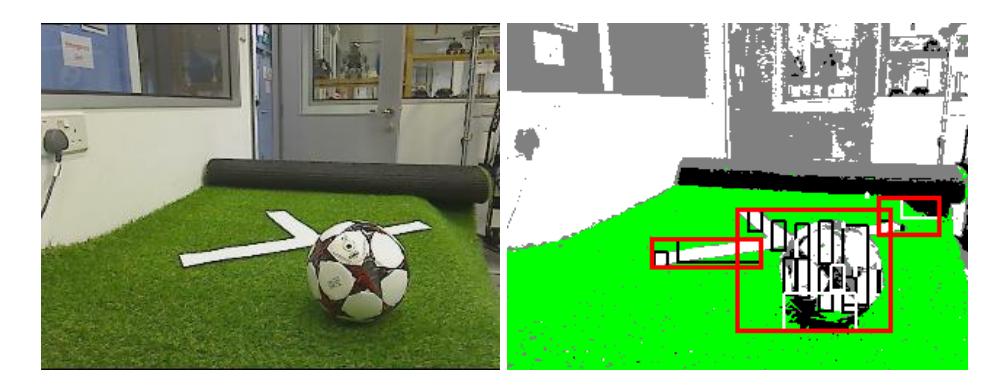
Image Processing Image processing is achieved using the YUV color space on REJr. Color segmentation using scan lines are realized to minimize computation time. Respective colors blob determined are explored to generate postulation of the ball, goals, field lines and junctions.
Localization The Monte Carlo localization is adopted to determine the position and orientation of the robot on the field. The particle filter utilizes key landmarks such as field lines, line junctions and goals. Orientation of the robot with respect to the home or opponent goal is determined using the gyroscope.
Behavior Control The control of the behaviors of REJr is divided into three layers: skill, reactive and planning layer[2]. Functioning of the humanoid in autonomous mode is support by a framework of hierarchical reactive behaviors. Complexity in the behavior control is reduced as the framework restricts the interactions between the system variables.
3 Major Improvements
In this section, the major improvements made to REJr in adapting to the new rules are described. The improvements are built upon or extension of accomplished work presented in Section 2.
3.1 Gait Generation
The introduction of the artificial grass playing field to the competition poses a key challenge to the gait generation of the humanoid for omni-directional dynamic walk. The work proposed and implemented by [3] of a preview controller using Zero Moment Point (ZMP) allows the generation of dynamically balanced walking gaits in real time.
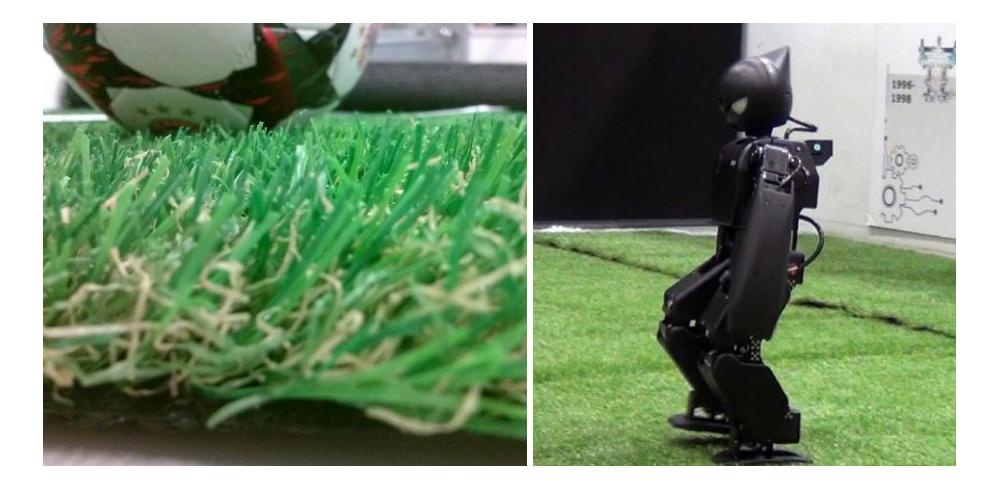
This year, REJr adopted the use of the preview controller in fuse with previous work to enhance the robustness of the dynamic walking on artificial grass play field (Fig. 4). Primarily, previously accomplished work on REJr for gait generation is also based on Zero Point Moment (ZMP) and the Linear Inverted Pendulum Model (LIPM). This effectively reduces the time and effort for the integration of the approach.
3.2 Image Processing
As per previous work, the image processing is still based on colors despite the new rules of moving away from colors. Primarily, the use of colors is still computation efficient and inexpensive.
The lookup table used is determine using the YUV color space where each color is defined as a block in term of the YUV parameters in 3 dimensional. The rigidness of a block in the color space resulted in overlapping of region and poor representation of the colors. This year, the Y color space is divided into 16 layers for better representation.
Scan lines and color segmentation allows area of interest on the image to be quickly and easily determine. Different from previous work where color blobs are determine, windows of a collective of color blobs are defined instead. More expensive computation such as edge detection and Hough transformations are perform on these defined windows before the postulation of the ball, goals, field lines and junctions. Limiting expensive computation to a smaller space effectively reduces resource and time as the playing field is largely green.
3.3 Localization
During RoboCup 2013, the localization algorithm implemented was largely unable to determine it orientation and the robots ended having own goals. The rate gyro was skeptic to drifting and the particle filter was not sufficiently robust.
This year, a posture estimator module is implemented based on the inertia measurement unit to predict and determine the robot axis in 3 dimensional. A complementary system is implemented to integrate information from the particle filter and the posture estimator to effectively determine the orientation of the robot. For short time intervals, the posture estimator updates the particle filter on the motion of the robot whereas for long time interval, drifting in the orientation by the posture estimator is corrected by the particle filter when the confidence level is sufficiently high. The complementary system is robust to handle robot slips, twist, fall over and kidnapped robot problems.
4 Conclusion
In this paper, we have covered briefly the previous research and development work done, and the major improvements to our robots for this year competition and adapting to the new rules. By not participating in last year competition, the break had allow the team more time to focus on key area the team is lacking for the Humanoid KidSize League competition. In compare to 2013, the team is better prepared and ready for this year RoboCup. For more detailed information about the Robo-Erectus, please refer to the team's website www.roboerectus.org.
Acknowledgments
The authors would like to thank staff and students at the Advanced Robotics and Intelligent Control Centre (ARICC) and higher management of Singapore Polytechnic for their support in the development of our humanoid robots.
References
- Buck Sin Ng. Biped gait generation for humanoid dynamic walk. National University of Singapore Ph.D. Thesis, 2013.
- Carlos Antonio Acosta Calderon, Changjiu Zhou, Pik Kong Yue, Mike Wong, and Mohan Rajesh Elara. A distributed embedded control architecture for humanoid soccer robots. In Proc. of Advances in Climbing and Walking Robots, pages 487–496, Singapore, July 2007.
- Johannes Strom, George Slavov, and Eric Chown. Omnidirectional walking using zmp and preview control for the nao humanoid robot. In RoboCup 2009: robot soccer world cup XIII, pages 378–389. Springer, 2010.