Team Mexico RoboCup 2015 Humanoid KidSize Team Description Paper
Luis F Lupi´an, Jes´us Savage, Alejandro Aceves-L´opez, Pablo Monroy, Luis Sergio Dur´an, Alejandro Ju´arez, Ismael Est´evez, Francisco Lecumberri
BioRobotics Lab, Universidad Nacional Aut´onoma de M´exico; Robotics and Intelligent Machines Lab, Instituto Tecnol´ogico y de Estudios Superiores de Monterrey; Mobile Robotics and Automated Systems Lab, Universidad La Salle, M´exico
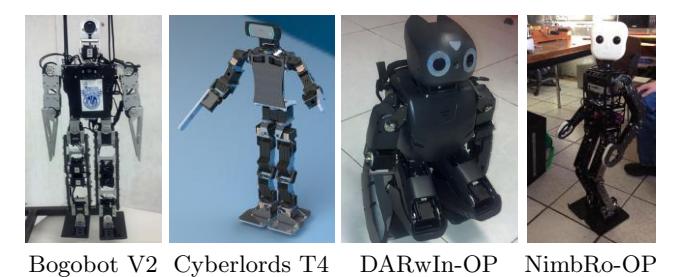
Abstract We describe the RoboCup KidSize humanoid robots to be used by Team Mexico in the RoboCup 2015 competition to be held in Hefei, China. For this edition of the competition Team Mexico is integrated by three institutions: ITESM, ULSA and UNAM. We present four different robot architectures: Bogobot V2, Cyberlords T4, DARwIn-OP and NimbRo-OP. We focus on the new hardware and software developments within the team since our last participation at the RoboCup World Championship.
1 Introduction
Team Mexico is a multi-institutional initiative represented this year by Instituto Tecnol´ogico y de Estudios Superiores de Monterrey (ITESM), Universidad La Salle (ULSA), and Universidad Nacional Aut´onoma de M´exico (UNAM). Each of these institutions have previously competed in the Humanoid KidSize League of the RoboCup World Championship under the names of Bogobots, Cyberlords La Salle and Pumas UNAM, respectively.
The three institutions representing Team Mexico for this edition of RoboCup have a history of participation in the Humanoid KidSize League that dates back to 2008, both at the local and international levels.
Team Bogobots participated for the first time in the Humanoid KidSize League in RoboCup 2008 in Suzhou, China [1–4], although they had previous international experience in the RoboCup four-legged league with Sony Aibo robots since 2002. In RoboCup 2009 in Graz, team Bogobots reached the quarterfinals. They were runner-ups during the RoboCup Mexican Open in 2009 losing the final against Darmstadt Dribblers, and then went on to become mexican champions in the 2011 edition of the RoboCup Mexican Open. They were also runner-ups at the 2012 and 2013 editions of the RoboCup Mexican Open. Their research has been focused on humanoid robot locomotion, computational vision and localization [5–9].
Team Pumas UNAM had their debut in the Humanoid League in RoboCup 2008 [10, 11]. They imported their accumulated experience from the @home league, where they participated in RoboCup 2006 for the first time, and have continued to do so ever since. They were runner-ups at the 2008 and 2011 editions of the RoboCup Mexican Open. Their research in humanoid robots is tightly linked to that of their service robots in the @home league [10–12].
Team Cyberlords La Salle debuted at the First RoboCup Mexican Open in September 2008. Since 2009, the team has taken part in all editions of the RoboCup World Championship [13–17], and three RoboCup Latin American Opens. Team Cyberlords La Salle took the championship at the RoboCup Mexican Open in 2008 and 2012, and at the RoboCup Latin American Open in 2010 and 2011. Their research has been concentrated on software architectures for mobile robots with heterogeneous architectures, localization and computational vision [17–20].
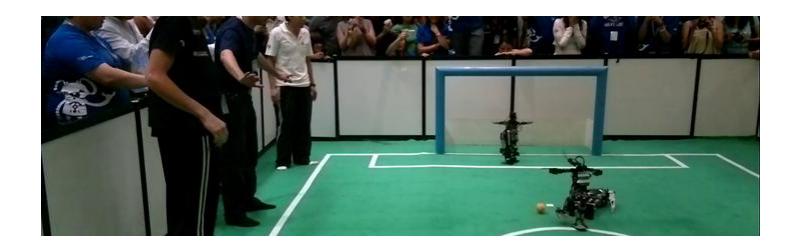
Team Mexico became champion of the RoboCup Mexican Open in April 2014, and participated in its first international event at the RoboCup World Championship 2014, in Jo˜ao Pessoa, Brazil, where the team advanced to the quarter finals ending up within the top eight teams in the competition.
2 Architectures
In 2015, Team Mexico intends to compete at several RoboCup competitions, including the RoboCup World Championship in 2015, with five different hardware architectures, all of which are depicted in Figure 2. Each of these architectures is briefly described in the following paragraphs. Further details can be found on the Specification Sheets submitted by Team Mexico for the competition.
Bogobot V2
Mechanically designed and built by the Robotics and Intelligent Machines research group at ITESM. It is based on Dynamixel RX-28 and RX-24F servomotors, for a total of 18 DOF. It features a FitPC2 embedded computer. Two of these robots are available for the competition. The software for these robots has also been developed locally at ITESM.
Cyberlords T4
Based on the Kondo KHR-3HV humanoid robot, but heavily modified to provide them with autonomy. Cyberlords T4 is an upgrade from architecture T3 developed by the team for the RoboCup 2014 competition. Both architectures use roughly the same kind of sensors, and use two Gumstix Overo Fire COM with Summit board. The main difference between architecture T3 and T4 is the mechanical redesign that fixes several problems detected in architecture T3 in 2014. A new torso and shoulder assembly were designed to give architecture T4 a significantly stronger build. In addition, the leg servomotors are being replaced by the new Kondo KRS-2572HV sevo motors, which have almost twice as much torque as the previously used KRS-2552HV motors. Two Cyberlords T4 robots will be available for the competition. Both robots run applications based on libCyberlords developed at the Mobile Robotics and Automated Systems lab of Universidad La Salle.
DARwIn-OP
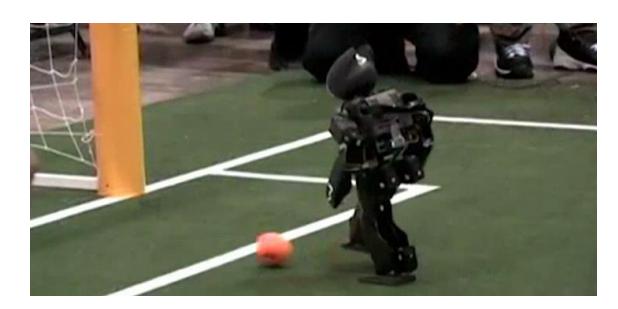
This is the well known commercial robot offered by ROBOTIS. One DARwIn-OP robot will be available for the team during the competition. All three institutions representing Team Mexico have developed code for the DARwIn-OP and have used it during official competitions. Figure 3 shows a Darwin-OP scoring at RoboCup 2012 under software developed by team Cyberlords La Salle in collaboration with team Falconbots Tec San Mart´ın.
NimbRo-OP
This robot was designed and built at Universit¨at Bonn [21, 22] by team NimbRo. It was acquired under a joint research grant in which several Mexican institutions are involved. In order to participate in the Humanoid KidSize League, the head of the robot was replaced with a significantly smaller mount so as to meet the height restriction of 90cm maximum. The robot was hosted at the BioRobotics Lab of UNAM until November 2011, where most of its current software enhancements were developed, based on the ROS-based code released by NimbRo.
3 Humanoid Robot Collaboration
Team Mexico is in essence a mix and match of humanoid robots that are not only brought in from different research labs, but which have notably different hardware architectures. It has then become a necessity for the team to establish a basis for humanoid robot collaboration on the RoboCup football field.
In 2014, Team Mexico developed a standard [23] that specifies three basic roles for the playing field, a strategy that allows each robot to choose their own role depending on the status of the game, and a small data packet that robots must be able to produce and understand in order to exchange meaningful information with their peers.
The main focus of this standard for robot collaboration is to specify at the highest levels of abstraction what kind of information must be exchanged by the robots and what kind of behavior is expected of them, in a way that is largely independent of the architecture of any particular robot. This allows freedom of implementation to each research group on the lower layers so that they can focus on their particular research interests without sacrificing interoperability of the robots.
To this day, the standard is implemented to different degrees of completeness on each of the robots of Team Mexico. It is our target to have a full implementation by mid-April 2015, on time for the RoboCup Mexican Open. Our qualification video demonstrates two robots collaborating on the soccer field and changing roles between defender and striker depending on which one has a better chance of scoring [24]. In this section of the video the two Bogobot robots exchange a data packet that contains eta-to-ball (based on the perceived size of the ball), and the following status flags: walking-towards-ball, see-ball and fallen. For now, all other fields of the specified data packet are ignored. The decision to change role is based on the information exchanged by the robots.
4 Goalie behavior
The NimbRo-OP robot has been programmed to exhibit a goalie behaviour by making use of the Bonn University's frameworks and libraries together with ROS. Slight modifications to the original code and robot structure have been made to suit specific needs, in the case of the code those changes are mostly related to the communication of sensor data and calibrations and for the structure to increase the robot robustness and to adhere to size restrictions of the KidSize category. To date, the robot has been used mainly for research and three masters thesis in areas of interest to the RoboCup soccer competition. These masters thesis are: (1) the automatic learning of basic motions for a bipedal robot through neuroevolutionary techniques, (2) instrumentation of computer vision algorithms in FPGA for use in a humanoid robot, and (3) basic motions for a bipedal robot using sliding-modes control. The results of these works is expected to be added to the robots of Team Mexico in the near future.
Instead of state machines to model the behavior of a robot in a given situation an approach to use knowledge based systems is also being considered, with such a system the robot will be able to make decisions based on facts, which are high level perceptions on the state of the world that modules that process data from the sensors, state of the game and communication between robots will generate, with these facts and a set of rules that define responses to them, an inference engine fires rules that respond to the facts allowing the generation of reactive behaviors and also enabling the planning of actions for more complex strategies without sacrificing the robot's autonomy. Since the concept of rules is more closely related to a human way of thinking it should allow a much easier definition of behaviors instead of writing code to increment/modify the states of state machines.
5 Automatic learning of bipedal motions
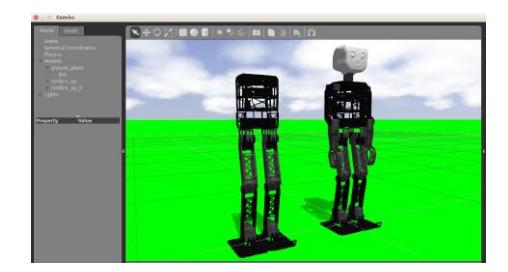
The work on automatic learning of bipedal motions mentioned in the previous section is using biologically inspired methods and concepts to solve bipedal walking locomotion for a NimbRo-OP robot (simulated model) by making use of a genetic algorithm that evolves both the structure and connection weights of an artificial neural network controller. This controller receives stimuli from the robot sensors and servomotors as inputs and generates signals that control the servomotors on the legs of the robot as outputs. A simulator and physics engine will be used to provide an risk-free environment with appropriate physical restrictions (see Fig. 4) so the locomotion generated by the controllers is tested and evaluated to direct the evolution process.
6 Vision subsystem
Significant new challenges have been introduced to the competition that will require the development of better solutions in the vision subsystems of every robot participating in the RoboCup Humanoid League. The main challenges are: (1) to identify in real time a moving ball that can no longer be assumed to be of a uniform color, and (2) to identify goals of uniform white color.
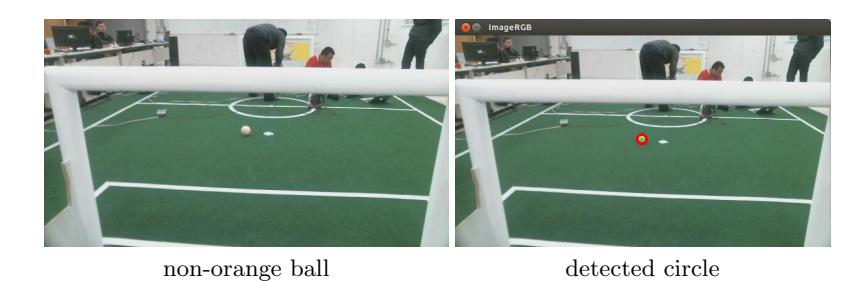
Our team has been discussing several possible solutions to these problems. For the first one: to identify a ball that can only be assumed to be round and with a minimum of 50% white, we are trying a combination of techniques that start by applying color segmentation and selecting all non-green objects that are surrounded by green. Morphological filters are applied to remove spurious objects and to fill holes in real objects. By doing this we expect to have a list of objects within the field. In order to differentiate the ball from the rest of the objects we plan to search for circular shape either using Hu moments or a Hough transform. This approach will work as long as the ball is completely surrounded by green in the scene. When the ball is being touched by a robot the Hu moment of the segmented object will not correspond to a circle, so a combination with other approaches will be necessary. Figure 5 shows preliminary results using the described approach in combination with function HoughCircles from OpenCV. It remains to be seen whether this approach can be applied in real-time at an acceptable frame rate (at least 15 fps) and whether this is a robust solution.
7 Conclusion and Future Work
We have outlined several of the new hardware and software developments within Team Mexico robots that have been implemented, and are in the process of being tested in preparation for the RoboCup 2015 World Championship. In particular, we have presented preliminary results on the implementation of the collaboration standard for heterogeneous humanoid robot architectures, the upgrades to the vision sub-system to solve new challenges in the league, and several hardware redesigns in some of the robot architectures.
Acknowledgements
This project is supported in part by CONACyT, the Federaci´on Mexicana de Rob´otica and the Red Nacional de Rob´otica y Mecatr´onica.
References
- Aceves-L´opez, A., Cruz-Hern´andez, E., Villarreal-Pulido, G., Sumohano-Verdeja, S.: Bogobots humanoid team 2008 (kid size). In: RoboCup World Championship, Suzhou, China, RoboCup Federation (July 2008)
- Cruz-Hern´andez, E., Villarreal-Pulido, G., Sumohano-Verdeja, S., Aceves-L´opez, A.: Bogobots-TecMTY humanoid kid-size team 2009. In: RoboCup World Championship, Graz, Austria, RoboCup Federation (July 2009)
- Villarreal-Pulido, G., Cruz-Hern´andez, E., Aceves-L´opez, A.: Bogobots-TecMTY humanoid kid-size team 2010. In: RoboCup World Championship, Singapore, RoboCup Federation (June 2010)
- Villarreal-Pulido, G., Cruz-Hern´andez, E., Aceves-L´opez, A.: Bogobots-TecMTY humanoid Kid-Size Team 2012. In: RoboCup World Championship, Singapore, RoboCup Federation (June 2012)
- Gonz´alez-N´u˜nez, Aceves-L´opez, A., Ram´ırez-Sosa: Control para el seguimiento de trayectoria de movimiento de un b´ıpedo con fase: pie de soporte, pie en movimiento. In: Primer Encuentro Internacional de Investigaci´on Cient´ıfica Multidisciplinaria ICM2007, Chihuahua, ITESM (2007)
- Gonz´alez-N´u˜nez, Aceves-L´opez, A., Ram´ırez-Sosa: An´alisis cinem´atico de un b´ıpedo con fases: Pie de soporte-pie en movimiento. In: IEEE 5º Congreso Internacional en Innovaci´on y Desarrollo Tecnol´ogico, Cuernavaca, Morelos, M´exico, CIINDET (October 2007)
- Mel´endez, A., Aceves-L´opez, A.: Human gait cycle analysis for the improvement of MAYRA's biped foot. In: 37 Congreso de Investigaci´on y Desarrollo del Tecnol´ogico de Monterrey, M´exico, ITESM (January 2007) 60–67
- Barrera-Tovar, L., Aceves-L´opez, A.: Clasificador de color y segmentaci´on para el sistema de percepci´on de los robots bogobots. In: XII Congreso Mexicano de Rob´otica, Mazatl´an, Sinaloa, M´exico, Asociaci´on Mexicana de Rob´otica (November 2010) 124–129
- Barrera-Tovar, L., Aceves-L´opez, A.: Interpretaci´on de la escena y auto localizaci´on v´ıa triangulaci´on de los robots bogobots. In: XII Congreso Mexicano de Rob´otica, Mazatl´an, Sinaloa, M´exico, Asociaci´on Mexicana de Rob´otica (November 2010) 136–142
- Llarena, A., Escalante, B., Torres, L., Abad, V., V´azquez, L.: Virbot@field : taking service robots to play soccer. In: RoboCup World Championship, Graz, Austria, RoboCup Federation (July 2009)
- Llarena, A., Escalante, B., Ar´ambula, F., V´azquez, L.: Virbot@field : taking service robots to play soccer. In: RoboCup World Championship, Istanbul, Turkey, RoboCup Federation (July 2011)
- Savage, J., Llarena, A., Carrera, G., Cuellar, S., Esparza, D., Minami, Y., Pe˜nuelas, U.: ViRbot: A System for the Operation of Mobile Robots. In: RoboCup Symposium, Atlanta, USA, RoboCup Federation (June 2007)
- Lupi´an, L.F., Romay, A.I., Monroy, P., Esp´ınola, A.F., Cisneros, R., Ben´ıtez, F.: Cyberlords RoboCup 2009 Humanoid KidSize team description paper. In: RoboCup World Championship, Graz, Austria, RoboCup Federation (July 2009)
- Lupi´an, L.F., Romay, A., Esp´ınola, A., Cisneros, R., Ibarra, J.M., Guti´errez, D., Hunter, M., del Valle, C., de la Loza, K.: Cyberlords RoboCup 2010 Humanoid KidSize team description paper. In: RoboCup World Championship, Singapore, RoboCup Federation (June 2010)
- Lupi´an, L.F., Romay, A., Esp´ınola, A., Ram´ırez, E.: Cyberlords RoboCup 2011 Humanoid KidSize team description paper. In: RoboCup World Championship, Istanbul, Turkey, RoboCup Federation (July 2011)
- Lupi´an, L.F., Romay, A., Esp´ınola, A., M´arquez, D., Reyes, D.M.: Cyberlords+Falconbots RoboCup 2012 Humanoid KidSize team description paper. In: RoboCup World Championship, Mexico City, Mexico, RoboCup Federation (June 2012)
- Lupi´an, L.F., M´arquez, D., Nelson, O., Lecumberri, F., Sanz, I.: Cyberlords RoboCup 2013 Humanoid KidSize team description paper. In: RoboCup World Championship, Eindhoven, The Netherlands, RoboCup Federation (June 2013)
- Lupi´an, L.F., Romay, A., Esp´ınola, A.: Vision Based Localization of Humanoid Robots by Inverse Pose-Estimation Using a Small Set of Fixed Landmark Features. In: Robotic Symposium, IEEE Latin American, Bogot´a, Colombia (October 2011)
- Romay Tovar, A.I.: Visi´on computacional para problemas de estimaci´on de pose. Master's thesis, Universidad La Salle, D.F., M´exico (2011)
- Esp´ınola Auada, A.F.: Sistema de visi´on de un robot humanoide en un ambiente semi estructurado. Master's thesis, Universidad Nacional Aut´onoma de M´exico, D.F., M´exico (2011)
- Schwarz, M., Pastrana, J., Allgeuer, P., Schreiber, M., Schueller, S., Missura, M., Behnke, S.: Humanoid teensize open platform nimbro-op. In: 17th RoboCup International Symposium, Eindhoven, Netherlands, RoboCup Federation (June 2013)
- Schwarz, M., Schreiber, M., Schueller, S., Missura, M., Behnke, S.: Nimbro-op humanoid teensize open platform. In: 7th Workshop on Humanoid Soccer Robots, Osaka, IEEE-RAS International Conference on Humanoid Robots (November 2013)
- Lupi´an, L.F., Savage, J., Aceves-L´opez, A.: Team Mexico RoboCup 2014 Humanoid KidSize team description paper. In: RoboCup World Championship, Jo˜ao Pessoa, Brazil, RoboCup Federation (July 2014)
- Team Mexico: Qualification video for RoboCup 2015. Electronic publication: http://youtu.be/qcCdbq3hmdQ visited 2015/02/08