Application from Hamburg Bit-Bots for RoboCup 2016
Marc Bestmann, Juliane Bödeker, Fabian Fiedler, Timon Giese, Judith Hartfill, Marcel Hellwig, Maxim Holand, Jessica Jobski, Wiebke Koll, Amrei Mueller, Maike Paetzel, Martin Poppinga, Dennis Reher, Bente Reichardt, Robin Riebesehl, Nils Rokita, Robert Schmidt, Oliver Sengpiel, Daniel Speck, Lars Thoms, Felix Wiedemann
Department of Informatics, Universität Hamburg, Vogt-Kölln-Straße 30, 22527 Hamburg, Germany
www.rohow.de/en/ · http://data.bit-bots.de/CodeReleaseHamburgBitBots2015.tar.gz · https://github.com/bit-bots/hambot · http://data.bit-bots.de/applications/application2016.mp4 · http://www.bit-bots.de
Abstract This Team Description Paper describes the humanoid robot team Hamburg Bit-Bots, from its history over currently used software and hardware to the research interests and achievements in RoboCup. We currently focus our development on hardware to have robots capable of playing on artificial turf. Therefore, we enhanced our open-source platform Hambot and developed a second one named Minibot (cf. Chapter 4). We especially research hardware features for the robots, like different types of joints or pressure sensors for the feet (cf. Chapter 2).
1 Introduction
The team Hamburg Bit-Bots consists of students from the Department of Informatics at the University of Hamburg, Germany. The team is financially supported by the University of Hamburg and its Department of Informatics. Apart from that Hamburg Bit-Bots are an independent work group led and organized solely by students.
1.1 Prior performance in RoboCup
Since 2012 our team participated in the GermanOpen (2nd place in 2013, 3rd place in 2012 and 2014). Moreover, our participation in the WorldCup since 2012 allowed us to connect with other teams and gave us the possibility to show our latest developments in hardware and exchange research ideas with the international RoboCup community. In 2014 we participated in the IranOpen for the first time. Following this rewarding experience we participated in 2015 again and achieved a 3rd place.
1.2 Further dedication to RoboCup
We have many further projects to push interconnectedness between teams and support the accessibility of robotics and RoboCup to the general public. In 2014 we established close collaboration with another RoboCup Team from our home town which competes in the SPL. This gave us the opportunity to host the RoHOW¹ jointly with them in 2014 and 2015. We also organized this years RoHOW in Dresden, which was a satellite event of the German KI conference. Moreover, we participated in "Robots on Tour" in Zurich 2013, in the "Hamburg Night of Knowledge" and "Berlin Night of Knowledge". In cooperation with a school we created a yearly course in robotics for high school students which is very successful since 2013. Furthermore, in 2014, we started to provide practical lectures in robotics at our university which are highly attended by students.
2 Current Research
After our experiences during the German Open and World Championship in 2015, the focus of our research for 2016 was the development of hardware which can face the challenge of walking on artificial grass. With regard to the roadmap we shifted the focus from optimizing the Darwin OP in general to the development of larger robots.
2.1 Walking
With larger robots the complexity of estimating the effects of movements on the stability of the robot is increased. With pressure sensors in the feet and the IMU we assume to get sufficient feedback of the robot's stability. We currently research on an algorithm using this feedback to enhance the stability of the walking in combination with the currently used ZMP algorithm. We want to do this by automatically learning the effects of the ZMP Walking rather than approximating them.
2.2 Construction of new feet
In contrast to human feet robot's feet in the HKSL are flat and stiff. The sole of human feet has a structure so that only some parts touch the ground and other parts do not. This renders the standing more stable. Human feet are also flexible in themselves which helps to adapt to the surface a foot is standing on. We'd like to develop more human-like feet to stabilize our walking on artificial turf.
2.3 Joints, muscles and tendons
While the human body contains a hard skeleton and a lot of muscles that are used to move the skeleton, the construction of our robots is different. The motors work as muscles and are a part of the robot's skeleton. This causes much pressure on the motors. Therefore we try to add ribbons with motors working like muscles and tendons similar to the human joints. We hope that the pressure on our motors will decrease and the joints themselves will become smaller without losing any degree of freedom. A bachelors thesis[1] about this topic has been written by one of our team members but it showed that its difficult to determine the strain on the tendons and therefore it is not yet applicable for humanoid robots.
3 Hardware
(section heading only)
3.1 Mechanical structure
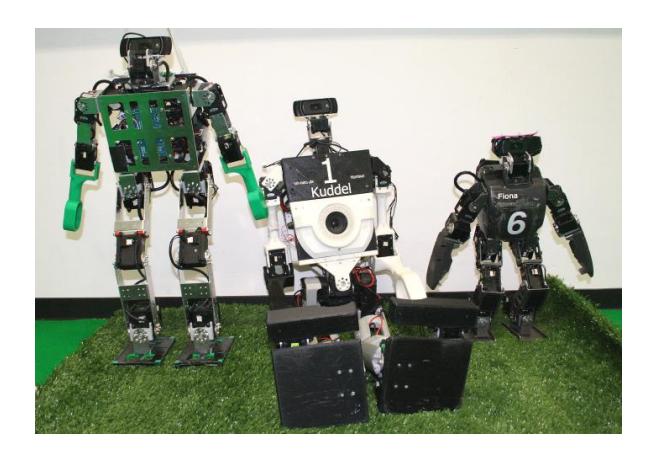
For RoboCup 2012 and 2013 a standard Darwin-OP robot was used by our team. Learning from the flaws in the Darwin-OP, a modified Darwin-OP was used for the RoboCup 2014 competition. The main change was the new head construction, which provides a better camera protection and more reliable image data.
In addition, the team worked on a new robot platform named GOAL, which is a 24 DOF robot and was brought for inspection to the RoboCup 2014, but was not used during the competitions because of software issues. Main differences to the Darwin-OP robot are the increased height of 86 cm, pitch and roll servos for the torso and a yaw servo for the shoulder to provide more human-like movement.
In 2015 the project was renamed to Hambot and due to the new possibility of 3D printing at our university we were able to completely build two Hambot robots as well as produce spare parts ourselves. The project is open source and can be found at GitHub [8]. As it turned out walking was yet difficult for the rather heavy Hambot robots, the smaller platform Minibot could be developed in a rather short time due to the experience with the Hambot platform. Minibot is not only smaller than Hambot, but it has also a very similar kinematic to the Darwins and is therefore able to walk with the old Darwin walking.
3.2 The modified Darwin-OP
The Darwin-OP robot has the following electronic components:
- Actuators: The Robotis Dynamixel MX-28 servos have Hall sensors to measure the position of the joint and measurement of voltage, current and the temperature inside the servo.
- IMU: The CM 730 board provides a 3 axis accelerometer and a 3 axis gyroscope that is used for the stabilization of the robot.
- Camera: The robot is equipped with a "Logitech HD Pro Webcam B910". A resolution of 800x600 is used at 20 frames per second.
- Computer: The main computing board is a "Fit Pc 2i", providing a singlecore Intel Atom process which runs at 1.6 Ghz. The subcontroller is the CM730 board by Robotis.
3.3 Hambot
Hambot has the following electronic components:
- Actuators: The Robotis Dynamixel MX-28, MX-64 and MX-106 servos have Hall sensors to measure the position of the joint and measurement of voltage, current and the temperature inside the servo.
- IMU: Hambot has 2 MPU6050 chips with 3 axis gyroscope and accelerometer per chip. It has more accuracy than the one built in the Darwin-OP robot and enhances the stability of the robot.
- Camera: The robot is equipped with a "Logitech HD Pro Webcam B910". A resolution of 800x600 is used at 20 frames per second.
- Computer: The main computing board is an Odroid XU3 Lite, with an ARM octacore processor. The subcontroller is a selfmade board with three independent buses for the servo communication and a direct UART communication between the ARM Cortex M4 and the Odroid board.
3.4 Minibot
Minibot has the following electronic components:
- Actuators: The Robotis Dynamixel MX-28, MX-64 and MX-106 servos have hall sensors to measure the position of the joint and measurement of voltage, current and the temperature inside the servo.
- IMU: The CM 730 board provides a 3 axis accelerometer and a 3 axis gyroscope that is used for the robots stabilization.
- Camera: The robot is equipped with a "Logitech HD Pro Webcam B910". A resolution of 800x600 is used at 20 frames per second.
- Computer: The main computing board is an Odroid XU3 Lite, with an ARM octacore processor. The subcontroller is the CM730 board by Robotis.
4 Software
(section heading only)
4.1 General Architecture
Our software framework (released, [7]) is split into two main parts: a cognition part for the behaviour and a motion part. The cognition part consists of a decision making behaviour which is described below and a set of basic modules which perform the preprocessing and the calculations required by the behaviour. Among other things this set of basic modules contains the vision, team communication and localization as described below. The motion part is a complex state machine acting as a service for the behaviour and can take commands for animations, positioning of motors and furthermore encapsulates the walking algorithm. We use Python for high level programming of behaviour and Cython as well as C++ for low level sensor/motor control and optimized implementations of algorithms.
4.2 Team communication
For team communication we use a shared protocol with other teams. The so called mitecom library was developed by the FUmanoids and is used in drop-ingames at the Worldcup and local events. For example we played successfully in demo-games together with the "Bold-Hearts" in WorldCup 2014 in Brazil and IranOpen in Tehran. Information received by the team communication is mainly used in decision-making processes.
4.3 Localization
In the last seasons we were working on different approaches for the localization to adapt to the new difficulties. Especially because of the goals being white now and the often hardly recognizable field markings caused by the artificial grass, we are working on a more robust approach. Our Monte-Carlo-Localization/ particlefilter based approach uses a variety of features from the field. We are also trying to adapt SLAM-like approaches for landmarks outside the field and using the team communication for further improvement. Thus, we try to further improve the result-based techniques like a Rat-SLAM based approach we used before [4].
4.4 Behaviour
Currently we are using a self written behaviour framework based on hierarchical state machines and decision trees. For the decision-making we are using information obtained from several other modules, such as vision and team communication, on a blackboard. We communicate abstract movement tasks like walking slowly forward or performing a kick in the same way.
In our behaviour tree we start with more general decisions like determining which role the robot has to perform. We distinguish three different roles: goalkeeper, defender and striker. Finished decisions are pushed on a stack and, if needed, registered for occasionally recomputing. Decisions deeper in the tree are more on a task level, e.g. attack and stay away. The leaves of the tree perform certain tasks, e.g. going to the ball.
For pathfinding and aligning to the ball we use an offline trained neural network based on ball and goal positions [5].
4.5 Vision
Camera setup: The image processing is independent from the image sources due to our modularized vision framework. The images can either be retrieved from the webcam or an alternative source like the simulator or recorded images. We implemented converters to be able to use several image formats like YUYV, RGB and BGR.
Colour detection: A subset of the pixels are assigned to one or more categories. This is done via lookup tables. Currently we use this technique to classify white pixels, turf, obstacles and team markers. The green of the turf is adapted during runtime because it highly depends on the angle at which we look at the field.
Vision basis: Our image processing is based on randomly pre-generated point clouds. The point clouds differ in density functions of the pixels, so that we can choose the area of highest considered pixel density depending on an image. This makes it easier to recognize small objects like the ball even when it is far away and reduces the number of pixels representing near objects.
Field contours: Due to the carpet being green we assume green to be the most represented colour. This assumption is utilized for determining the field's contours. Any feature detected outside this contour can be ignored. We use vertical scan lines to calculate a convex hull of the field contour. Furthermore we are able to feed additional information into the vision framework based on knowledge of the camera position when taking an image. Therefore the number of considered pixels is reduced if the corresponding areas do not belong to any feature on the field.
Object recognition: For the object recognition we use colour separation. Considering only pixels of a given colour we perform shape recognition to extract the ball, the goal or the field lines. To detect huge obstacles we look for dents in the horizon line.
Test data: To further improve our algorithms we need the ability to simulate or replay realistic boundary conditions. Because a simulated environment is not always lifelike, we implemented a mode in which the robot can record images as well as kinematic information for the triangulation of positions on the filed and localization of the horizon. For quick tests which don't need kinematic information, the vision can be run with graphical output on a laptop.
4.6 Code from other teams
Right now our code base is fully written by members or former members of our team. We include a cross-team developed C communication libary named mitecom which is also used by many other teams. Our walking is heavily influenced by the Team DARwIn.
5 Publications
(section heading only)
Design and Control of Biologically Inspired Joints
In this thesis a biologically inspired joint operating with tendons and the controlling of such with neural networks is developed. Joints operated by tendons have some advantages over motors directly in the joint, e.g. the elastic properties of the joint can protect the motor from the forces if the robot falls down.[1]
Development of a user-interface for realtime editing of robot animations
This work covers the design and implementation of a user-friendly application to generate and edit static robot-animations (or motions) in realtime directly on a robot via an arbitrary text-terminal.[2]
Hambot: An Open Source Robot for RoboCup Soccer
In this paper we present our newly developed soccer robot platform Hambot. Hambot can be produced entirely using 3D-printing. [9]
Development of a stable robot walking algorithm using center-ofgravity control
Bachelor thesis of the implementation of a walking algorithm, which is based on capture steps, as described in [10]. This thesis concludes, that the capture steps are not applicable for our robot hardware [3]. In this context, we also improved our inverse kinematics, which is conceptually inspired by the FUmanoids.
Estimation of optical-flow fields in multispectral images
Bachelor thesis in which an algorithm was developed to robustly estimate the optical-flow in an image sequence using additional information provided by color gradients [6]. The algorithm can be used for better tracking of the ball once it is located.
6 Statements
(section heading only)
Participate
We assure to participate in the RoboCup 2016 Humanoid League.
Referee
We further assure that we have a person with sufficient knowledge of the rules and that this person will be available as referee during the competition.
7 Video & website
The following resources provide access to our team application video for the tournament: http://data.bit-bots.de/applications/application2016.mp4 . Further material can be found at our offical homepage: http://www.bit-bots.de.
8 Conclusion
We gained a lot of experience during the last RoboCup seasons and are working hard on improving our hardware and software for the upcoming years. Furthermore we started many cooperations with other teams participating in our league. We consider the possibility of developing custom platforms one of the most exciting aspects of our league. Hence we recently invested a lot of time and resources into hardware development.
We are looking forward to see how our robots compete at this year's WorldCup in Germany, which is also another opportunity to exchange our experiences with other students and researchers from all over the world and improve our cooperation with other teams as well as contribute to the success of humanoid robotics. We sincerely hope to again become part of this great event.
References
- Rokita, N.; Design and Control of Biologically Inspired Joints. Bachelor thesis, Universität Hamburg, Department of Informatics, Germany (2015)
- Giese, Timon.: Development of a user-interface for realtime editing of robot animations. Bachelor thesis, Universität Hamburg, Department of Informatics, Germany (2015)
- Schmidt, R.: Development of a stable robot walking algorithm using center-ofgravity control. Bachelor thesis, Universität Hamburg, Department of Informatics, Germany (2015)
- Bestmann, M.: Biologically Inspired Localization On Humanoid Soccer Playing Robots. Bachelor thesis, Universität Hamburg, Department of Informatics, Germany (2014)
- Poppinga, M.: Intelligente Wegfindung humanoider Roboter am Beispiel des RoboCup. Bachelor thesis, Universität Hamburg, Department of Informatics, Germany (2014)
- Bestmann, O.: Konzeption und Implementierung eines Verfahrens zur Messung von Verschiebungsvektoren in Multispektralbildern. Bachelor thesis, Universität Hamburg, Department of Informatics, Germany (2012)
- Hamburg Bit-Bots. Hamburg Bit-Bots Coderelease 2015. Available online at: http://data.bit-bots.de/CodeReleaseHamburgBitBots2015.tar.gz
- The mechanical parts of the open source robot Hambot are available at https://github.com/bit-bots/hambot
- Marc Bestmann, Bente Reichardt, Florens Wasserfall. Hambot: An open source robot for robocup soccer. 19'th RoboCup international Symposium, Hefei, 2015
- Marcell Missura and Sven Behnke. Balanced walking with capture steps. 18'th RoboCup international Symposium, Joao Pessoa, 2014