Robo-Erectus Jr-2016 KidSize Team Description Paper
Buck Sin Ng, Mabel Koh, Carlos A. Acosta Calderon, Changjiu Zhou
Advanced Robotics and Intelligent Control Centre, Singapore Polytechnic, 500 Dover Road, 139651, Singapore
Abstract This paper provides the team description of Robo-Erectus Junior (REJr) that is set to participate in the Humanoid League KidSize Soccer Competition of Robocup 2016. REJr are a series of KidSize humanoid developed in the Advanced Robotics and Intelligent Control Centre (ARICC) of Singapore Polytechnic (SP). The latest version of the REJr humanoids are the Bv-MkIII+ and Bv-MkIV.
1 Introduction
Biped locomotion research and development work started in Singapore Polytechnic (SP) in 1996. Since then, SP has been active in the field of biped research and development. In 2002, the work was extended to the humanoid robot with the establishment of the Robo-Erectus project (www.robo-erectus.org) in the Advanced Robotics and Intelligent Control Centre. The aim of the project is to develop a humanoid platform that can be used for research and education [1].
Team performance since 2002
| Competition Category | Result |
|---|---|
| RoboCup 2002 Humanoid Walk | 2nd Place |
| RoboCup 2003 Humanoid Free Style | 1st Place |
| RoboCup 2004 Humanoid Walk | 2nd Place |
| RoboCup 2004 Humanoid Free Style | 2nd Place |
| RoboCup 2004 Humanoid Kick H40 | 2nd Place |
| RoboCup 2004 Humanoid Kick H80 | 2nd Place |
| RoboCup 2007 Humanoid TeenSize | 4th Place |
| RoboCup 2008 Humanoid TeenSize | 4th Place |
| RoboCup 2010 Humanoid AdultSize | 2nd Place |
| RoboCup 2011 Humanoid AdultSize | 2nd Place |
| RoboCup 2015 Humanoid KidSize Tech. Challenge | 4th Place |
2 Overview
In this section, an overview of the REJr robot is presented. As majority of the improvement to the robot this year pertains to the software, the hardware is only briefly described. More details of the robot's hardware are available from previous year team description papers [2].
2.1 Hardware Design
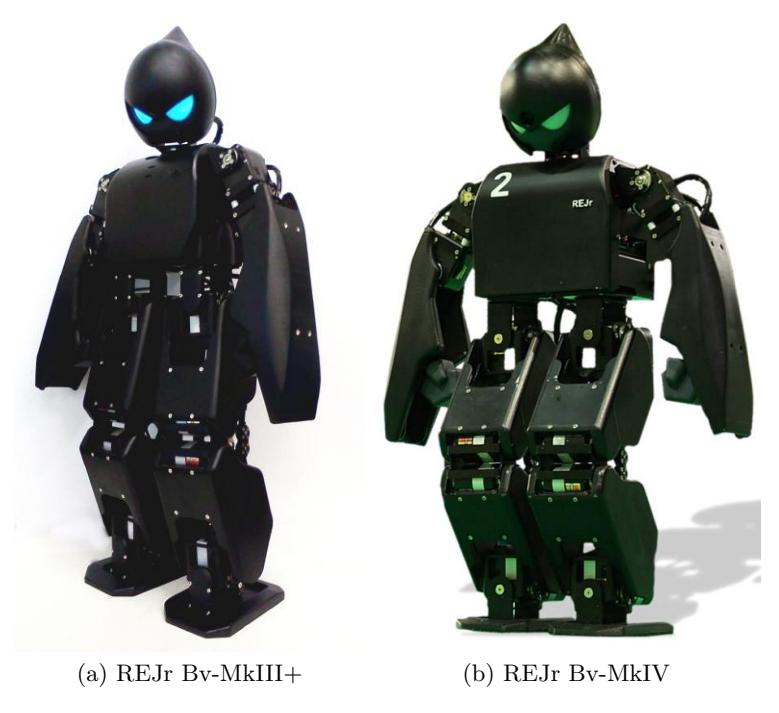
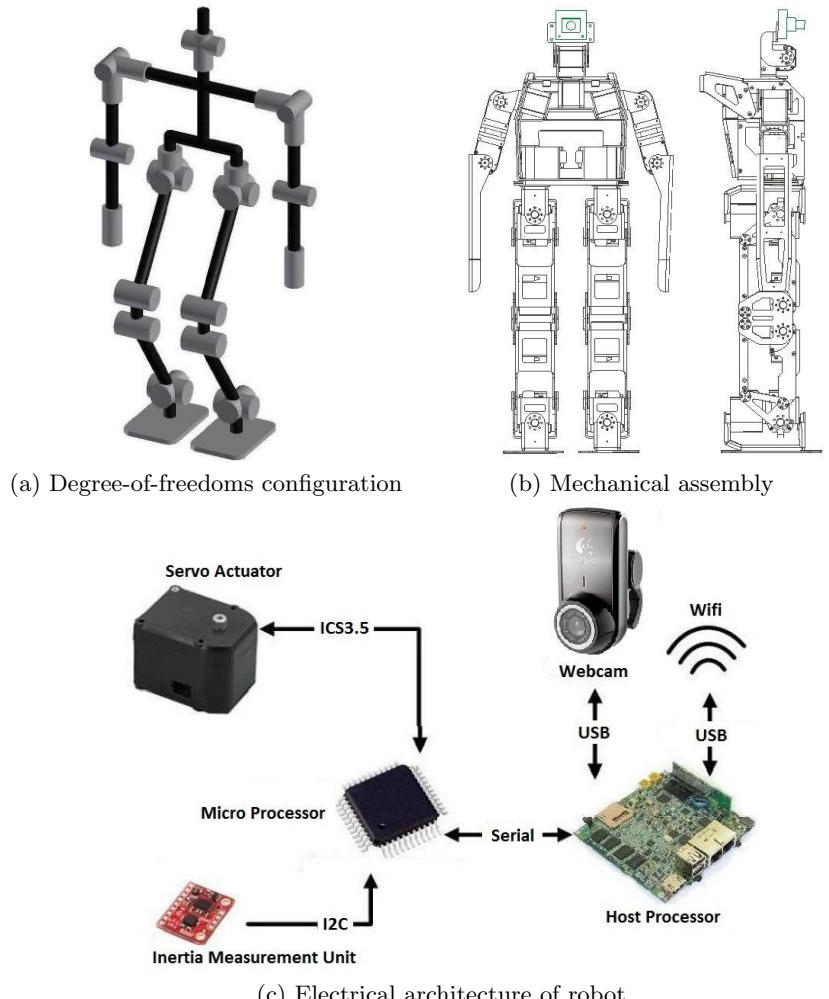
The team will be adopting the same robot from last year's competition. Figure 1 shows the current version of the REJr humanoids for the competition; Bv-MkIII+ and Bv-MkIV. Figure 2 shows the mechanical and electrical hardware of the robot. Detail specifications of the robot is available from the robot's specification papers.
2.2 Software Specifications
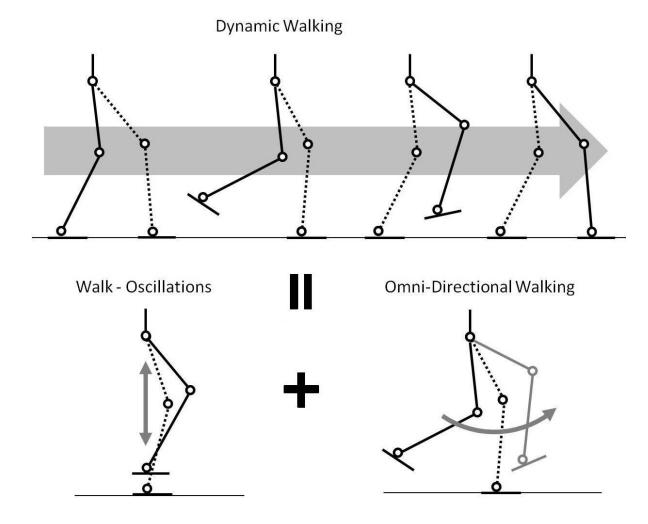
Locomotion Control REJr adopts a decoupling approach for dynamic walking gait generation(Fig.3) based on the Zero-Moment Point(ZMP) using the inverted pendulum model[3]. The dynamic walk is decoupled into lateral walk-oscillations and omni-directional walking gait generation to reduce the complexity in implementation. A ZMP preview controller[4] is implemented to further enhanced the robustness of the walking gait on artificial grass.
Image Processing Image processing is achieved using edge detection and the YUV colour space on REJr. Scan lines are used to minimize computation time and to generate window of interest for in-depth processing. Postulation of the ball, goals, field lines and junctions are determine from the generated window of interest.
Localization As per previous year, the Monte Carlo localization is adopted to determine the position and orientation of the robot on the field. The particle filter utilizes key landmarks such as field lines, line junctions and goals. Orientation of the robot with respect to the home or opponent goal is determined using a complementary system that infuses data from the gyroscope and vision.
Behaviour Control The function of the humanoid in autonomous mode is supported by a framework of hierarchical reactive behaviours. Three layers:skill, reactive and planning[5] determine the control of the behaviours of the robot. Restriction placed on the interactions between the system variables by the framework reduces the complexity in the behaviour control for optimum performance.
3 Major Improvements
In this section, the major improvements made to REJr are described. The improvements are built upon or extension of accomplished work presented in Section 2.
3.1 Gait Generation
The introduction of the artificial grass play field was a key challenge to many teams in last year competition. Although, REJr was able to omni-walk, the robot was not able to attain its' top walking speed as the artificial grass was softer than expected.
This year, the work[3] using compliant joint sensing in the knee for ground reaction force estimation and foot landing in REJr is extended. Based on [6], an adaptive foot and ground contact model is implemented to alter the walking speed without changes to the gait pattern for adapting to different stiffness properties(softness) walk surfaces.
3.2 Image Processing
Despite the introduction of the new rules for RoboCup 2015, REJr mainly relies on colour for image processing in last year competition. Primarily, the use of colours is still computation efficient and inexpensive. However, reliability and effectiveness is subjective to conditions of the environment.
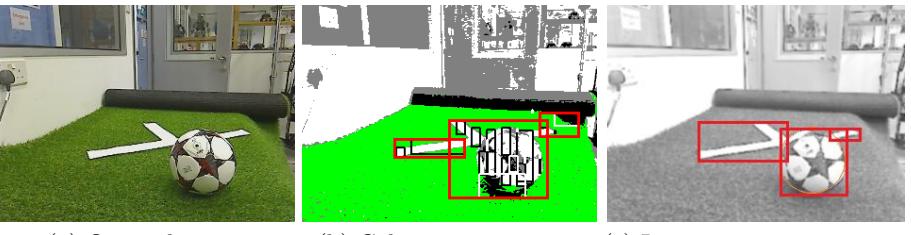
For RoboCup 2016, REJr adopts an improved image processing algorithm to reduce the reliance on colours. Gaussian blur is applied to the image to reduce noise before segmentation. Blob segmentation is performed to generate window of interest based on luminance rather than colour as per previous implementation. This reduces blob splitting due to non-homogeneity and varying lighting (eg. shadow) of the object's colour; Figure 5 shows the difference in the window of interest generated using the two different approach. Edge detection performed in the window of interest is extended to colour and shape detection to increase the likelihood estimate of identifying the objects.
3.3 Game Play
One of the major issues the team faced in last year competition was the lack of game play. In particular, the inability to search for the ball in the large playing field of 9m x 6m. Each robot has a limited vision range of 2m and this often results in the lack of game play as the robots are unable to determine the ball position once the ball moves out of all robots' vision range.
Ball localization is implemented in REJr to address the problem in lack of game for this year competition. A simple rolling ball prediction model and particle filter is implemented to postulate the position of the ball based on the vision inputs from all the robots on the play field. Once the ball is missing, the robots will search and move towards the likely position of the ball determine by the ball localization algorithm.
4 Conclusion
In this paper, the team have presented the overview of the robot and highlighted the major improvements for this year competition. The team is currently focusing on the robot software and aims to put up a better performance for RoboCup 2016. For more detailed information about the Robo-Erectus, please refer to the team's website www.robo-erectus.org.
Acknowledgements
The authors would like to thank staff and students at the Advanced Robotics and Intelligent Control Centre (ARICC) and higher management of Singapore Polytechnic for their support in the development of our humanoid robots.
References
- C. Zhou and P.K. Yue. Robo-Erectus: A low cost autonomous humanoid soccer robot. Advanced Robotics, 18(7):717–720, 2004.
- Buck Sin Ng, Carlos A Acosta Calderon, and Changjiu Zhou. Robo-erectus jr-2015 kidsize team description paper. Robocup China, 2015.
- Buck Sin Ng. Biped gait generation for humanoid dynamic walk. National University of Singapore (Doctoral dissertation), 2013.
- Johannes Strom, George Slavov, and Eric Chown. Omnidirectional walking using zmp and preview control for the nao humanoid robot. In RoboCup 2009: robot soccer world cup XIII, pages 378–389. Springer, 2010.
- Carlos Antonio Acosta Calderon, Changjiu Zhou, Pik Kong Yue, Mike Wong, and Mohan Rajesh Elara. A distributed embedded control architecture for humanoid soccer robots. In Proc. of Advances in Climbing and Walking Robots, pages 487–496, Singapore, July 2007.
- Yu Okumura, Tetsuo Tawara, Ken Endo, Tkayuki Furuta, and Masaharu Shimizu. Realtime zmp compensation for biped walking robot using adaptive inertia force control. In Intelligent Robots and Systems, 2003.(IROS 2003). Proceedings. 2003 IEEE/RSJ International Conference on, volume 1, pages 335–339. IEEE, 2003.