Barelang FC Team Description Paper Humanoid Kid Size League of RoboCup 2017
Susanto, Hendawan Soebhakti, Eko Rudiawan, Riska Analia, Nur Rafia Dija, Hanjaya Mandala, Reno Saputra, Gobar Bethara Agung, Akhbar Ferdeansyah, Fadhlul Azmi, Karen Paulus
Department of Electronic Engineering Politeknik Negeri Batam
Abstract This paper presents the system overview of Barelang FC Humanoid Robot Soccer Politeknik Negeri Batam Team as representative of Indonesia to join the 2017 RoboCup Humanoid Kid Size competition in Nagoya, Japan. In this paper, the system architecture, mechanical design, and vision system will be discussed. We used the ball detection and recognition system in order to recognize and coordinate the position of white ball in the field.
Introduction
Barelang FC team was founded as humanoid robot soccer that able to play football since 2010. At first, the name was given to this team is Barelang 4.1 which has five members conducted by four students and one adviser. Since 2014, Barelang 4.1 has changed into Barelang FC and permanently used as a team name until now. This team already won many competitions held in Indonesia since 2010 which describes in section 1.2. Fortunately, in 2016 we won the national competition and represent Indonesia to join RoboCup 2017 in Nagoya, Japan.
Besides explaining the brief introduction of Barelang FC team, the robot system also will introduce in this paper. This paper consists of 6 sections. Section 1 describes a brief introduction of Barelang FC team while the system architecture of the robot will explain in section 2. The mechanical design of robot will present in section 3. In section 4, the vision system of robot will describe in short explanation. The last section will introduce the kinematics of robot and conclusion.
Team Member
- Hanjaya Mandala : team leader, also handle overall architecture system and vision programming.
- Gobar Bethara Agung : programmer of algorithm soccer strategy.
- Akhbar Ferdeansyah : mechanical designer of robot mechanical design.
- Reno Saputra : mechanical engineer of fabrication robot parts.
- Fadhlul Azmi : as electronic engineer of main controller and sub controller board.
- Karen Paulus : software developer of develop and research systems.
Achievements:
2011
- 3 rd place Humanoid Soccer Competition Sumatera Region 2011 in Batam.
- Best Algorithm Award 2016 in Batam.
- Best Strategy Award 2016 in Batam.
- 2 nd place Humanoid Soccer Competition National 2011 in Jogjakarta.
2012
- 1 st place Humanoid Soccer Competition Sumatera Region 2012 in Medan.
2013
- 1 st place Humanoid Soccer Competition Sumatera Region 2015 in Bandar Lampung.
2015
- 2 nd place Humanoid Soccer Competition Sumatera Region 2015 in Palembang.
2016
- 1 st place Humanoid Soccer Competition Sumatera Region 2016 in Pekanbaru.
- Favorite Team Award 2016 in Pekanbaru.
- 1 st place Humanoid Soccer Competition National 2016 in Surabaya.
- Best Innovation Award 2016 in Surabaya.
- Best Design Award 2016 in Surabaya.
- Best Strategy Award 2016 in Surabaya.
- Humanoid RoboSoccer Trophy (Indonesia) Awards.
- Delegate Indonesia to International Humanoid Kid Size Soccer Competition (RoboCup) in Nagoya, Japan on 22nd -28th July 2017 (next year)
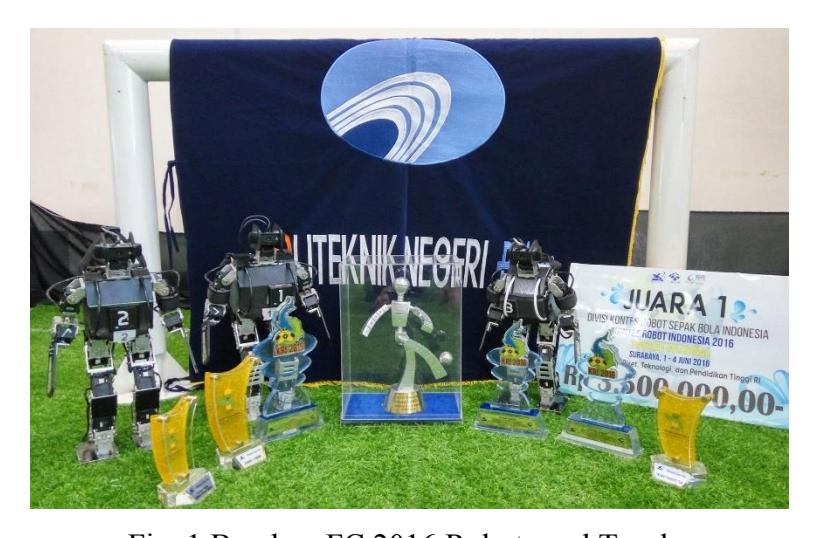
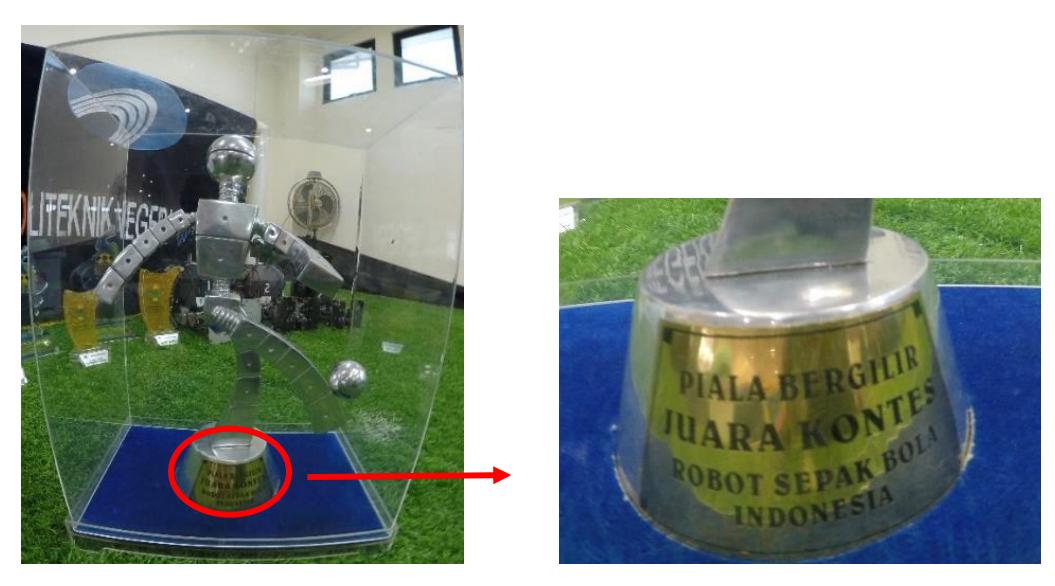
BarelangFC team has started their several of excellent achievement awards every year since 2011 until now, although in 2013 the team could not give any achievements because of some technical problem. However, in 2016 this team has proven the ability of humanoid robot with 7 trophies plus Humanoid Robot Soccer Trophy Awards. As the winner of 2016 Indonesia national event, BarelangFC will delegate Indonesia to compete with other countries in International RoboCup event in Nagoya, Japan (July 2017).
System Architecture
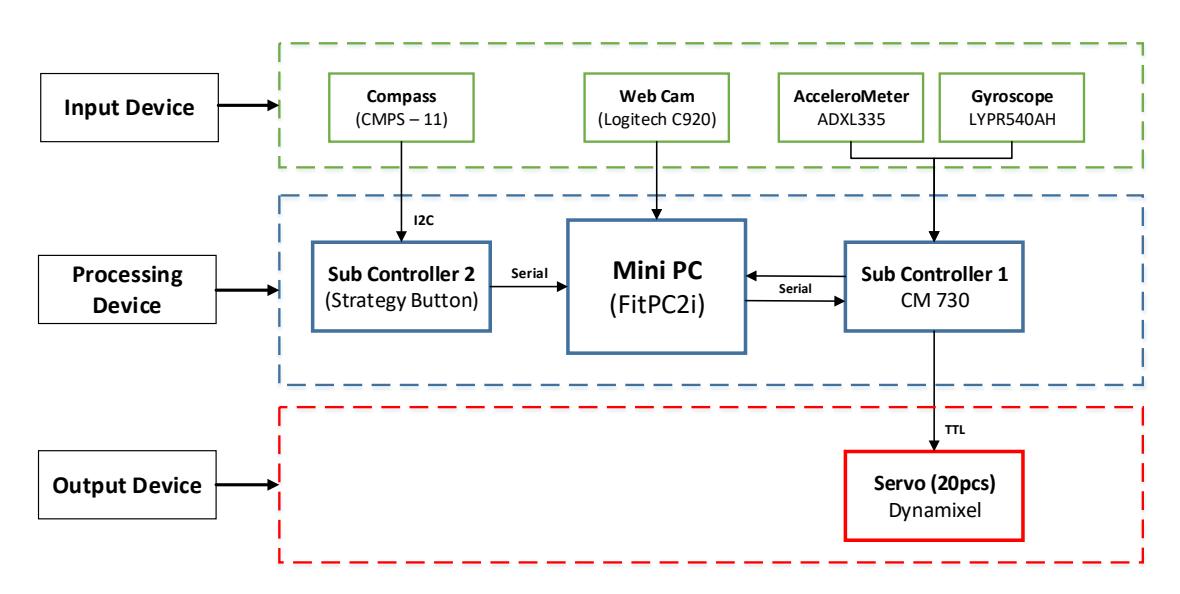
The architecture of the robot system divided into software and hardware part. Hardware system consists of some part which mounted in the body of robot. Fig. 3 illustrates the hardware system of robot which has input device, processing device and output device. All the sensors used to collect environment data while robot in action installed as input device. The sensors used in this system are compass, WebCam, Accelerometer, and Gyroscope. The processing device used the miniPC to control the data from input device and translate it to the output device to make the robot active and move depend on the command given by user. The output device consists of twenty servo motors to manipulate the robot movement.
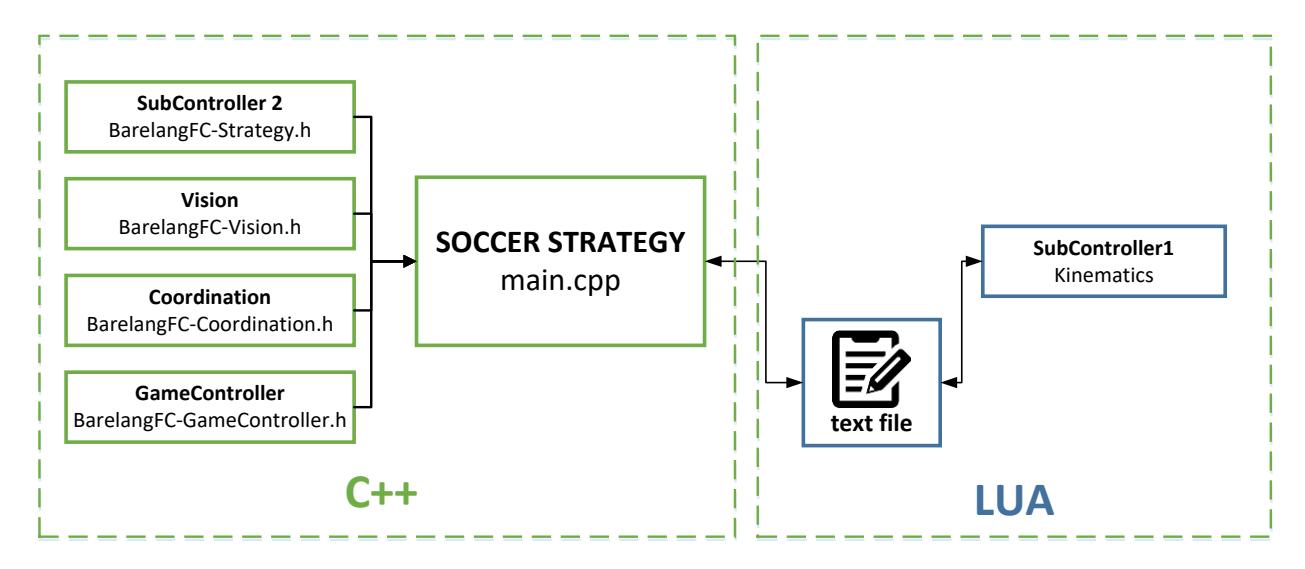
Fig. 4 show the software system applied in the robot system. This part will implement the robot strategy in order to see the ball, environment, and also the team opponent. The robot strategy was developed by getting all the data from sensors, vision, environment coordinate, and also the game controller. We used C++ programming to collect the data and control the robot strategy which runs parallel by using the multi-threading system. We also used the LUA programming language to control the kinematics of robot movement. All the collect data will transfer in the text file before distribute to all servo motors.
Mechanical Design
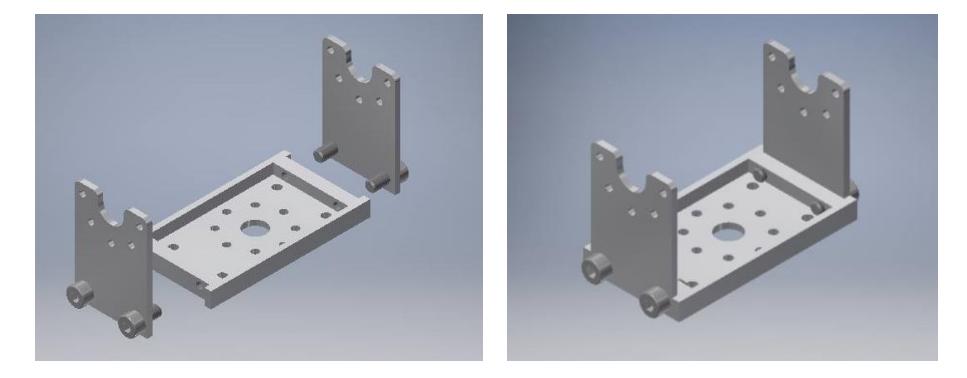
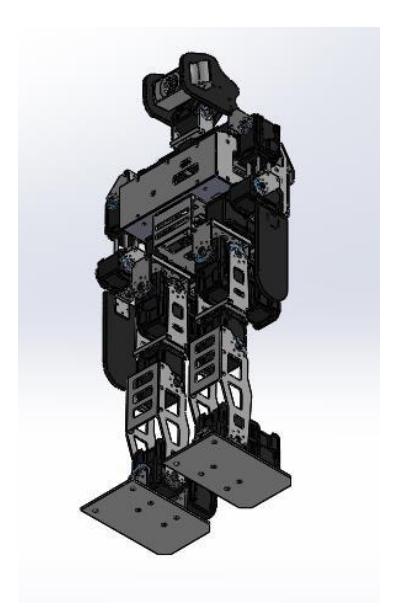
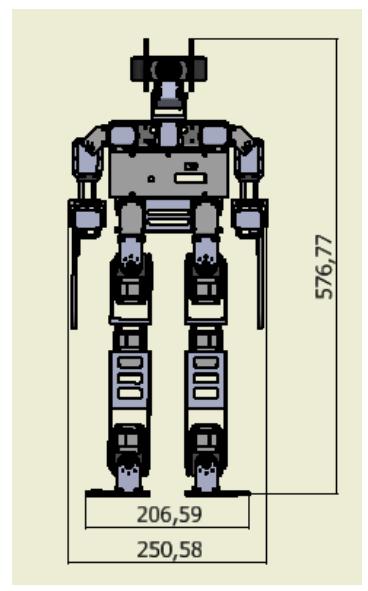
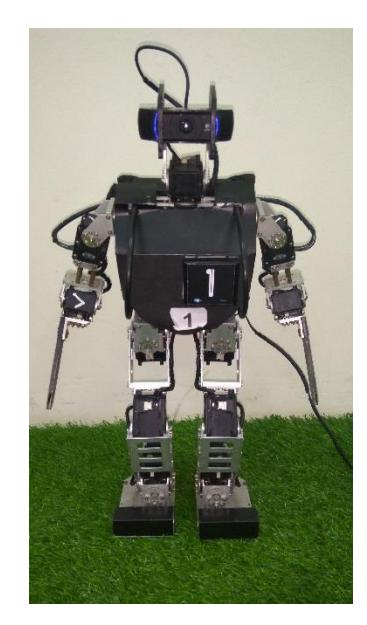
The based mechanical construction of Barelang FC robot soccer has three sided parts and bolts which used to assemble each side part of robot shown in Fig. 5. By separating each part of robot, it will gain more precision in manufacture the Barelang FC robot soccer. For the material of assembling the robot, we used aluminum 5052 with 2mm and 6mm thickness. Fig. 6 illustrates the final design of robot soccer with a height of 57 cm in total and 4.1 kg of weight. This robot has 20 degree of freedom (DOF) in each part such as 12 DOF in legs part, 2 DOF in neck part, and 6 DOF for right and left hand side.
Vision
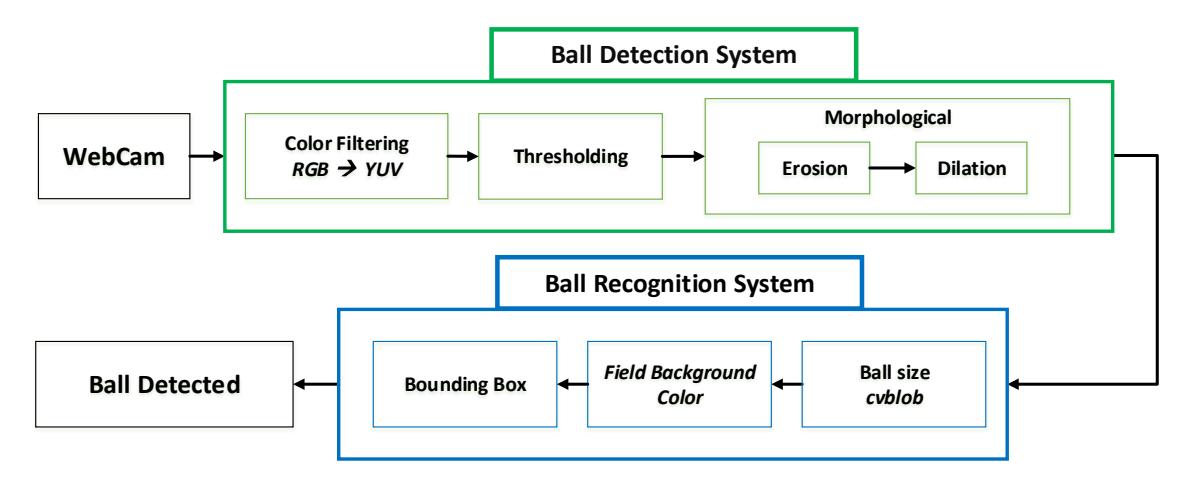
To detect the white ball in soccer filed we used the system which shows in Fig. 7. In this figure, the WebCam camera is used to detect the ball while the robot moves in the field to find the ball location. This system has two main parts such as ball detection and recognition system. In ball detection system can be explained as follow; when the webcam detects white ball, the system will transform the RGB data into YUV and then did the thresholding to get the morphological data before distribute it into ball recognition system. In ball recognition system, the former data coming from transformation data of ball detection system will convert into ball size, filed background and bounding box to detect the ball.
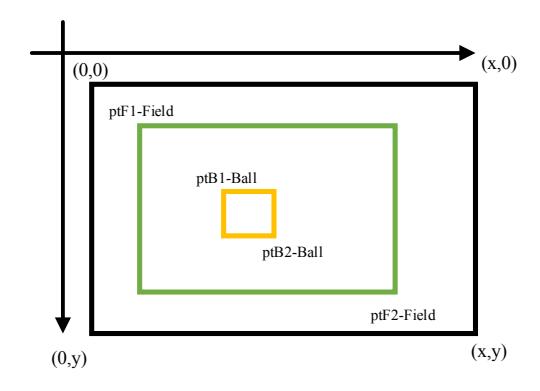
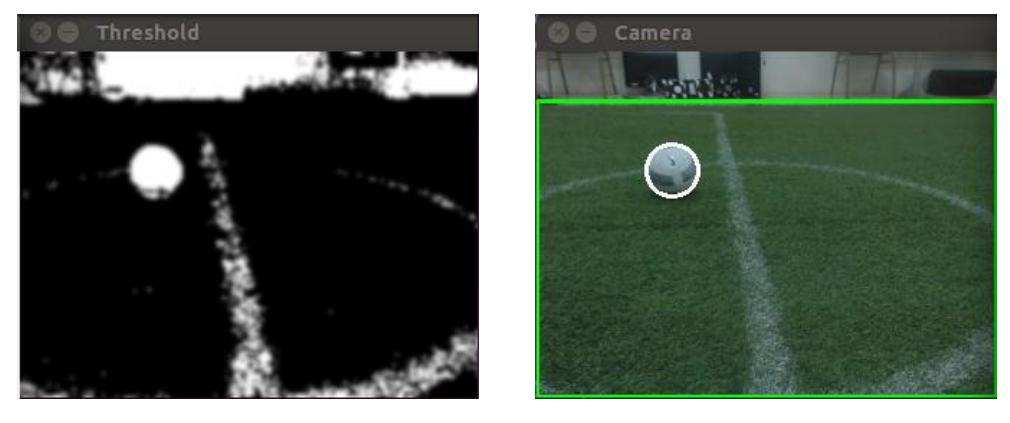
To recognize the white ball, the algorithm system of ball detection and recognition system should be developed based on camera coordinate of field object and ball. The result of camera coordinate can be seen in Fig. 8 which detects the position of the ball in the yellow square part. The result of white ball detection in the soccer field describe in Fig. 9.
Conclusion and Acknowledgments
By implementing all system which has explained in every section to Barelang FC, system performance of robot show a good impact in order to seek and recognize the white ball for the first entry to RoboCup 2017 (Humanoid Kid Size League) and support dynamically progress to RoboCup 2050 goal.
References
- Mandala, Hanjaya (2016). Sistem deteksi bola berdasarkan warna bola dan background warna lapangan pada robot Barelang FC. Surabaya: The 4th Symposium on Robot Soccer Competition.
- https://www.robocuphumanoid.org/, last accessed November 2016.