Falconbots Team Description Paper RoboCup 2017 NAGOYA, JAPAN
I.S.C. Julio Cesar Juarez Martinez, Mtra. Araceli Vivaldo Vicuña, Alberto Adán Sánchez Morales, Alejandro Vázquez García, Jorge Francisco Sánchez, Adolfo Altamirano Ortega, Luis Ángel Ramírez Reyes
Programa de Robótica y Mecánica del ITSSMT (PROMETEC), Technological Institute of San Martin Texmelucan, Camino a la barranca de pesos S/N, 74120 San Martin Texmelucan, Puebla, México
http://www.itssmt.edu.mx/Estudiantes/parp.html
Abstract This paper describes the research conducted at the ITSSMT robotics and mechanics laboratory in the area of humanoid robotics in preparation for the upcoming RoboCup in Nagoya Japan. The most important characteristics of the research and the characteristics of our robots are observed, as well as some reviews of the FALCONBOTS team's participation in 6 consecutive years within RoboCup. We present the most important features of our developed robots and those being investigated.
1 Introduction
ITSSMT. Falconbots Robotics Team is the name of the robotics team within the RoboCup organization, which comes from a word game between robot and hawk. This team is formed by students of different degrees, from which they are selected to participate in the team. The Falconbots team has a significant track record throughout RoboCup, participating for the first time in 2011 in Istanbul, Turkey, in 2012 in Mexico, in 2013 in the Netherlands, in 2014 in Brazil, in 2015 in China and in 2016 in Germany. The participation of the team has made an evolution over the years, with a new administration since 2015 and revolutionizing the way to generate robotics. The creation of our first prototype FALCONBOT ONE, prompted the creation of many other robotic devices dedicated to scientific research. Solving important challenges proposed by RoboCup Humanoide league, the first step was to walk on synthetic grass, which was also very stable. A predictive autobalance algorithm stabilizes the robot on uneven surfaces. For the first time, the problem of the 50% white balloon size 1 is attempted. Simple image segmentation algorithms are used in conjunction with a simplified version of the K-Means Clustering algorithm, and detection of circles by means of the NEWTON transform, obtaining An advantage over the detection of the ball, however, had problems in the participation with the first robot built 100% in the team FALCONBOTS ITSSMT. The creation of our second version, the FALCONBOT TWO, improved the team's participation in the competition, improving the detection of the ball and goalposts for orientation, as well as walking on artificial grass is much more stable. Throughout the year 2016 the third version of the Falconbots has been developed, being at the moment in the stage of machining and assembly, in order to improve the participation within the competition.
Commitment
The Falconbots team is committed to participate in the RoboCup 2016 in Leipzig, Germany and provide a knowledgeable arbiter of the rules of RoboCup humanoid league.
2 Mechanical structure
All versions of FALCONBOTS, are built on aluminum 5052 H32, with a thickness of 2.32 mm, and chemically treated for greater strength. We used 3D and CNC technology for the machining of each of the pieces, being able to build our own robots. At the PROMETEC ITSSMT research center, different robotic prototypes are being built for research and are developed entirely at the research center.
The mechanical structure of the FALCONBOTS versions are based on the typical structure of 20 degrees of freedom, two on the head, three on each arm and five on each leg. Improving in each version the torque or torque in the engines and reestablishing the dynamic and kinematic calculations, causing an increase in the size of the robot.
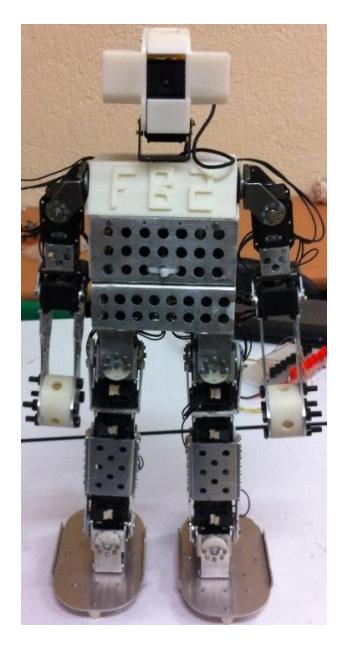
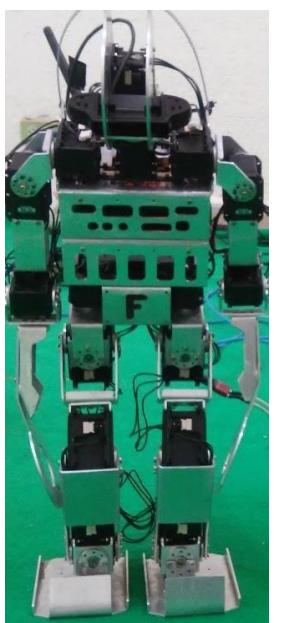
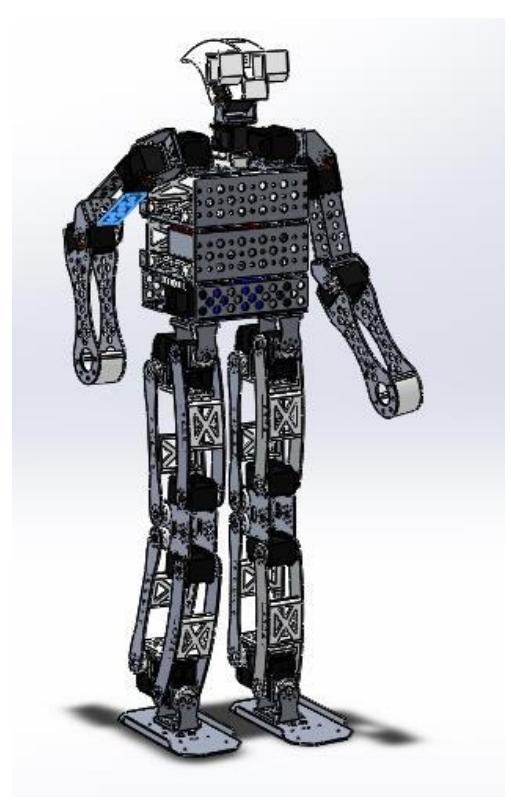
The first version of FALCONBOT had a height of 54 CM, the second version of Falconbots had a height of 60 CM, and it is intended that the third version of FALCONBOT has a minimum height of 80 CM. Shown in the following figure, the three versions of the Falconbots platform, their similarities and differences in mechanical structures refers.
2.2 Sensor and actuator
The robots of FALCONBOTS, has as a method of driving the joints, high torque motors brand Dynamixel, of different series, we use the series MX28, MX64 and MX106, which are implemented according to the nature of the joint. The actuators are placed in strategic positions according to the kinematic configurations to fully exploit the capabilities of the actuator. Constant feedback is obtained to optimize engine performance, setting a look-up table for optimal performance of each actuator. In addition, HALF DUPLEX communication is used in four open channels to control the actuators bilaterally, this leads to better use and more feedback cycles for optimization.
Our robots use the readings of a 9DOF IMU to know the physical state of the system in space in very short periods of time. A predictive autobalance algorithm uses these readings to optimize and improve the position and stabilization of the robot. The sensors in conjunction with the system use the inertial movement of the body to generate an improvement in the position of the body when the robot is parked or when the robot is dynamically walking.
The camera is the most important sensor of our robots, since we know the state of the system and space to determine the next action. The camera used by our robots is the LOGITEC C920 brand, with a resolution of 640 * 480, and the YUV color space.
2.3 Main Controller
To optimize processing and improve system speed, a NUC INTE, with 4GB in RAM, is used in conjunction with the Linux-based operating system. This computer version is used for the resources offered and thus maximize the results of all algorithms.
The interfaces used in the main computer are the ETHERNET port and a USB-SERIAL converter, in order to communicate the robot with the secondary card. This communication makes possible the feedback by some sensors in the robot.
2.3 Sub Controller
Development board STM32F4DISCOVERY is used to create a gateway to the main computer in the Falcnbot TWO, In the robot Falcnbot 3, a card developed by the research laboratory PROMETEC is used, which has an IMU sensor of 9DOF for the inertial measurement of the robot. This card offers 4 channels of bilateral open communication with the actuators, to improve the speed of communication with these and thus improve the feedback to make the corresponding improvements.
3 Software
The control system and decision-making is scheduled MatLab with a main control module and the vision system, and c ++ and assembly for motor control and acquisition of inertial data through the gateway. The system is divided into 4 modules of interest:
- Artificial vision module
- Locomotion and kinematic control module
- Module filtering and interpretation of inertial data
- Localization Module
3.1 Artificial Vision System
In the competition of RoboCup in humanoid league, mostly in the category was established that the ball game, the goals and lines of the court were white, that means that most elements are there in the environment have a Color in common.
This makes difficult the collection of data of particular interest. In order to facilitate recognition of objects of interest within the vicinity of the soccer field, apply techniques to make the computational cost is cheaper and at the same time facilitate the recognition of patterns.
Image acquisition is done through the C920 camera in his YUV color space, to subsequently apply a Gaussian filter to improve the image basic medium. An algorithm for optimal recognition of light in the environment applies to level the native camera settings and so have the optimal image.
$$f(x) = ae^{-(x-b)^2/c^2}$$
Recognition of the ball and the goals is performed under two conditions, the first is to have only a pattern and unique colors for detection, ie, the minimum detected colors to save computational resource. The Kmeans algorithm is used to cluster with pixels. By applying the Gaussian filter and jointly kmeans algorithm, the result is an image with only 8 detectable and filtered to make a mapping of colors in which the target will be the important colors.
$$\underset{\mathbf{S}}{\operatorname{arg,min}} \sum_{i=1}^{k} \sum_{\mathbf{x}{i} \in S{i}} |\mathbf{x}{j} - \boldsymbol{\mu}{i}|^{2}$$
Later when the image is already in the core data, two sets of individual data are separated by applying a basic Hough transform algorithm, to detect patterns in a circle and patterns shaped line, and the ball correspondingly goals. All this is done through Octave.
3.2 Locomotion and behavior control
The behavior of the robot is based on the classic control system of finite state machines, where viewed from high level, this provides behavior based on the decision making process of the central control system. The main decision is based on what the vision processing system. A finite state machine high level controls movement of the body in general.
In low-level system of locomotion it is in kinematic analysis. The resolution of inverse kinematics is based on the resolution made by the team Darwin for robot DARwIn OP. Kinematic analysis is solved and through the technique of pendulum balance invested a stable ride is done. 20 DOF robot-like DARwIn OP, make the system locomotion much lighter and stable.
The center of mass of the robot is in the right spot to generate a higher speed in the FALCONBOT TWO, ONE unlike FALCONBOT.
4 Electronics
The electrical system of the robot Falconbot One is based on the robot DARwIn OP, with an CM730 controller for controlling the motors and sensors. A serial communication interface to a compass through the i2c bus was implemented. The compass sensor is implemented to cast the orientation of the robot on the field.
In the Falconbot two, the control system is based on the discovery SMT32f4 microcontroller, which serves as a gateway between the servomotors and the computer through a direct communication to UART2 serial bus.
In the FalconBot Three robot, the control system is based on a microcontroller PIC 18F2550, with direct communication through its USB interface and using an FTDI logic converter, it is connected through its serial port to the servomotors.
5 Conclusions
This paper mainly shows the progress of the FALCNBOTS ITSSMT team, facing the next RoboCup 2017 in Nagoya, Japan. It shows improvements from the first version of our robots to the latest version that is currently under development, which will feature 24 DOF and high torque motors in most joints.
References
- Vaughan, R. N. Sumpter, A. Frost, and S. Cameron. "Experiments in Automatic Flock Control." Edinburgh, UK, 1998.
- O. Chutatape, Linfeng Guo. A modified Hough transform for line detection and its performance. Pattern Recognition, 32(2): 181-192, 1999
- Dieter Fox, Wolfram Burgard, Frank Dellaert, and Sebastian Thrun. "Monte Carlo Localization: Efficient Position Estimation for Mobile Robots." Copyright 1999, AAAI.
- Dynamixel Robotis. Updated information available at: http://www.robotis.com/xe/dynamixel
- UM6 Orientation Sensor. Updated information available at: http://www.chrobotics.com
- R. Grabowski, L. Navarro-Serment, and P. Khosla. "An Army of Small Robots." SciAm Online May 2004.