Team Description Paper for Team I-KID Robocup2018
Gai Na, Ning Siheng, Wang Jun, Yan Bixi, Lou Xiaoping, Dong Mingli, Zhu Lianqing
Beijing Information Science&Technology University,Beijing, China
Abstract In this Team Description Paper, we describe the main changes of our humanoid robot for RoboCup 2018 Canada,We mainly expatiate on the improvement of the algorithm of the robot in ball detection, the algorithm improvement on targettracking , the new design of robot mechanical protection that aim to improve the performance of the robot.
1. Introduction
Founded in 2010, the I-KID team is composedof overtwenty students including undergraduates and postgraduates at different levels. The machine vision, as one of core technologies in the field of robot, has become the important study direction of the Instrument Science and Technology discipline opened in our university. Since 2011 when our I-KID team participated in the China Robot Competition and The RoboCup China Open 2011 for the first time and won the First Prize (Runner-up) and took the first name in the Soccer and Race Competition in Kid-size group, we have made great achievements and won many prizes in some competitions at home and abroad in the following six years including the 2012 Mexico Robocup Competition, 2013 Netherlands Robocup Competition, 2014 Brazil Robocup Competition.We won the second place of the team competition in the RoboCup Competition in China in Kid-size group, which is held in Shandong province.We won the fourth place in the technical challengen in 2017 Japan Robocup Competition in Kid-size group. and various robot competitions held in Beijing, five regions in north China (Beijing, Tianjin, Hebei province, Shanxi province and Nei Monggol Autonomous Region) and domestic competitions jointly held by both sides ofTaiwan Strait. We have ceaselessly improved and updated the structure of software and hardware so as to enhance the level of our robots in accordance with the competition rules ofRobocup World Cup.
2.Overview of the System
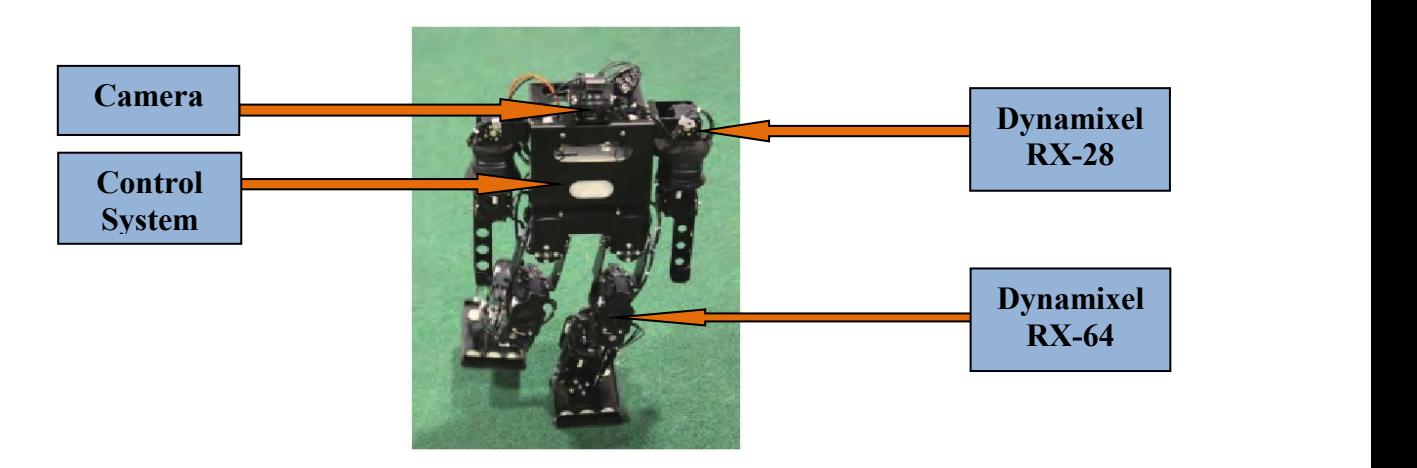
Our new robot is shown in Fig.1. It has twenty degrees offreedom (DOF), six RX-64 in each leg, three RX-28 in each arm and two RX-28 in the neck.Compared with old robot, the new one removes the DOF inwaist, this change makes mechanical structure more stable and achieve a faster walking speed with 20% improvement.
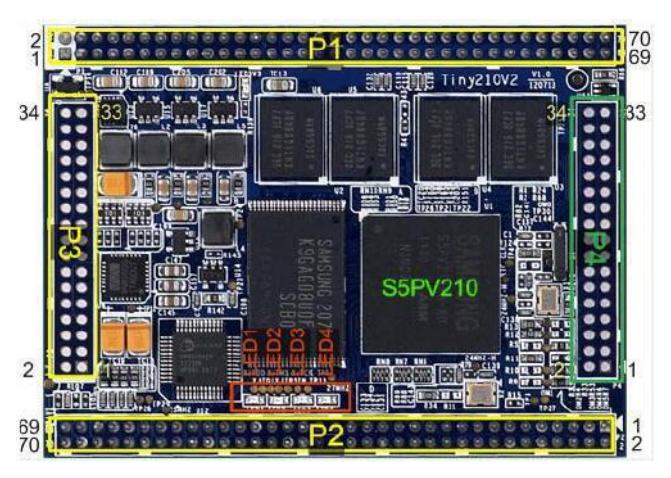
The newly designed robot makes a significant improvement with the computing speed. PC104 computer is replaced with a cortex-A8 based CPU Samsung S5pv210, depicted as Fig.2.The processor clocked at 1GHz does not only exceed in frequency, but also in power consumption. 512MB memory combined with 1G FLASH is sufficient to load any algorithms for soccer, such as fast image processing, particle filter based world modeling. High data load on USB bus with YUV space image, which means noise vulnerable for transfer, is exchanged with smaller sized JPEG alternatives. While on PC104 computer, the time consumption for JPEG decompression is unable to fit system requirement. S5pv210 is capable to decode the image at little cost,powered by its hardware JPEGcodec.
3.1 Optimized visual recognition of target soccer ball
In light of the changes in the RoboCup competition rules, our team has taken an innovation approach to upgrading the robot's system for recognizing the target ball by integrating a lookup table method and a connected domain method to detect it. It is experimentally proved that, with our team's humanoid robot as the center of a circle, a radius of (4.5±0.5) m falls within the robot's normal "field of view" range. Under ambient light conditions, the target ball's recognition failure rate can be as low as below 5%. In contrast to the previous 2.5-meter range, the robot's ball recognition radius has greatly increased. In the 2017 RoboCup competition, this method markedly improved our robot's ability to control the ball on a soccer field of 9m×6m. Our robot was capable of controlling the ball's movement on a half field and self-adjusting its strategy in accordance with the ball's position in a timely manner.
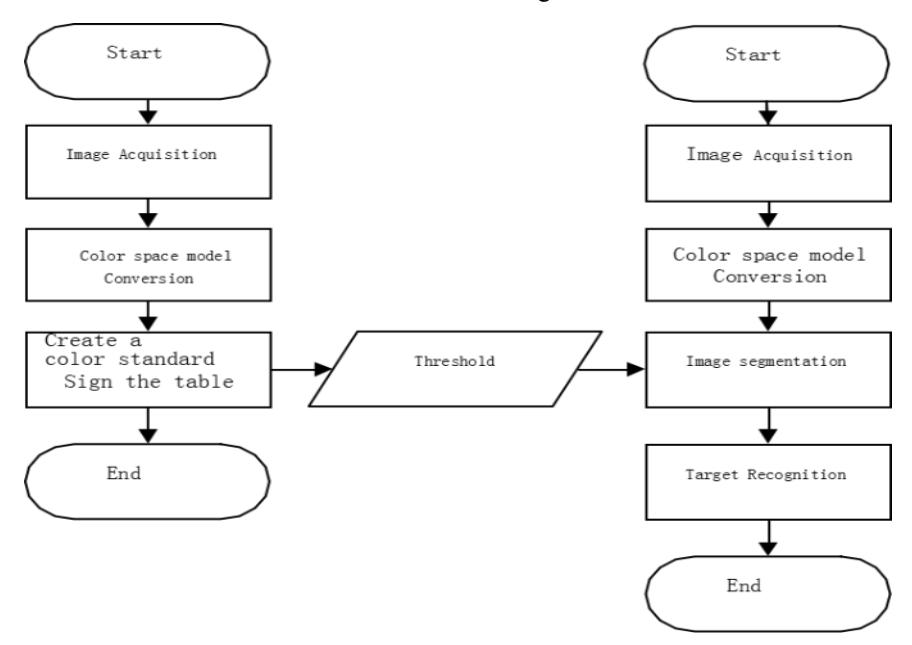
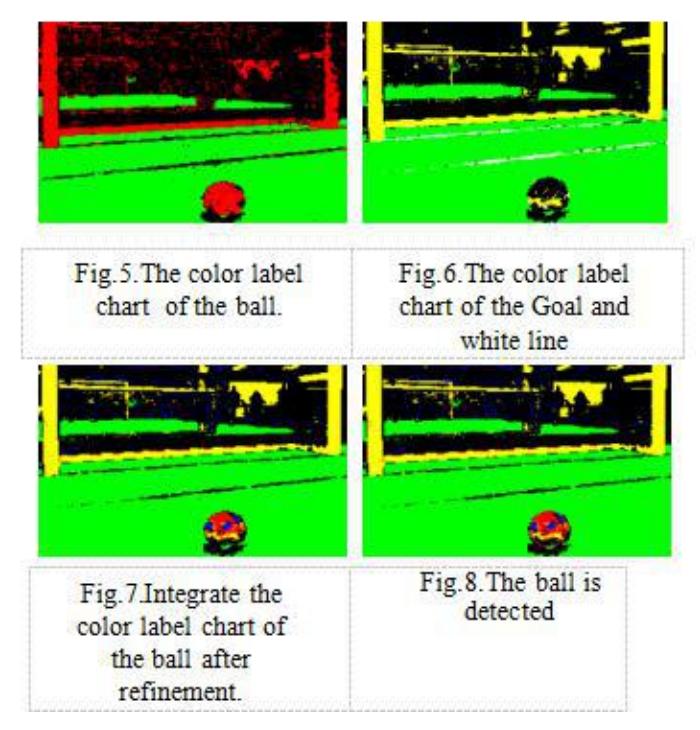
Our humanoid robots'general strategy for target ball recognition (as shown in Figure 2) consists of two major parts: establishing color label tables before a game and detecting the targetball during a game. The primary implementation modules include image acquisition, color space model conversion, establishment of color label table, image segmentation, target recognition, etc. Image acquisition is used to obtain real-time scene images. Acquired RGB format images, after compression, are then converted into YUV format imagesthrough hard decoding. The purpose of calibrating and creating color label tables is to establish a mutually mapped relationship table between each image's YUV data and its characteristics in a known image library. Image segmentation is a process through which the table lookup method is adopted for color classification and color integration in order to identify the possible location of the target ball. The target recognition module uses color feature constraints and geometric constraints to determine the exact location of the target ball.
Experimental procedure
After the video camera makes image acquisition, the acquired RGB format images are converted into YUV format through hard decoding, which are sent to the robot core board for processing.
1) Color space conversion
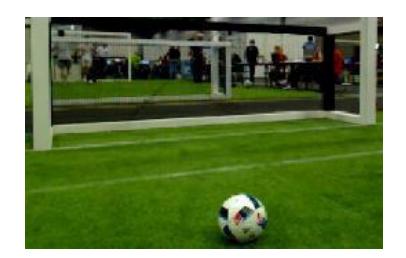
Take an image acquired at the 2017 RoboCup scene as an example. The YUV space result after color space conversion is shown in the picture below.
2) Region-based Image Segmentation
The color label table isestablished based on the color characteristics of such markers as soccer field lines, the ball, the two goals, grassland, etc. By looking up all the image pixels in the table, it is made sure that each pixel corresponds to a relevant classification (Figures 5 & 6), and all the pixels correspond to a relevantclassification (Figure 7), which will then be replaced by a corresponding color label through integration. In this way, images will be filtered and separated by discrete points, and image segmentation will be realized.
3.2 Optimization of target tracking
After one of our robots recognizes the ball on the soccer field, it is possible for the ball to move to its back since the opposing team's robots are running after the ball at the same time and may even kick it. Once the target ball is blocked, our robot will lose track of it. Our team (iKid) has optimized the target tracking method and remarkably avoided track loss in similar situations. Assuming that the target ball is in a uniformly variable motion, our robot applies the Kalman filter algorithm to tracking and positioning the moving ball. As the sample image numbers increase, the covariance of the current position and the next moment is used to update the ball's motion state, estimating the moving ball's position. When the ball is blocked for a certain period of time, the robot will be able to recognize and track the lost ball.
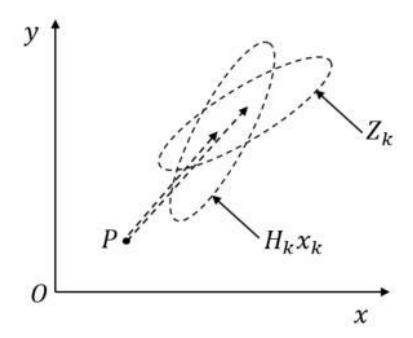
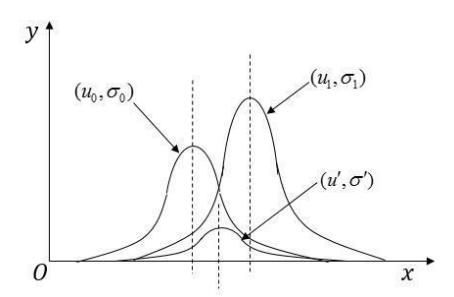
Generally speaking, our estimation model is reliable. However, when the first-stage estimation commits an error, as the recursion formula proceeds, the problem will be magnified and the estimation will end up completely wrong. As the distribution of the measured value and estimated value isshown in Figure 9, a sufficient condition for the Kalman filter algorithm is that the position and velocity of the moving target obey the normal Gaussian distribution over the entire domain. If the probability distributions of the measured value and the estimated value obey the Gaussian distribution, the product of the two Gaussian distributions will still be subject to the Gaussian distribution. The Gaussian distribution is shown in Figure 10.
The biggest difficulty with target tracking is that, due to the complexity and randomness of the movement of the moving target in the environment, the moving target can be easily blocked, and the target tracking information is lost and the tracking fails.
That the ball is blocked on the field can generally be divided into two situations: first, the ball is blocked and the ball's movement information is lost;second, the ball gets out of the blocked state and the ball's information is restored.Therefore, the remaining information of the target ball is used during the blocked period to keep track of the target ball. Once the ball leaves the blocked zone, the tracking is resumed, namely that using the tracked ball's information before it gets lost to estimate the ball's state of motion in the lost process to avoid losing track of it.
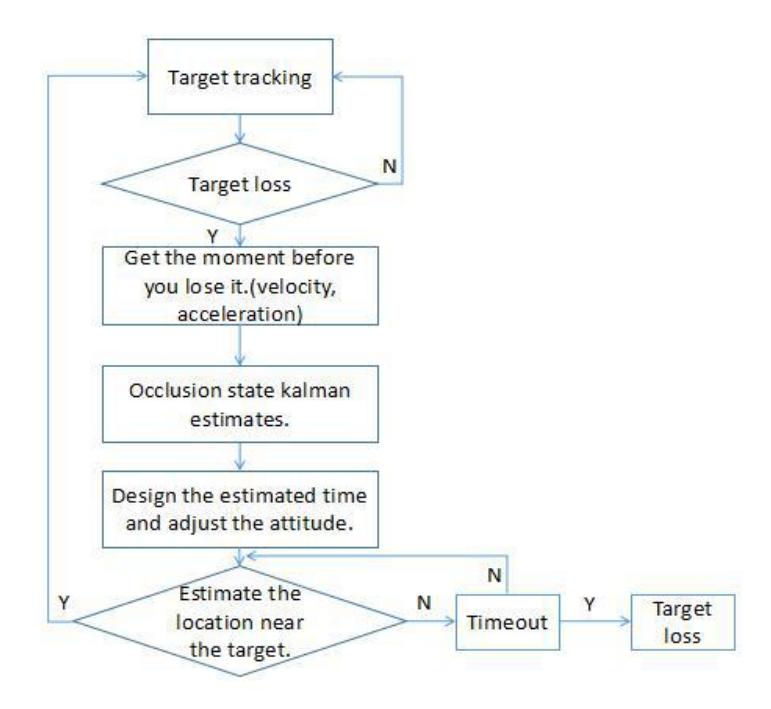
During a game, changes in the ball's velocity and the time period when the ball's view is blocked often lead to differences in the robots' estimation accuracy. Therefore, based on the ball's velocity the moment before it is lost, the Kalman filter is used to estimate the lost period. When the ball appears again, tracking is resumed. The ball block estimation flowchart is shown in Figure 11.
During a game, when the ball is blocked, the robot will use the Kalman filter algorithm to estimate the ball's movement in the remaining time according to the ball's velocity and acceleration the moment before it is lost. If the target ball appears again in the estimated area within a certain period, the tracking will be continue; if the tracking failsand the tracking time exceeds a given period, the robot will consider the target ball to be lost.
3.3 The Improvements on the protection structure.
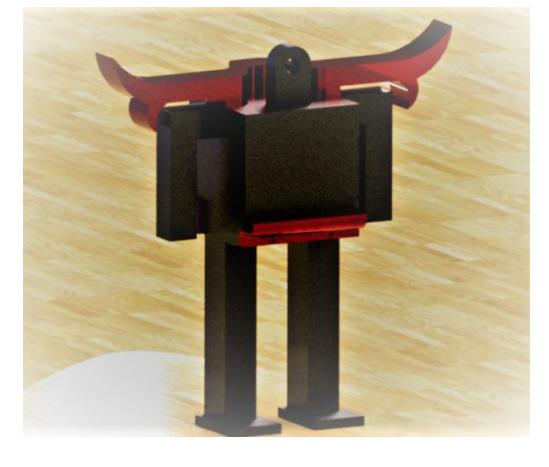
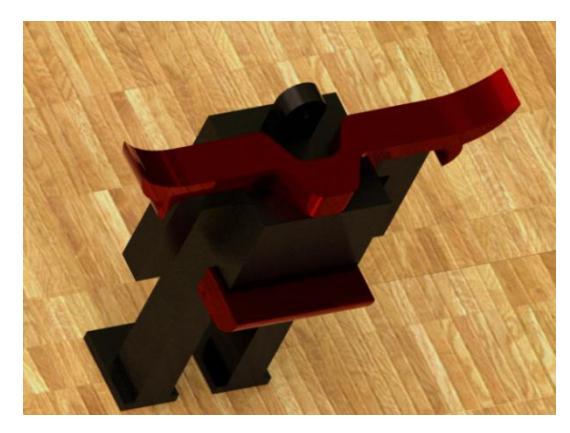
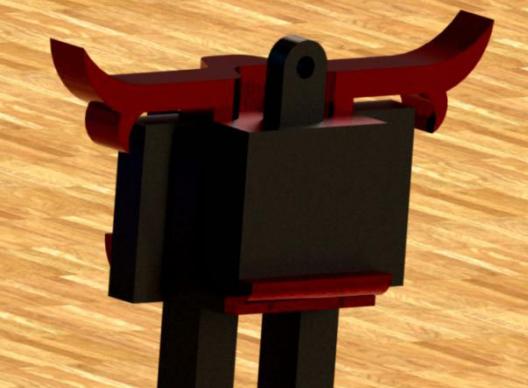
Humanoid robots are human-like biped walking robots. However, bipedal walking is often unstable. Consequently, under unfavorable working conditions, humanoid robots may lose their balance and fall due to collisions with each other, uneven road surfaces, or improper designs of special robotic motions. This subsequent ground impact may result in the destruction of the mechanical structure or some core components of the humanoid robot, causing it to fail at appointed tasks and objectives. The purpose of designing the protective structure is to improve the adaptability of the humanoid robot on the soccer field. When the robot falls or gets hit, the protective structures for the shoulders and the waist can effectively prevent the robot's core components (such as the shoulder and crotch servos) from being destroyed.
Based on an analysis of the laws of motion involving the human body ' s falling forward, backward, to the left, to the right and relevant protective instincts, our design has laid the foundations for the design of the protective structure of the humanoid robot and the development of new protective measures.
For independent design, the fall protective structure is divided into three parts,and three different principles ofmechanical protection structure are applied to the humanoid robot's shoulders, front waist and back waist.
3.Conclusion
In this article, we describe the visual aspects ofthe target identification, target tracking improvement optimization and improvement in the structure of protection, the purpose is to improve the ability of the robot, stability, and can have a better performance in the game. IKID will provide referees with an understanding of the rules ofthe league of people during RoboCup Canada in 2018, and will participate in the match in schedule.
References
- Zhu lifu,Xu xiaofeng,Yan Bixi,Wang jun,Lou Xiaoping,Dong Mingli,Zhu Lianqing:I- KID: Team Description Paper for Team I-KIDRoboCup2017(2017).
- Bi Junxi, Xie Ning, Chen Shuo, Ren Kaike, Shang Tian, Lou Xiaoping, Yan Bixi, Zhu Lianqing.: I- KID: Team Description Paper for Team I-KIDRoboCup2014(2014).
- Bi Junxi, Tan Xiaofeng, Guo Yunkai, Xie Pengcheng, Zhang Jiwen, Lou Xiaoping.: I-KID: Team Description Paper for Team I-KIDRoboCup2013(2013).
- Xu Xiaofeng, wang jun, Dong Ying, Xie Ruiqin,"Research on detection method of humanoid soccer robot target ball" Robot Technology and Application,2016.
- Zhang Chunlin, Cui Laiyou, Tan Cheng, Wang Guangqun, Kong Linjia,"Biom echanical M easurem ents and Analysis on the Sole of Human Foot"Beijing Institute of Technology,2013.
- Yuan Gang, Zhang Muxun, Zhang Jianhua, "The measurement systerm of dynamic foot pressure and its clinical application"Chinese Journal of Rehabilitation, 2013.