ROBIT Team Description Paper for Humanoid KidSize League of RoboCup 2018
Hae Bum Jung, Dong Min Shin, In Gu Choi, Ka On Park, Chae Won Park, Yeon Seo Lee, Tae Gyeom Kim, Ju Yeb Shin
Kwangwoon University Wolgae-Dong, Nowon-gu, Seoul, Republic of Korea
Abstract This document describes hardware and electronics and software specifications of the humanoid robot developed by team ROBIT. This robot is built to play soccer autonomously and intelligently. The developments in team ROBIT are about bipedal locomotion, object recognition and localization. The robot will be used to participate in Humanoid League (KidSize) of ROBOCUP 2018.
1 Introduction
Team ROBIT is a professional robot game team of Kwangwoon University in Republic of Korea. Team ROBIT was established in November 2006, and has participated in several domestic and international tournaments, and received more than 100 awards in competitions including president's awards. Team ROBIT has a ten-year accumulated robot technology. We have put a lot of efforts for the 'ROBOCUP 2018' league as much as we did for 'ROBOCUP 2017', where we were awarded 2nd Place in TeenSize League, and we also have studied robot system which would be covered during the league.
2 Hardware and Electronics
An overview of the system is shown in Table 2. Our robot system consists of a C920R Logitech USB camera, an Odroid Xu-4 main CPU, an Inertial Measurement Unit (IMU), 23 servo motors and a 4 sell battery. The Odroid Xu-4 has been used with Ubuntu OS for using ROS (Robot Operating System). Images are captured by the C920R Logitech USB camera and processed on Odroid Xu-4 main CPU. The robot transmit data continuously. Depending on the processed image data, the robot executes its next behavior. An Odroid Xu-4 main CPU communicates with actuators via RS-485 and communicates with Inertial Measurement Unit (IMU) via UART.
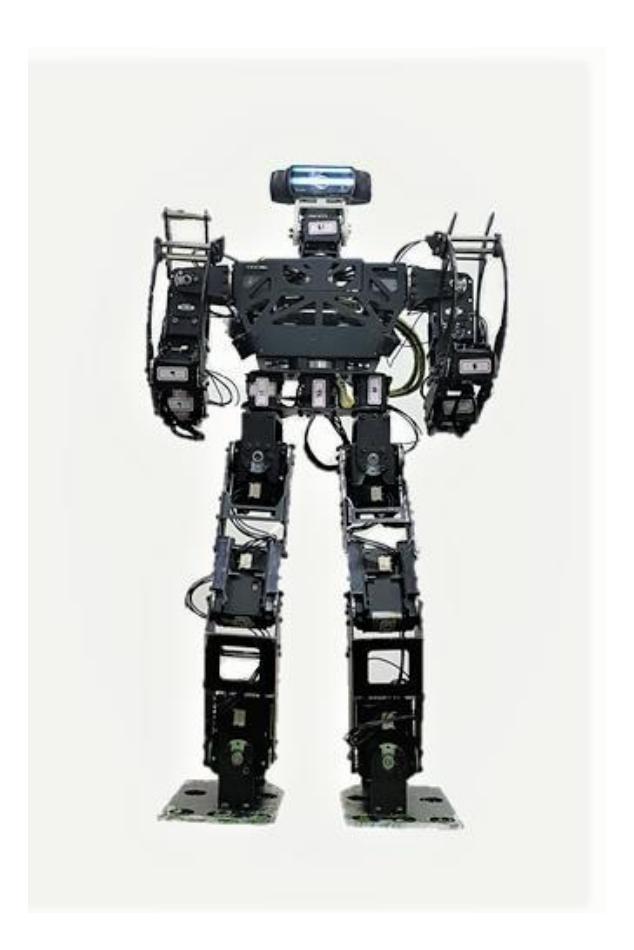
Table 2. Specification of the robot
| Weight | 4.7kg | ||
|---|---|---|---|
| Height | 57.7cm | ||
| DOF | Leg | 12 | |
| Waist | 1 | ||
| Arm | 8 | ||
| Head | 2 | ||
| Actuators | MX-106, MX-64, MX-28 | ||
| Camera | C920R Logitech | ||
| Computing Unit | Odroid Xu-4 |
3 Software
This section describes the software systems used by the ROBIT team.
3.1 Teaching Software
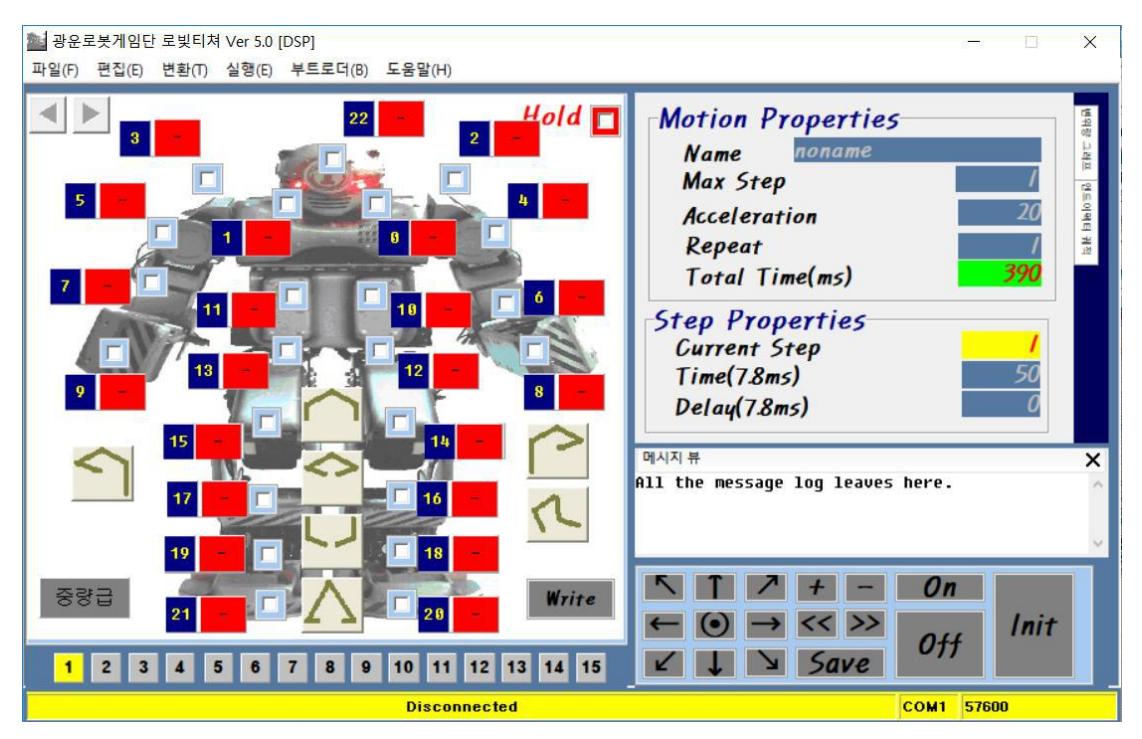
Fig. 1 is a teaching program. The teaching program is to make fundamental motions. The motions consist of several connected slides provide that we fix specific robot body postures using different robot IDs. Then these slides reverse as data in Odroid Xu-4 via UART. We use this program for making motions kicking the ball towards the goal post and getting up autonomously from a fall.
4 Vision
This section describes the vision system used for object recognition and localization.
4.1 Remove Background
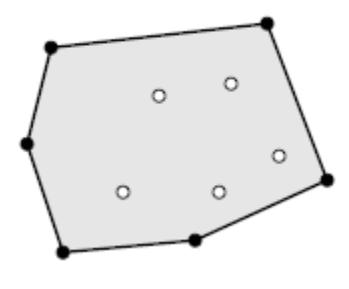
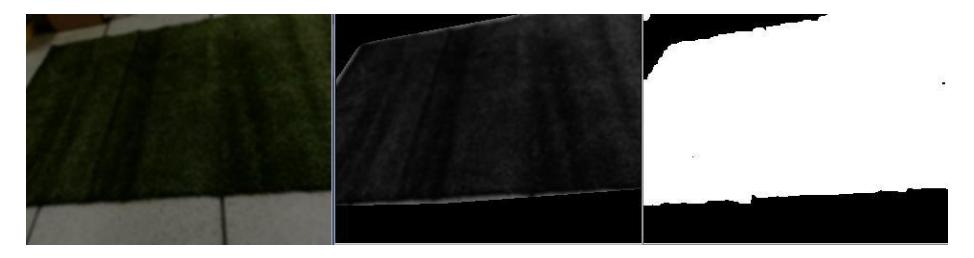
Our team used convex hull algorithm for removing background. The image data was not processed for the portion excluding the field. We are given a set P of n points in the plane. The convex hull is the smallest convex polygon containing the points. Computing the convex hull means that a non-ambiguous and efficient representation of the required convex shape is constructed. The complexity of the corresponding algorithms is usually estimated in terms of n, the number of input points, and h, the number of points on the convex hull.
Artificial grass is the points and the field is the convex polygon. A noise is reduced after processed background remove.
4.2 Ball
Our team used RANSAC(random sample consensus) algorithm for finding ball. The RANSAC algorithm is a learning technique to estimate parameters of a model by random sampling of observed data. RANSAC is much better suited for fitting very noisy data containing measures that do not belong to the model that is to be estimated. In first step, a circle containing minimal data items is randomly selected from the input database. A fitting model and the corresponding model parameters are computed using only the elements of the circle. The cardinality of the circle is the smallest sufficient to determine the model parameters. In the second step, the algorithm checks which elements of the entire dataset are consistent with the model instantiated by the estimated model parameters obtained from the first step. A data element will be considered as an outlier if it does not fit the fitting model instantiated by the set of estimated model parameters within some error threshold that defines the maximum deviation attributable to the effect of noise.

5 Sensor
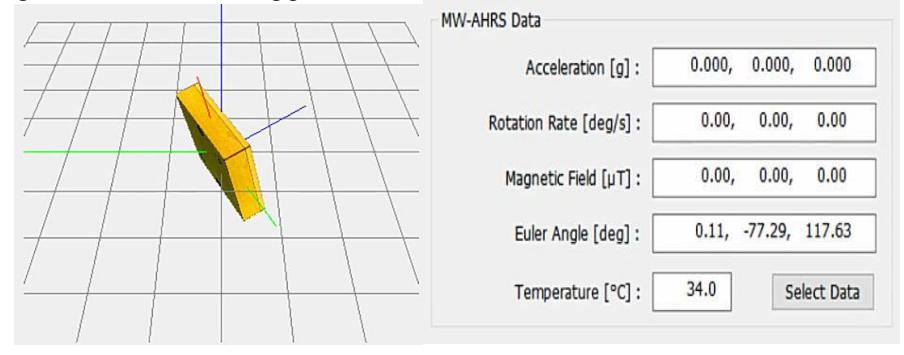
Our team used MW-AHRSv1 sensor for feedback control. We received data of Euler Angle for PID control using pitch axis and roll axis.
6 Conclusion
Our system was described in the abstract. Since 2006, we completed the design and built, based on our experience to try to join the 2017 ROBOCUP competition. Higher level of robot mobility and powerful shoot also accurate imaging breakthrough in tracking the movements of the robot will be able to determine. We will develop vision and localization more accurate.
References
- None provided in original paper