EagleBotx.MX Team Description Paper RoboCup 2019 SYDNEY, AUTRALIA
Jos é Pedro Villafan Luna, Salvador Guadalupe Rojas V á zquez, Ing. Julio Cesar Ju á rez Martinez, Ing. Daniel Neri Ram í rez
Highest Institute of Technology of Tepeaca
Abstract This document describes the investigations carried out in the robotics laboratory of the Higher Technological Institute of Tepeaca. The robotics laboratory has participated in other Robocup @home competitions, as well as national robocup tournaments in Mexico. Winners of the first place in the Robocup Humanoid Kid Size category of the Mexican robotics tournament. This document shows the investigations in humanoid robotics, artificial vision and localization, is based on the experience in participation in robocup @home. We will present a person with sufficient knowledge in the rules of robocup humanoid kid size to perform the task of referee
1 Introduction
EagleBots.MX is the new robotics team of the Higher Technological Institute of Tepeaca, which is willing to participate in the Humanoid Kid Size category of Robocup. The robotics laboratory of our institution has participated in the @HOME category, and due to a modification process it is motivating to participate in the Humanoid Kid Size category.
The investigations carried out in the artificial vision were used and the location was used in the @HOME category, as a point of entry to the new investigations and the problems of the systems of solving problems of the humanoid category were taken into account. in this project are taken into account research in artificial vision, inverse kinematics, mechanical analysis and localization.
To the participation in the humanoid league, a humanoid robot of 22 degrees of freedom called Aquiles 1 was built. This robot has been developed in our laboratory, using manufacturing methodologies, mechanical analysis, gait analysis and walking prediction.
The team EagleBots.MX is totally convinced to collaborate with the goal that robocup has for the year 2050 a team of humanoid robots football players winners in the FIFA tournament that same year, so we have committed to show quality information that contribute to this objective.
Commitment
Commitment
2
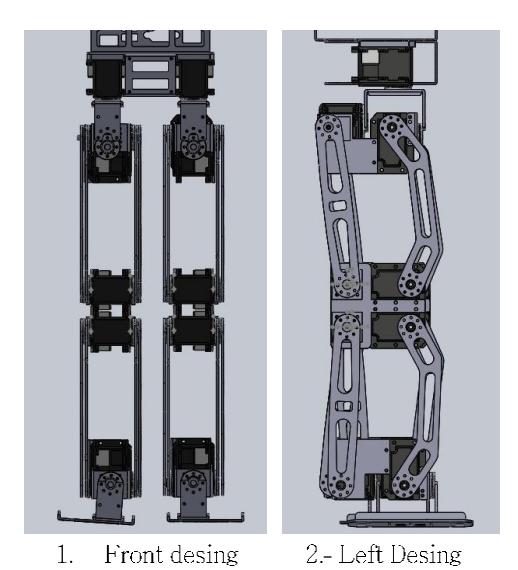
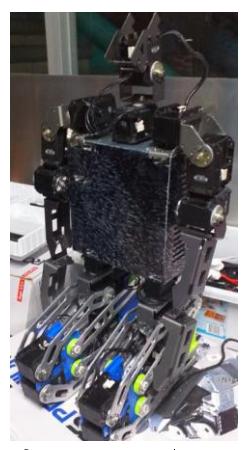
The mechanical design was made to increase the torque and height of the legs, since the goal of the humanoid league is to evolve according to the demands demanded by the original goal of Robocup. The manufacture was made in Aluminum 5052 t32. The image below shows the built robot which has a height of 70 CM.
2.2 Sensor and actuator
The robots of the EagleBots.MX team, use servomotors of the brand Dynamixel, since they offer high efficiency and high torque for the operation. Twenty-four servomotors per robot were implemented to drive the joints, all controlled by an ARM 32 microcontroller. A compensation algorithm is used to have control at all times without amperage loss, which makes battery consumption efficient.
TTL type communication is used, continuously synchronizing the current state of the motors to use another algorithm for feedback and recovery of motors in poor condition, this makes kinematic and dynamic control efficient.
The robots used an IMU unit to receive the physical and dynamic state of the robot, in order to perform a constant feedback to make predictions of calls and autobalance. This is done by means of a humanoid running prediction and correction module, which precedes if the robot is a falling point, a prediction of the fall is made and then a correction for the next prediction. This algorithm is implemented in the walk module of the robot.
Our robots use the readings of a 9DOF IMU to know the physical state of the system in space in very short periods of time. A predictive autobalance algorithm uses these readings to optimize and improve the position and stabilization of the robot. The sensors in conjunction with the system use the inertial movement of the body to generate an improvement in the position of the body when the robot is parked or when the robot is dynamically walking.
2.3 Main Controller
It uses a computer based on the Intel NUC with an Intel core I5 processor, with 8 GB of RAM. A Linux-based system is used to execute all the modules. ROS is used as a platform, where the different control modules of the system are mounted. A limited version of Linux is used to take advantage of all the computing resources offered by the on-board computer.
2.3 Sub Controller
An ARM microcontroller is used as the basic kinematic and dynamic control system, connected to a USB-SERIAL port of the main computer. An asynchronous communication is established in order to be able to ignore the transport of information at non-critical moments. That offers a less amount of data lost at system runtime. Below is a small basic diagram of the operation of the base system and the robot's main system.
3 Software
The main control system is written in Python, and is based on a convolutional neuronal network, where the actions taken by the robot are classified according to a knowledge base that collects information on the current state of the robot. ROS is used as the base framework of everything. The control system is divided into 4 stages:
- Locomicion and communication module (4 NODES of ROS)
- Artificial Vision (3 NODES of ROS)
- Location module
- Decision making module
3.1 Artificial Vision System
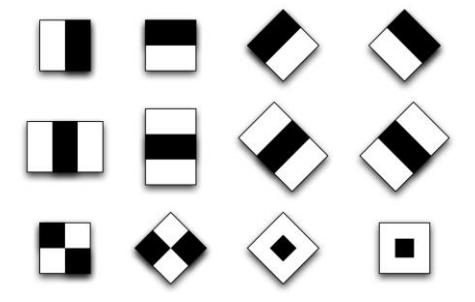
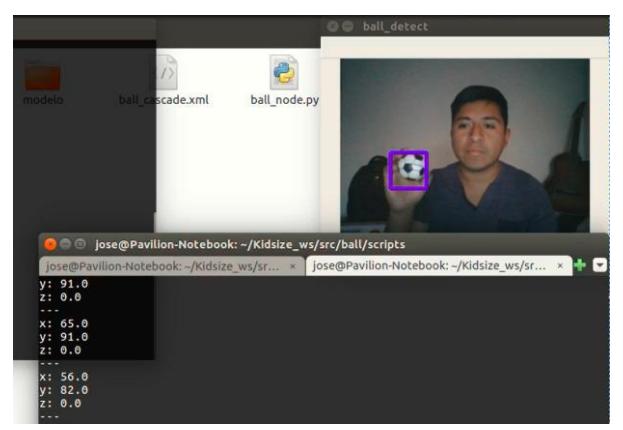
The system of artificial vision of the robot, is based on two stages, the first is carried out for the recognition of the ball by means of a haar cascade classifier, which is implemented in the detection of objects through a previous training. In this case used for the purpose of rapid detection of a soccer ball, with an approach based on machine learning where the classifier trains from many positive and negative images.
The positive samples consist of a set of images of soccer balls, while the negative samples are a set of images in which no soccer ball is found, this to be able to make an overlap of the positive samples in the negative samples. Positive samples overlap at different angles to reduce the margin of error in detection if the object changes its orientation.
The previous scheme, results in a powerful classifier that normalizes the light from outside and the following test could be performed:
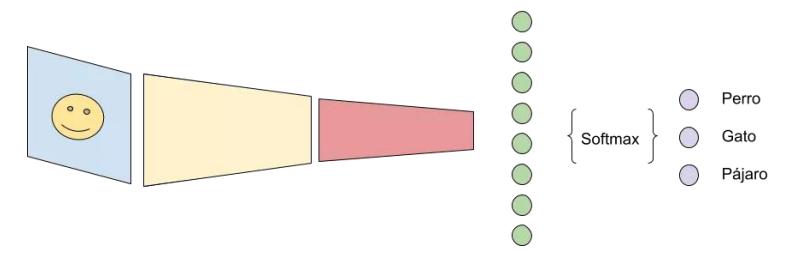
Likewise, to correct the false positives that may come to exist, a neural network with tensor flow and keras was created. A convolutional neural network also called CNN or ConvNet are a class of deep neural networks very convenient for a better prediction in conjunction with artificial vision. These consist of layers designed to require a small pre-prostration in comparison with other image classification algorithms.
3.2 Locomotion and behavior control
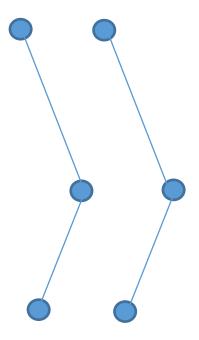
The locomotion system of the humanoid robot EagleBots.MX is based on a regular support polygon, such as the following:
In which the parallel angles of the legs are calculated in order to keep the orientation horizontal at all times, with the aim of a better stabilization at the time of walking.
References
- Vaughan, R. N. Sumpter, A. Frost, and S. Cameron. "Experiments in Automatic Flock Control." Edinburgh, UK, 1998.
- O. Chutatape, Linfeng Guo. A modified Hough transform for line detection and its performance. Pattern Recognition, 32(2): 181-192, 1999
- Dieter Fox, Wolfram Burgard, Frank Dellaert, and Sebastian Thrun. "Monte Carlo Localization: Efficient Position Estimation for Mobile Robots." Copyright 1999, AAAI..
- Dynamixel Robotis. Updated information available at: http://www.robotis.com/xe/dynamixel
- UM6 Orientation Sensor. Updated information available at: http://www.chrobotics.com
- R. Grabowski, L. Navarro-Serment, and P. Khosla. "An Army of Small Robots." SciAm Online May 2004.