Elecatrón-Laredo – Team Description Paper Humanoid Kid-Size League, Robocup 2019
Juan Arévalo-Nazario, Nayli Nohemi Gracia-De León, Luis Onofre Caldelas-Caixba, Raúl Francisco Aguilera-Hernández, Juan Joel Escobar-Vazquez, José Eduardo Ibarra-Ramírez, Andrea Sofía Sáenz-Páez, David Enrique Tello-Muñoz, Karla Giovanna Miranda-Santos, Martha Isabel Aguilera-Hernández (Mentor)
Instituto Tecnológico de Nuevo Laredo, Av. Reforma 2007 Sur, Col. Fundadores, 88000 Nuevo Laredo, Tamaulipas, México
Abstract In this paper, a general explanation in advances of the implementation of vision systems on Kid-size humanoid robots for playing soccer is presented. The team "Elecatrón_Laredo" presents the characteristics of the robots to get ready for the participation in the upcoming 2019 competition.
1 Introduction
The team "Elecatrón-Laredo" participated in the Robocup 2018 representing the Club Mecatrón of the technological institute of Nuevo Laredo, México. This was our first time in the tournament. Even though the robots didn´t perform as we expected, we acquired a lot of highlights in the changes that our robots needed but most of all we realized the need for a more advanced vision system for the robots.
The group has been working dynamically. The team participated in the Mexican Robotics Tournament 2018 that was held in Monterrey, Nuevo León. The team has also participated with an exposition for primary, secondary and preparatory schools in the COBAT innovation show, in October 2018.
The funds have been an issue, the club has made some activities to buy the components needed for the upgrades. The efforts were focused in the design of a vision system with the help of neural networks.
Commitment
The team ELECATRON-LAREDO commits to participate in RoboCup 2019 in Sidney (Australia) and to provide a referee knowledgeable of the rules of the Humanoid League.
This year, the group has been working on:
- a) Designing a neural network system for the robot. This aims to locate the ball in less time.
- b) Analyze the center of gravity of the robots while playing soccer.
- c) Designing 3D pieces for the robots to make them more robust.
2 Hardware Overview
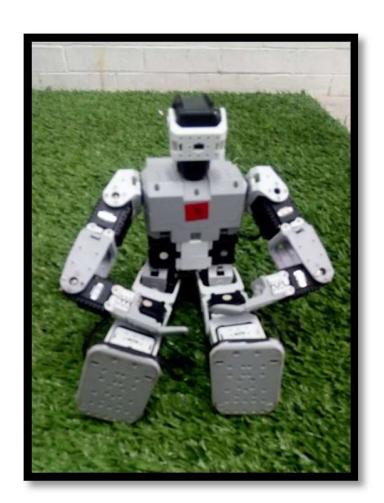
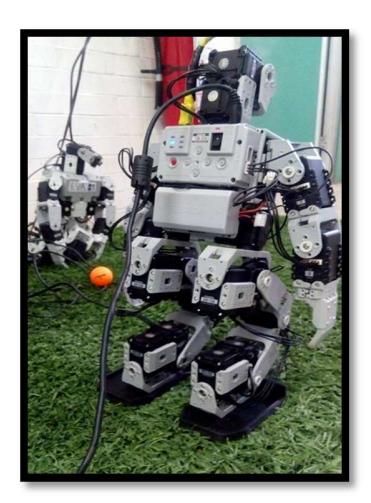
The specifications of the robots are shown in figures 1-3. The type of the robots is bioloid. The robots use CM-5 and CM-530 control modules.
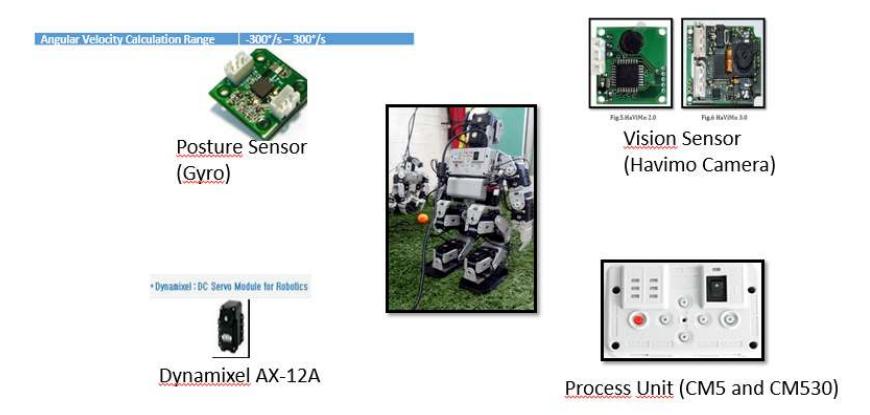
Each robot has a gyro sensor providing information through serial communication that allows the program to know when the robot has fell down or changed direction. Basically, when the robot tilts and angular velocity increases in a specific direction, the servo motor's value can be adjusted in the opposite direction to straighten the robot.
Robot "TACO" Specification sheet
| Item | Specification |
|---|---|
| Weight | 2.017 kg 4.4467 lb. |
| Height | 42.7 cm. – 16 13/16 in. |
| Motor type | DYNAMIXEL AX-12 |
| Degrees of freedom | 20 |
| Sensor type | GYRO GS-12 HaViMo camera (2.0,3.0) |
| CPU | CM- 530 |
| Walking speed | 17 cm./s. |
Figure 1: Robot "TACO"
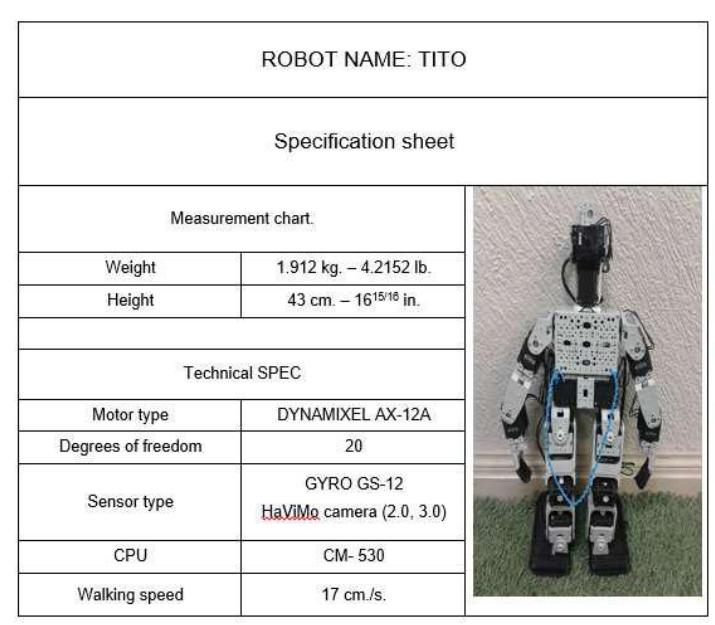
Robot "TORO" Specification sheet
| Item | Specification |
|---|---|
| Weight | 1.806 kg. 3.9815 lb. |
| Height | 43.6 cm. – 17 1/4 in. |
| Motor type | DYNAMIXEL AX-12A |
| Degrees freedom | 20 |
| Sensor type | HaViMo camera (2.0,3.0) |
| CPU | CM-5 |
| Walking speed | 17 cm./s. |
Figure 3: Robot "TORO"
General description of the robot parts are indicated in figure 4.
3 Vision system
The vision system is based on HaViMo cameras. The 2.0 cameras sample pictures with a resolution of 160x120 pixels with a framerate of 19 fps. and the HaViMo 3.0 samples pictures with a resolution of 2 megapixels with an ARM Cortex M3 as the main processing unit. For the image to be ready to the training, it has to be processed in grayscale. We use gaussian filters to prepare the images taken by the camera. One of the approaches is to locate contours of the image. The process of choosing which movement will be made is based in neural networks.
The NN algorithm is trained with sigmoidal activation functions to detect the ball and field markings. Convolutional neural networks has been one of the most influential innovations in the field of computer vision. Part of the program applied in the goal of classification giving an image is shown in figure 6.
Figure 6: Convolutional Neural Networks partial PROGRAM
At this time, our investigation is centered in training the robot to detect the ball and the markings on the field. An initial filter has been added to process and classify the images more quickly so the robot can make a decision.
The block of decision-making developed is based in the algorithm show in Figure 7. At this time this part is fed with the output of the NN.
Depending on the case, the servomotor that functions as the robot's neck performs horizontal movement of the camera. It rotates to one side or the other to follow the ball.
If it is centered in front of the robot
- o Take a step forward
- o If the ball is near the robot a certain distance
- If the ball is centered
Kick the ball
Else //Adjusts the position
- If the ball is to the right
- o Take a short step to the right
- If the ball is to the left
- o Take short step to the left
- If the ball is to the right
If the ball is not detected, the function búsqueda_enfrente is called.
Figure 7: Algorithm for decision making.
References
- McCulloh, Warren S. and Pitts, Walter. A logical calculus of the ideas immanent in nervous activity. In: The bulletin of mathematical biophysics. 1943, Volumen 5, Libro 4, pp 115–133. ISSN: 0007-4985, 1943.
- Francium Tech, https://blog.francium.tech/build-your-own-imageclassifier-with-tensorflow-and-keras-dc147a15e38e, Nov. 21, 2018.
- Olivetto Rendón A., "Aprendizaje profundo para la identificación de objetos", Revista la Mecatrónica en México, Vol. 7, No 1, Jan. 2018.
- Neural-network", http://www.diegocalvo.es/definicion-de-redneuronal/, Dec. 5, 2018.
- Wail Mustafa, Mirko Waechter, Sandor Szedmak, Alejandro Agostini, Affordance Estimation For Vision-Based Object Replacement on a Humanoid Robot, ISR 2016: 47st International Symposium on Robotics, Proceedings.
- Ariffin, I. M., Rasidi, A. I. H. M., Yussof, H., Miskam, M. A., & Omar, A. R. (2016). Vision tracking application for mobile navigation using Humanoid robot Nao. In 2015 International Symposium on Micro-NanoMechatronics and Human Science, MHS 2015
- Baturone, F. J. Moreno-Velo, V. Blanco, J. Ferruz, "Design of embedded DSP-based Fuzzy Controllers for Autonomous Robots", IEEE Transactions on Industrial Electronics, Vol. 55, pp. 928-936 (2008).
- U. Franke, C. Rabe, H. Badino, and S. Gehrig, "6D-vision: Fusion of stereo and motion for robust environment perception," in 27th DAGM Symposium, 2005, p. 216.
- Do-Young Lee, Yan-Feng Lu, Tae-Koo Kang; In-Hwan Choi, Myo-Taeg Lim, 3D vision based local obstacle avoidance method for humanoid robot, 2012 12th International Conference on Control, Automation and Systems
- GUTIERREZ-Karina, AGUILERA-Martha, ORTIZ-Simón, ARRAMBIDE Gael, Aplicación de un Sistema de Reconocimiento de Formas y Colores en un Robot Humanoide. Revista de Tecnología e Innovación 2015, 2-2:315-321, Ecorfan.
- Velasco-Marín, Aguilera-Hernandez, Implementación De Sistema De Visión Basado En Red Neuronal Artificial Y Sistema Difuso En Un Robot Móvil, Reporte de Investigación. Instituto Tecnológico de Nuevo Laredo, Dec 2018.
- Draghici S1., A neural network based artificial vision system for licence plate recognition, Wayne State University, https://www.ncbi.nlm.nih.gov/pubmed/9228583
- Wail Mustafa, Mirko Waechter, Sandor Szedmak, Alejandro Agostini, Affordance Estimation For Vision-Based Object Replacement on a Humanoid Robot, ISR 2016: 47st International Symposium on Robotics, Proceedings.
- Tecnológico de Nuevo Laredo site: www.itnuevolaredo.edu.mx
- Club Mecatrón site: mecatronteclaredo.jimdo.com