Extended Abstract from CIT Brains 2020
Kanta Takasu, Riki Hayashi, Hayato Kitaura, Takaharu Nakajima, Morito Ito, Satoshi Shimada, Koki Matsumoto, Nguyen Anh Quan, Takumi Ogasawara, Ema Tamamizu, Gaku Kuwano, Ryoko Shiojima, Takehiro Hasegawa
Chiba Institute of Technology, 2-17-1 Tsudanuma, Narashino, Chiba, JAPAN
Abstract This paper briefly summarizes our team's current changes and development since RoboCup 2019. We describe 4 major improvements we have done to our system. The first improvement is the development of a new hardware prototype, Xevion. This new hardware was developed to improve ball control capability by installing NVIDIA Jetson AGX Xavier to perform high-speed image processing and designing non-interfering leg structures. The second improvement is using the segmentation method for detecting white lines and field-area, with the network designed using the Chainer framework. The segmentation method improves the object detection range and tuning efficiency. The third improvement is designing shock absorption parts (bumpers) using thermoplastic polyurethane (TPU) material. The bumpers were designed to improve internal hardware protection and extend protection range. The fourth improvement is stabilizing the walk-kick method. By adjusting the walking and kicking cycle to improve the robot balance, the robot can stably execute the walk-kick method.
New Robot Development
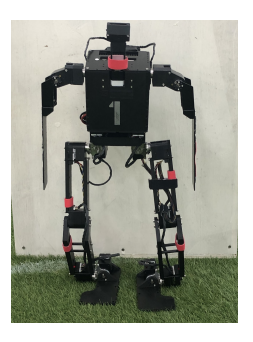
In RoboCup 2019, we often observed a deadlock situation where two robots facing each other, with the ball in between, kicks the ball to each other. Our robot uses its high push recovery ability to kick the ball out of this deadlock situation. However, the ball sometimes rolls to an unexpected direction which leads to goal loss. To avoid this situation, we are developing a robot (Fig. 1) with improved ball control capability by designing non-interfering leg structures and mounting NVIDIA Jetson AGX Xavier to perform high-speed image processing.
Detecting white lines using segmentation
In previous years, we created color tables to detect white lines and field areas. This method was time-consuming and its accuracy varies depending on the person who tuned the parameter. This year, we implemented a segmentation method to detect white lines, reducing the need to tune the parameters for white lines.
The white lines detector consists of only a fully connected layer and was designed using the Chainer framework. We created the datasets by annotating the white lines using thresholding. We are currently developing the field area detection using this method.
Walk-kick
Last year, we developed a walk-kick method for our robot[1]. However, we had difficulty implementing the method because our robot loses balance when executing the walk-kick. This is because the robot leg did not follow the intended trajectory during the kick. To ensure that the leg follows the intended trajectory, we adjusted the walking and kicking cycle rate. We experimented and verified that the robot succeeds 85% of the walk-kick which is an acceptable range in our robot. We are currently implementing this modified system for the robot.
TPU bumper
We developed a flexible bumper made out of thermoplastic polyurethane (TPU). Compared to the polyacetal bumpers we previously used, the TPU bumper reduced the impact transmitted to the robot by 90%. We used this in RoboCup 2019 and found that the bumpers could not protect the camera from the impact to the ground due to the narrow protection range the bumpers provided. We are currently redesigning and developing new TPU bumpers not only for the head but also for easily damageable parts.
References
- R. Hayashi, Y. Hayashibara. :Study of a Gait Pattern Generator with Kick Motion. In: The Proceedings of JSME annual Conference on Robotics and Mechatronics (Robomec) 2019. The Japan Society of Mechanical Engineers, 2019. (in japanese)