Rhoban Football Club – Extended abstract Humanoid Kid-Size League, Robocup 2020 Bordeaux
A. Boussicault, L. Gondry, L. Hofer, P. Laborde-Zubieta, O. Ly, L. Mathé, S. N'Guyen, G. Passault, A. Pirrone, A. Skuric
CNRS, LaBRI, University of Bordeaux and Bordeaux INP, 33405 Talence, FRANCE
https://github.com/Rhoban/hl_labelling
Abstract This paper presents some of the experience acquired by Rhoban during RoboCup 2019, some of the modifications made since and our future plans. It focus on three points: video based labeling, in-game kicks and development of new hardware for the knees.
1 Introduction
Team Rhoban FC has been involved in RoboCup since 2011. It has won the KidSize league for the last four editions.
Some of the key problems met and improvements envisioned for RoboCup 2020 are discussed in this document using a thematic structure. We present the following elements:
- our video based labeling tool and its expected evolution,
- the points we will work on to enable in-game kicks from moving-ball and
- the current status of a new joint design we are planning to use for the knees of our robot.
An extensive review of the improvements we brought is presented in [2].
2 Video based labeling
Training and testing performance of perception systems required labeled data. Last year we experimented a new approach based on labeling videos rather than images. Trajectories of the pose of the cameras from the robots was reconstructed based on two different elements: inertial based odometry and frames with keypoints labeled. While this process of labeling allowed to retrieve a large amount of information more easily, we fixed major bugs in our training procedure and our prediction process after the competition, as mentioned in [2]. It highlighted the strong requirement to improve our testing process and to benchmark rigorously the accuracy of our labeling approach.
For next year, we plan to strongly improve the ergonomy of our labeling tool in order to make it available to the community, a process which has already started. Moreover, we aim at combining inertial measurements with visual odometry to increase the accuracy of the trajectories and reduce even further the input required from humans. Finally, we plan to integrate additional information on the robots such as their orientation or their current action to increase the number of information available for the decision-making layer.
3 In-game kicks from moving ball
Last year, we tackled with success the problem of kicking from a moving ball after a pass performed by a robot. We identified two major obstacles to implement this behavior during games: the localization need to be accurate enough and the prediction of the ball trajectory need to be satisfying.
With the improvements brought to our perception system since the competition and the development of our video based labeling tool, we hope to strongly improve our localization system. We experimented various models for trajectories including the blade of the grass. This year, we plan to investigate more in depth those models to reduce the discrepancy between the theoretical and measured trajectories.
4 Experimental joint design
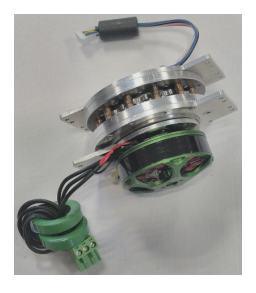
We are working on a new joint design using a cycloidal speed reducer based on [1]. The main purpose of that work is to replace the dynamixel motors by a low cost speed reducer having better specifications (torque and velocity).
A first prototype has been produced and can be seen in Figure 1. Its characterization is progressing and it will be realeased soon. We hope to be able to use it to replace the knee joints of our robot in order to increase the kicking power.
References
- Biser Borislavov, Ivaylo Borisov, and Vilislav Panchev. Design of a planetary-cyclodrive speed reducer : Cycloid stage, geometry, element analyses, 2012.
- Loic Gondry, Ludovic Hofer, Patxi Laborde-Zubieta, Olivier Ly, Lucie Mathé, Grégoire Passault, Antoine Pirrone, and Antun Skuric. Rhoban Football Club: RoboCup Humanoid KidSize 2019 Champion Team Paper. oct 2019.