TKU Extended Abstract for Humanoid Kid-size League of RoboCup 2020
Chih-Cheng Liu, Ching-Chang Wong, Yi-Chung Lin, Liang-Chin Wang, Yu-Chih Wang, Wei-Fan Lai, Huan-Sheng Wei, Ting-Rui Lian, Tsung-Yen Lee, Po-Wei Huang, Kai-Wei Chang, Guan-Wen Lin, Po-Hao Chang
Department of Electrical and Computer Engineering, Tamkang University No.151, Yingzhuan Rd., Tamsui Dist., New Taipei City 25137, Taiwan (R.O.C.)
Abstract This paper describes the robot system designed by team TKU. We explain hardware and software overview, and the system structure of our robot. The robot we made is 62 cm tall and 4.1 kg with 21 Degree-Of-Freedom biped humanoid. We use industrial personal computer (IPC) for vision and strategy part and Field Programmable Gate Array (FPGA) for walking and balance part.
Keywords: RoboCup 2020, Humanoid league Kid-size, Intelligent Humanoid.
1 Introduction
This paper is written in order to participate in RoboCup 2020. We are members in Intelligent Control Laboratory (I. C. Lab). I. C. Lab is one of the research laboratories within the Department of Electrical Engineering at the TamKang Univeristy (TKU), and is directed by Dr. Wong, Dr. Li and Dr. Liu. Our robot is autonomous humanoid, which is 62 cm tall and 4.1 kg. It constructed as a 21 Degree-Of-Freedom biped humanoid. We use inverse kinematics for our basic walking, use OpenCV for our basic vision, and use ROS 2.0 for our team communication. Our research interests are in the area of intelligent robot control, SoPC embedded system, localization and deep learning.
2 Hardware and Software
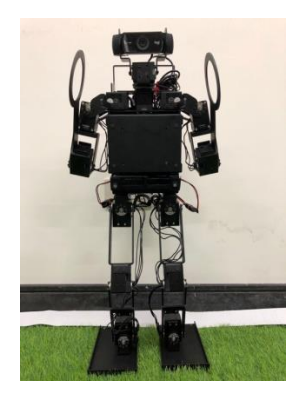
For the hardware part, an industrial personal computer (IPC) combined with a FPGA board are used as the processor unit. We designed a transfer board between our IPC and FPGA. One webcam is installed on the robot to obtain the environment information so that it can be an autonomous mobile robot. Mechanical structure is composed of aluminum alloy parts, 21 Degree-Of-Freedom which is 21 XM430-W350 Dynamixel motors. The robot shows in Fig. 1.
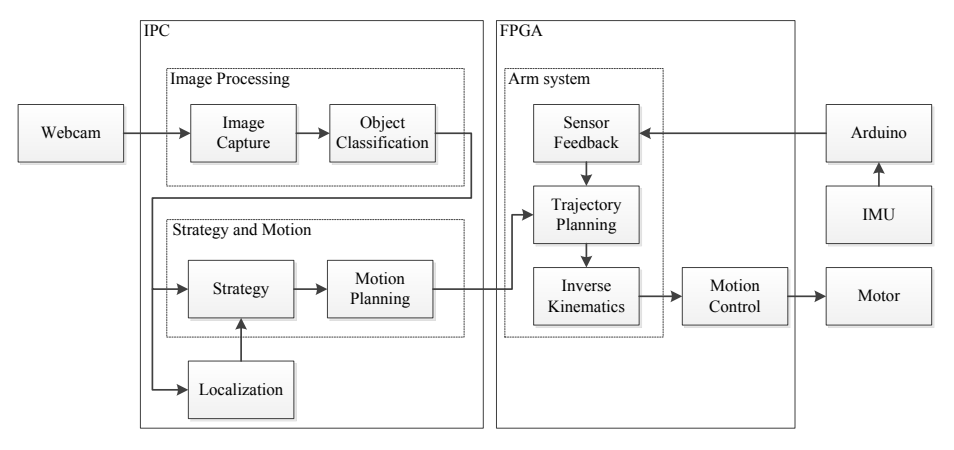
For the software part, IPC processes the image and determines the strategies. We use the Robot Operating System (ROS) to design our system. The FPGA board receives the command from IPC. It calculates the walking trajectory, balance control, sensor feedback and controls the motors. The system structure shows in Fig. 2.
3 Conclusion
A design and implemented method of a humanoid robot is presented. Building on previous research and FIRA Hurocup experience, we hope to challenge our robot that can compete in RoboCup 2020.