Unbounded Designers & Shahed Robo
Mohammad Reza Reiahi Dehkordi, Javad Rahmai, Ehsan Aghdami, Farid Mahdavi Ikhechi, Soroush Abdollahi, Mohammad Hossein Rezayat, Mohammad Jannesari, Hamid Reza Shajaravi, Reza Pazan, Farid Shokri, Mahyar Shokraeian, Satyar Salehian Dardashti, Mahdi Reiahi Dehkordi
Islamic Azad University Isfahan Branch; Shahed Mechatronics Research Lab
Abstract In this article, the activity of UD Robot (Unbounded Designers) was briefly described in artificial intelligent field and humanoid robots to participate in France RoboCup 2020. In this article we try to explain the latest activities and evaluations in Machine Vision, Motion Control, Localization and software, and hardware designing. This year we're trying to improve previous activities and ideologies in Machine Learning, Machine Vision, and Localization and prepare ourselves for a coherent presence in competitions.
Introduction
Unbounded Designers Team formed up with an essence of research and development in the Islamic Azad University of Isfahan in 2014 and in addition to its activities in Information Technology and Artificial Intelligence, started its research in humanoid robots. In 2017, this team became champion of Iran Open 2017, in Teen Size Humanoid league.
Participate in Robocup 2017 Japan competitions in the same year and then in Robocupap2017 Thailand and Robocup-ap2018 Iran, respectively; and showed relatively good performance.
In the current year, this team followed prepare and improve plan for previous activities and the main issues mentioned as follow:
- Improvement of mechanical structure and balance control system
- Improvement match strategy and robot behavior
- Improvement Machine Vision and localization
Hardware
Mechanic Design
Our platform is a fusion of Baset Pazhooh Tehran's commercial platform for Teen & Kid size [1], and Unbounded Designers platform designed in 2018. In our new design, we have tried to solve previous design's problems. Hence, the final design is complementing the aforementioned two.
The designed robot (Fig. 2), has the size of 85cm, 6 degrees of freedom for each foot, 3 degrees for each hand and 2 degrees for the neck, and is in accordance to 2019 rules. In this design, MX-28, MX-64, and Dynamixel MX-106 motors are used to provide the torque needed for walking, jumping shooting and etc.
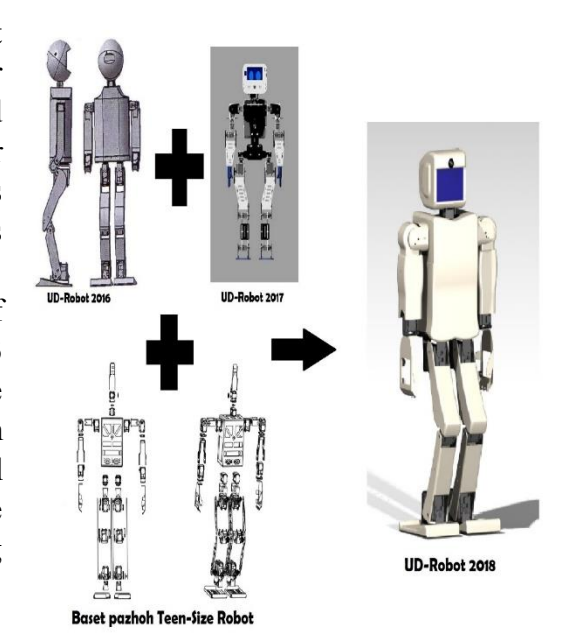
Table 1. The Robot information
| Baset Pazhoh Robot | UD-Robot | |
|---|---|---|
| Height | 85 | 65 |
| Weight | 6.7 | 5 |
| Camera | Logitech C905 | Logitech C930e |
| DOF | 20 | 20 |
| Actuators | Dynamixel MX Series | Dynamixel MX Series |
| Processing Unit | QutePC-3000 | Intel NUC |
| OS | Windows 8.1 | Windows 8.1 |
| Battery | Li-Po 11.1 V | Li-Po 11.1 V |
Electronics Design
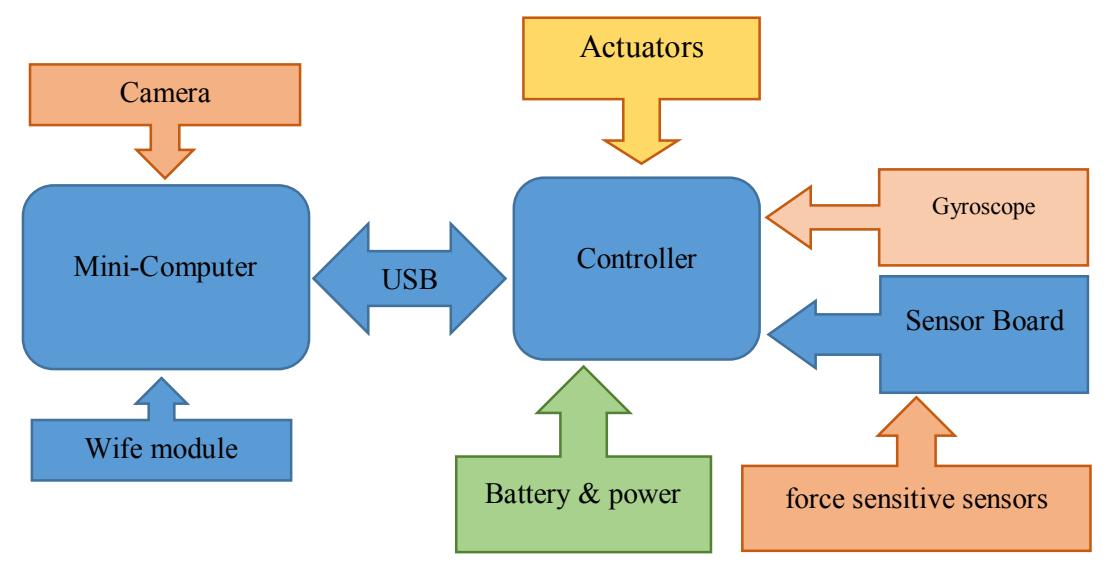
In the electronic unit, we used a central computer alongside two set up and control boards. These two boards are responsible to control and drive motor and sensors and collecting data and feedbacks which represented as follow:
Controller Board: The main role of the control board is as a mediator between motor and central processor. This board benefit from STM32 micro-processor. Having 6 input for the right side of the robot and the same number of the left side makes it possible to drive all robot's motor. IMU6050 used in robot is another responsibility of the board. Also robot power management and feeding central computer, motors, other board and sensors in among other responsibility of the board.
Sensor Board: Our team has been researching and developing some time on a balance control system using sensors beyond the inertia sensors. In reality if robot height increased, balance control needs more feedback from balance status. Then we try to use 6 sensitive sensors to power and pressure at the bottom of every foot and receive their feedback and information to develop and improve our control system several times. In fact, our purpose in homogenous control of pressure and power at the bottom of every foot and also controlling the center of each pressure in feet. However, Rhoban Football Club [2] team recently used multiple control system in their Kid Size robots. In this way we used a drive board alongside applied sensors in each foot. Indeed, analog data of sensors send to drive board with stm32f103c8t6 central processor. This board delivered received data to RS232 controller board and then submitted to main PC trough controller board and consider in robot balance system.
Generally, Block diagram of the electronic hardware robot is as follow:
Software
Motion Control
Currently, our main and most important concern is a dynamic and fast walk. After investigating different methods and algorithms by Baset Teen & Kid Size, MRL-HSL 2019[3] and Nimbro 2017[4], we decided to use an Omni-direction based method that can process with different speeds and has been created and developed by Baset Teen-Size. The major improvement of this module is using a trajectory learning approach that was trained on NAO robot in simulation [5] In this module, hands are used to increase dynamic and speed, and to prevent any decrease in stability. In addition, we slightly modified this module and added a balance control system through force sensitive resistors to improve the performance of this module.
Game Strategy
Before the year in Kish Robocup-ap2018 Tournament, Iran, our strategy and purpose in competitions were briefly catching the ball, moving toward it, finding gate, adjusting angle of standing and shooting ball. The strategy caused always robot select the shortest direction to reach the ball; but considering that robot moves to shoot regardless the direction of target, in most cases either scoring position was provided for the opponent or before shooting, the opponent's robot was blocking the ball rout and the opportunity was lost.
So we alter priorities and equivalence some of them and also using the new localization system, change our strategy as the oval movement towards the ball. Actually, robot in this movement considered shooting direction and try to choose the shortest elliptic direction to reach the ball and keep moving. This way shortened decision-making time for shooting and in fast-moving cases, the robot could be an interesting strategy than before.
Machine Vision
This robot used a USB wen camera by 640*480 pixel pictures at 30 frames per second. The main challenge of the robot in vision part was detecting elements inside the football field such as ball, field lines, and gate. Several algorithms and modifiers were presented by different teams from the beginning of the formation of this league. But each of these algorithms has its own weakness and strength points. As mentioned above and reviews, the TensorFlow library were used for this robot vision. TensorFlow is an open source software library for machine learning in a different type of conceptual responsibilities and language.
Method of identifying the ball and the elements of the ground is based on the lookup table (LUT) approach [6]. In the first stage the performances of semantic segmentation networks trained for official ball of RoboCup were evaluated and then rank them by label and then learned to designed algorithm. We compare real-time and run-time performance of various networks with each other and with a base classification method to prevent excessive use of central processor. This method directly compares pixel values to trained classes. Forming a table, a support vector (SVM) were learned in the same CNN complex to classify pixels [7]. We also use image inputs in HSV color space and searching in trained network to optimize ball detection and ground elements performance. The result of this training and tests was detecting ball was between 90 to 95 accuracy in different part of the ground
Localization
In humanoid League in last year, different algorithms were used which included Extended Kalman filter, particles filter, and Rao-Blackuzelize. In order to estimation absolute current position of the robot in this field, Monte-Carlo localization was used. The robot was benefited from Gyroscope module to estimate (x, y, phi). X and y showed the robot situation in field and phi represented the direction of robot body. We need combination of odometry data and visual signs such as ball, field lines, and gates which originated from camera and Gyroscope module. Monte-Carlo localization is a Bayes filtering method which recursively estimates X^t time to time.
$$p(\mathbf{x}{t} \mid m, \mathbf{o}{1:t}, \mathbf{u}{1:t}) = \eta \cdot \underbrace{p(\mathbf{o}{t} \mid m, \mathbf{x}{t})}{\text{observation model}} \cdot \underbrace{p(\mathbf{x}{t} \mid \mathbf{x}{t-1}, \mathbf{u}{t})}{\text{recursive term}} \cdot \underbrace{p(\mathbf{x}{t-1} \mid \mathbf{o}{1:t-1}, \mathbf{u}{1:t-1})}{\text{recursive term}} d\mathbf{x}_{t-1}$$
Here, η is a normal stabilization resulted by Bayes law, U1:t, O1:t showed all sequence of measurement readings for t time. p(Xt|Xt-1, Ut) term nominated as movement model and showed the possibility of ending robot in (Xt) situation. Considering this movement program run in Xt-1 state. In MLC, reliability distribution rather current robot status is proximate with the collection of n weighted samples or raised hypotheses. The weight of each particle is in proportion to the possibility of robot status.
References
- Farazi H, Hosseini M, Mohammadi V, Jafari F, Rahmati D, Bamdad E. Baset Teen-Size 2014 Team Description Paper. Baset Pazhuh Tehran Corporation, Tech. Rep. 2014
- Allali J., et al., Rhoban Football Club–Team Description Paper
- Mahmudi H, et al., MRL-HSL Teen Size Team Description Paper 2019
- Allgeuer P, Farazi H, Behnke S, Nimbro Teen Size Team Description paper 2017
- Farazi H, Ahmadinejad F, Maleki F, Shiri ME. Evolutionary approach for developing fast and stable offline humanoid walk. InAI & Robotics and 5th RoboCup Iran Open International Symposium (RIOS), 2013 3rd Joint Conference of 2013 Apr 8 (pp. 1-6). IEEE
- Sander G. van Dijk and Marcus M. Scheunemann. Deep Learning for Semantic Segmentation on Minimal Hardware, 2018. To appear in RoboCup 2018: Robot World Cup XXII.
- Da Silva, I.J., Vilao, C.O., Costa, A.H., Bianchi, R.A.: Towards robotic cognition using deep neural network applied in a goalkeeper robot. In: Robotics Symposium (LARS) and 2017 Brazilian Symposium on Robotics (SBR), 2017 Latin American. pp. 1–6. IEEE (2017).
- Hornung A, Oßwald S, Maier D, Bennewitz M, 2014. Monte Carlo localization for humanoid robot navigation in complex indoor environments. International Journal of Humanoid Robotics, 11(02), p.1441002.
- Maier D, Hornung A, Bennewitz M, "Real-time navigation in 3D environments based on depth camera data," in Proc. of the IEEE-RAS Int. Conf. on Humanoid Robots (Humanoids), 2012.