Extended Abstract CIT Brains for RoboCup2022
Masato Kubotera, Hayato Kambe, Kiyoshi Irie, Koki Matsumoto, Gaku Kuwano, Dan Sato, Hiroki Noguchi, Kiyoshiro Kawanabe, Riku Yokoo, Satoshi Inoue, Yuta Mibuchi, Haruki Ogawa, Keita Mori, Naoki Iwasawa, Riko Bato, Ryodai Arai, Yugo Nishio, Yuki Shigematsu, Chikara Hanakawa, Hiroki Hasegawa, Ikuo Shige, Kaito Miyawaki, Kenta Tsukino, Kenzo Fujisaki, Misaki Sekitori, Shun Hoshina, Takuya Nagamine, Yusaku Matsuyama, Yuto Aiba, Hideaki Minakata, Yasuo Havashibara
Chiba Institute of Technology, 2-17-1 Tsudanuma, Narashino, Chiba, JAPAN
Abstract We introduce developments of the CIT Brains for RoboCup2022. We show the lessons learned from RoboCup2019 and introduce a new robot GankenKun Ver.4 for RoboCup2022.
Keywords: durability, maintainability, self-occlusions
Lessons Learned from RoboCup2019 and Development for RoboCup2022
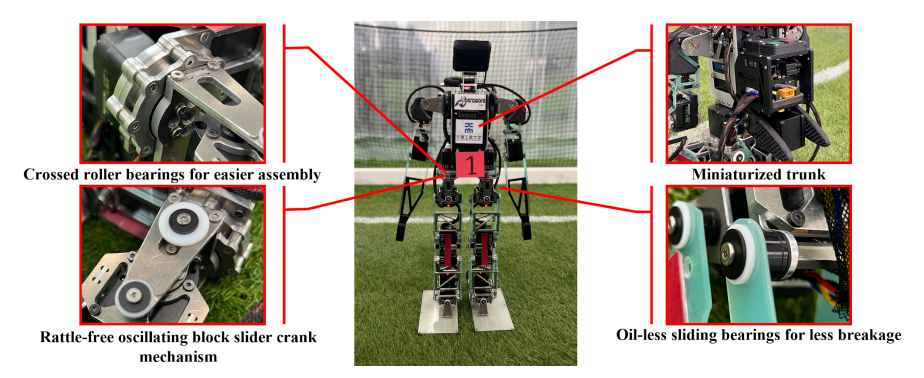
We developed a robot "GankenKun Ver.3" and participated in RoboCup2019. We won the second and third place. The robot was relatively rigid and durable. However, the bearings used in the joint axes often broke down. In addition, the robot was difficult to assemble and maintain. Considering these results, we are now developing "GankenKun Ver.4", a robot with higher rigidity, durability, and maintainability.
Improvement of Leg Joints
When the robot GankenKun Ver.3 played soccer games, the ball bearings used in the robot's legs often broke down. To solve this problem, we changed ball bearings to oilless slide bearings. In addition, it was difficult to assemble the connection between the body and legs with thrust bearings. To make assembly easier, we changed the thrust bearings to crossed roller bearings.
Development of Circuit Board
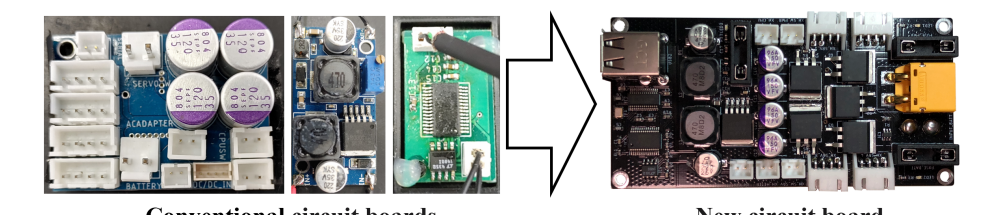
To improve maintainability and add new functions, the circuit boards have been combined into one board. Conventional electrical circuits had separate boards for each function. Then there were many cables to connect them, resulting in poor maintainability and caused problems such as poor contact. The new electrical circuit has solved these problems by consolidating a single circuit board function. In addition, we have added a short circuit that protects the board and a USB-HUB for connecting many USB devices.
Reduction of Self-occlusions
In the GankenKun Ver.3, when the robot's head turns backward, the self-occlusions become large, and the robot may lose sight of the ball behind it. To solve this problem, we changed the location of the battery, the shape of the Wi-Fi antenna, and the size of the handle. This makes it easier for the robot to find the ball behind it.
New Computer and Camera
In GankenKun Ver.3 and Ver.4, we used NVIDIA Jetson TX2 as the computer module, Auvidea J120 as the carrier board, and a USB camera as the source of computer vision. We are now developing new robots with the Jetson Xavier NX to improve performance and a MIPI camera to reduce CPU load during capture.