RO:BIT Team Extended Abstract for Humanoid Kid Size League of RoboCup 2022
Sung Jun Kim, In Gyun Ahn, Eui Jeong Yang Yang Jun Ho Koh, Yong Yeon Kwon, Ji Hun Park, Dong Hui Jo
Robot sports game team of Humanoid Robot School of Robotics, Kwangwoon University, Republic of Korea
Abstract This paper describes the team RO:BIT, which was developed and will be developed based on experience through RoboCup 2019, for RoboCup 2022. In previous competition, due to the inaccuracy of robot position recognition, collisions between robots of the same team and ability to accurately kick the ball toward the goal were insufficient. Also, there were many cases of falling while walking towards the ball. To solve problems, we had big research development in localization and walking control. We put a lot of efforts for RoboCup 2022, and we will represent more developed robot by newly introduced research technology.
Introduction
This paper describes the team RO:BIT, which was developed and will be developed based on experience through RoboCup 2019, for RoboCup 2022. In previous competition, due to the inaccuracy of robot position recognition, collisions between robots of the same team and ability to accurately kick the ball toward the goal were insufficient. Also, there were many cases of falling while walking towards the ball. To solve problems, we had big research development in localization and walking control compare with [1]. We put a lot of efforts for RoboCup 2022, and we will represent more developed robot by newly introduced research technology.
Localization And Vision
We previously located the robot based on walking odometry. However, walking of robot becomes inaccurate due to differences on the floor or unexpected situation. Accordingly, as time passes, errors accumulate, and the difference between the estimated position of the robot and the actual position of the robot increases. We introduced MCL-based localization model to correct the position of the robot [2]. We spread particles throughout the map and compare the distance values between the robot and some points in the lines on field given from vision information to estimate a more accurate location. We give a weight to particles using likelihood field and we find out a particle most like sensor information [3]. But there are many lines in the field that it was complex to differentiate which line it was. To solve this problem, we decided to modify likelihood field and recognize only the core parts rather than all lines. By using these methods, even if walking is inaccurate, it has been improved to recognize the feature points of the field of view and know the exact location. Now, we have completed the development of the above, and we plan to find and try other localization techniques.
Walking Control
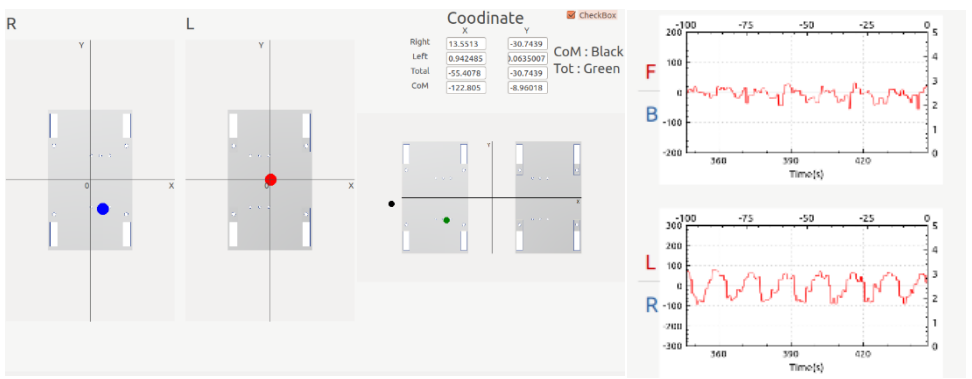
Our team creates walk patterns through several parameters such as time, position, velocity, and acceleration, and adjusts it as a manual program through trial and error. There was a problem of having to adjust the parameters again when the environment changes because we work on adjusting the parameters and walking in a limited environment. To prevent this, posture control was performed through IMU, but there was a limit to compensating for various parameters for walking with only one IMU. To improve these problems and increase the stability of walking, it was decided to add posture control using ZMP (Zero Moment Point) [4] (refer to Fig. 1). Thanks to this, it was possible to save time for controlling parameters, and it was possible to improve the stability of walking and the walking speed. Now, we have completed the development of the above. For better walking stability, we plan to develop LIPM and MPC, which are nonlinear pattern control using ZMP.
References
- Tae Gyeom Kim, Yeon Seo Lee, Chae Won Park, Ju Yeb Shin, Dong Hyeon Kim, Keon Hui Kim, Jun Hui Nam, Hyo Jae Park, "RO:BIT Team Description Paper for Humanoid TeenSize League of RoboCup 2019", Feb 2019.
- Sebastian Thrun, Dieter Fox, Wolfram Burgard, "PROBABILISTIC ROBOTICS", pp. 195-200, 1999-2000.
- Sebastian Thrun, Dieter Fox, Wolfram Burgard, "PROBABILISTIC ROBOTICS", pp. 139-147, 1999-2000.
- Napoleon, Shigekhi NaKaura, and Mitsuji Sampei, "Balance Control Analysis of Humanoid Robot based on ZMP Feedback Control", IEEE International Conference on Robotics and Automation, vol. 3, pp. 2437-2442, Oct 2002.