RoboFEI Humanoid Team 2022
Mariana Aguirre de Oliveira, João Victor Gomes Prado, Luana Watanabe Tonieti, Guilherme Lugon, Thiago Travagini Moura, Reinaldo A. C. Bianchi
Department of Electrical Engineering and Department of Computer Science Centro Universitário FEI, São Bernardo do Campo, Brazil
Abstract In order to prepare a team fully capable of playing soccer in RoboCup Humanoid League, this extended abstract presents the lessons learned and the main changes made since the competition in 2019.
1 Introduction
RoboFEI team started developing humanoid robots in 2012 and has been participating in RoboCup Humanoid KidSize League since 2014. In 2017 the team began the development of taller robots, the first one was Sirius with 90cm and 9.4Kg. This robot participated in Montreal (Canada, 2018). After this, the team optimized the design and built Mirzam and Bellatrix ( 75cm and 5.5Kg ) which participated in Sydney(Australia, 2019)[1]. Since then, the team has been working on improvements in hardware and software to achieve better conditions to participate in the next competition.
In the previous edition held in Sydney(Australia, 2019) the team noticed that the motors were not able to provide the necessary torque for some movements, causing damage to some of them. Futhermore, during the participation in the virtual competition (2021) the group realized that rewriting the code in ROS should be a priority, to facilitate code exchange with other teams, improve code reusability, increase software modularity and reduce the differences between real and simulation codes. So that, a new model of robot was designed with different servo motors and the software is being rewritten to work with ROS.
2 Hardware Improvement
This year we chose to compete with two robots with different models of motors, two players with 19 Dynamixel's servo-motors already used in the previous competitions (XM-430, MX-64, MX-106), named Bellatrix and Mirzam, and two players with 19 Dynamixel's servo motors never used by the team (XM-540, XM-430), named Prometheus, forming a team of 4 players. We decided to make this change because they are engines with more torque and with strategic positions to be attached to parts made of 3D printing, aluminum, and carbon fiber. Furthermore, we are studying better ways and materials to build the chest plate to cushion the fall and reduce the chance of engines breaking down.
3 Software
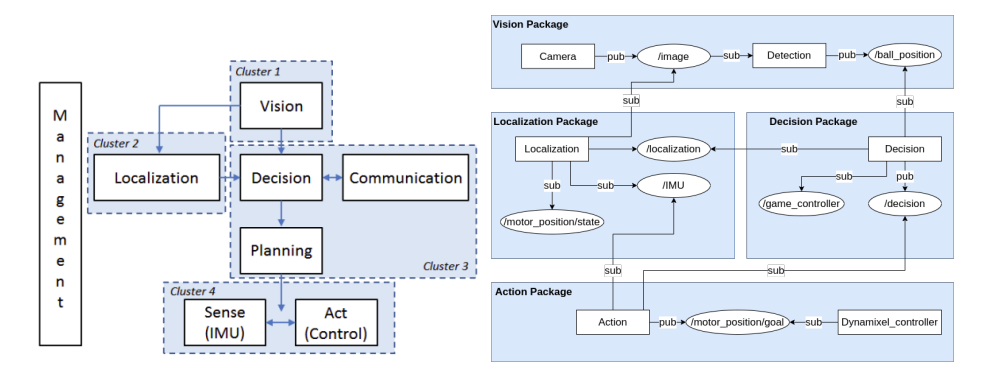
The software used is structured upon Cross Architecture, which is a hybrid architecture since it has aspects of both reactive and hierarchical paradigms. This structure is shown in Figure 1. To improve code exchange with other teams and between our real and simulated robots, the team is rewriting its code using ROS 2, which is an open-source framework for building robot applications. The structure the team is developing can be seen in Figure 2.
4 Status
One of the Prometheus robots designed with XM series Dynamixel motors is already built and we are currently finishing the other one. The main focus of the team now is to finish the implementation of all the packages in ROS 2. The Vision and Action packages shown in 2 were already done and tested in both real and simulated robots, although further tests will be needed to integrate with the other packages that are still being developed.
References
- Coelho, G. C. , et al. "RoboFEI Humanoid League Team 2020." RoboCup Humanoid Soccer KidSize League(2020).