Barelang FC - Team Description Paper Humanoid Kid-Size League, RoboCup 2023 France
Eko Rudiawan Jamzuri, Iman Rofiq Syamsul, Salman Al-Farisi, Abdillah Fikri, Leo Chandra Yulianto, Aldi Wahyudi, Adimas Arief Rahman, Yang Delila Salsabila, Yeni Aryani, Diki Saputra, Susanto
Politeknik Negeri Batam, Jl. Ahmad Yani, Batam Centre, Batam 29461, Indonesia
Abstract This paper presents a description of the Barelang FC team for RoboCup 2023. We described several problems from the previous competition and the current improvements of the Barelang FC robot.
Keywords: humanoid robot · bipedal robot · robot soccer · RoboCup humanoid.
Introduction
Barelang FC is a humanoid robot team from Politeknik Negeri Batam formed in 2012. We participated several times in the RoboCup Humanoid League and achieved third place in the kid-size in RoboCup 2018. Unfortunately, since the COVID-19 pandemic, we have stopped participating in the RoboCup. However, research was still being carried out to face problems from the previous competition.
Some lessons learned from the last competition were the lack of robustness and slow vision speed, less optimal robot's gait and kick engine and inaccurate robot localization. Moreover, during COVID-19, we have a mechanical issue with the robot. The shoulder joint is easy to break when the robot falls. Nevertheless, the team has made several improvements regarding the problems. We describe Barelang FC's latest improvement in the following section.
Hardware Improvement
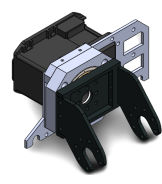
We still maintain the mechanical design from the previous year. However, we changed the material type and modified the shoulder pitch joint design. Currently, we use 6061 aluminum alloy, Garolite (G-10), and Polyoxymethylene (POM). Modifications at the shoulder pitch joint can be seen in Fig. 1. This modification aims to reduce the direct impact and burden on the servo when the robot falls and performs standing.
On the other hand, we developed a Unified Robot Description Format (URDF) simulation model to support research. The kinematics and dynamics parameters used in the simulation model are directly obtained by exporting from CAD designs, but the link weight is weighed directly from the robot. We use Jetson Xavier NX and OpenCR as the robot controller for the electrical systems. In addition, we upgraded the servo protocol to Dynamixel 2.0 to increase the data communication speed.
Software Improvement
We used ROS2 as the main software framework for the robot. Meanwhile, we adopted the source code from the team UPennalizers for the gait and motion controller[5]. We developed the ROS2 bridge in [1, 2] to communicate ROS2 with UPennalizers frameworks. Additionally, we made improvements in motion by tuning gaits and kick engine parameters manually. Currently, robots can kick the ball with a distance of 8-10 meters, improving from the previous year, which was only 4.5-6 meters. In the vision system, we changed the last detection approach in [4, 3] by YOLOv7, which can achieve a maximum detection speed of 47 FPS and [email protected] of 52.78%. For the localization system, we changed from the Monte Carlo Localization approach to grid-based localization using visual landmarks only. We tested the localization system on the virtual environment and achieved a maximum accuracy of 92.8%.
References
- Jamzuri, E.R., Mandala, H., Baltes, J.: Ros based software framework for kid-size humanoid marathon robot. In: 2019 2nd International Conference on Applied Engineering (ICAE). pp. 1–6. IEEE (2019)
- Susanto, S., Priono, E., Analia, R.: Establishing ros on humanoid soccer robotbarelangfc software system. Jurnal Integrasi 13(2), 113–121 (2021)
- Susanto, S., Putra, F.A., Analia, R.: Xnor-yolo: The high precision of the ball and goal detecting on the barelang-fc robot soccer. In: 2020 3rd International Conference on Applied Engineering (ICAE). pp. 1–5. IEEE (2020)
- Susanto, S., Rudiawan, E., Analia, R., Pamungkas, D.S., Soebakti, H.: The deep learning development for real-time ball and goal detection of barelang-fc. In: 2017 International Electronics Symposium on Engineering Technology and Applications (IES-ETA). pp. 146–151. IEEE (2017)
- Yi, S.J., Hong, D., Lee, D.D.: A hybrid walk controller for resource-constrained humanoid robots. In: 2013 13th IEEE-RAS International Conference on Humanoid Robots (Humanoids). pp. 88–93. IEEE (2013)