RoboFEI Humanoid Team 2023
Mariana Aguirre de Oliveira, Maria Gabriela Aguirre de Oliveira, João Victor Gomes Prado, Thiago Travagini Moura, Luana Watanabe Tonieti, Julia Gagliera Hernandes, Leticia Rodrigues Galante, Vinicius Prates, Luis Filipe Rotta, Lucas Lagoeiro, Flávio Tonidandel, Plinio Aquino Jr, Danilo H. Perico, Isaac Jesus da Silva, Reinaldo A. C. Bianchi
Department of Electrical Engineering and Department of Computer Science Centro Universitário FEI, São Bernardo do Campo, Brazil
Abstract In order to prepare a team fully capable of playing soccer in RoboCup Humanoid League, this extended abstract presents the lessons learned and the main changes made since the competition in 2022.
1 Introduction
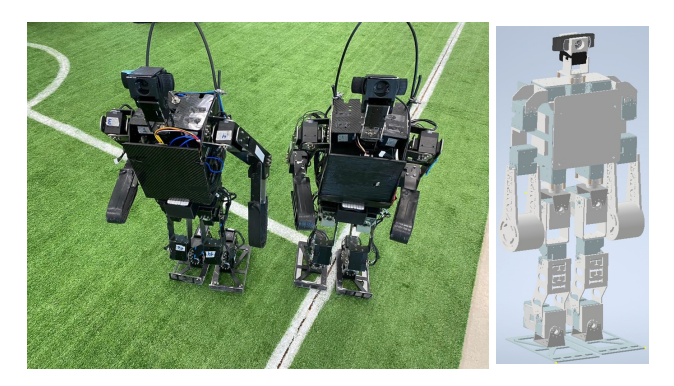
RoboFEI team started developing humanoid robots in 2012 and has been participating in RoboCup Humanoid KidSize League since 2014. In 2017 the team began the development of taller robots, the first one was Sirius with 90cm and 9.4Kg. This robot participated in Montreal (Canada, 2018). After this, the team optimized the design and built Mirzam and Bellatrix ( 75cm and 5.5Kg ) which participated in Sydney (Australia, 2019)[1]. In the last competition in Bangkok (Thailand, 2022)[2] the team used another robot project named Prometheus Figure 1 ( 80cm and 7,5Kg ).
In the previous edition held in Bangkok (Thailand, 2022) the team noticed that the Prometheus project has many mechanical and electrical problems, which causes instabilities in the robot's movements and consequently we had to keep adjusting all the time. We also participated in LARC-2022 the team got second place in the competition with the same robot used on RoboCup.
2 Hardware Improvement
This year we chose to make a completely new robot named Crusis Figure 2, for this project we are studying ways to improve the damping when the robot falls, testing carbon fiber filaments for 3D printing to perform this damping. We are also adapting the pieces by placing threads to avoid letting the screws fall out during movements.
We are currently in the assembly phase of this new project, also studying better ways to organize the interior to maintain a good center of mass to improve the balance of the robot. While the physical assembly of the robot is being carried out, we are using the gazebo to carry out some software tests already using the project's URDF.
For improvement in electrical, we are developing an electronic board that combines power and communication. The motors will be connected in series and will have only four connectors on the new board. Previously having many connections resulted in problems with unstable connections and a lot of maintenance.
3 Software
The team's current software is fully working with ROS2 framework, having the vision, decision, control and sensors' and gamecontroller's communication ready. The neural network used in the robot's vision has been updated to a newer network, the old one being MobileNet and the current one being YOLOv7-tiny. It'll be capable of recognizing balls, robots and field's landmarks.
At the moment, the team's goal is to improve its code, since there are still several problems to be solved. Furthermore, the team intends to implement localization using ROS2, with the Monte Carlo algorithm, given that currently the robot is not able to know its position in the field.
References
- Coelho, G. C., et al. "RoboFEI Humanoid League Team 2020." RoboCup Humanoid Soccer KidSize League(2020).
- Oliveira, M. A., et al."RoboFEI Humanoid League Team 2022." RoboCup Humanoid Soccer KidSize League(2022).