ZJUNlict Extended Abstract Humanoid Kid-Size League of Robocup 2023
Zheyuan Huang, Jiangpin Liu, Jialei Yang, Jiazheng Yu, Jiaxi Huang, Wei Yu, Chunlin Zhou, Rong Xiong
Zhejiang University
Abstract The ZJUNlict 2023 team from Zhejiang University builds upon the ZJUDancer team after a three-year gap. The team focuses on two main improvements: developing a more agile gait algorithm and a more robust odometer. To support these goals, the team has developed new hardware to increase computing resources and improve feedback frequency, replacing the main computing board and redesigning the communication board. The team plans to further enhance robot recognition, add more targeted football tactics, implement real-time gait planning, and develop a visualizer for gait parameter tuning.
Introduction
The ZJUNlict 2023 team from Zhejiang University (China) builds upon the ZJUDancer team. It's been three years since our ZJUDancer team last competed in RoboCup 2019 so our team members participating this year are all rookies.
The last game in Sydney mainly exposed our lack of gait algorithm and kicking ability. Since the last competition, we mainly focus on the following two points. A more agile gait improves movement speed, reduces falls and enables more complex soccer skills, and a more robust odometer is a prerequisite for improving long-term positioning accuracy with the scene of repetitive landmarks.
We developed new hardware to support the above two points, mainly focusing on increasing computing resources and improving feedback frequency.
Hardware Changes
The main goal of our hardware changes is to increase computing resources and increase the frequency of force feedback. So we replaced the main computing board and redesigned the communication board (shown in Figure 1-c). The comparison of robot specifications is in Table 1.
Compared with before, we can obtain higher communication frequency and lower latency using new communication topology(shown in Figure1-b), which is well supported for agile gait.
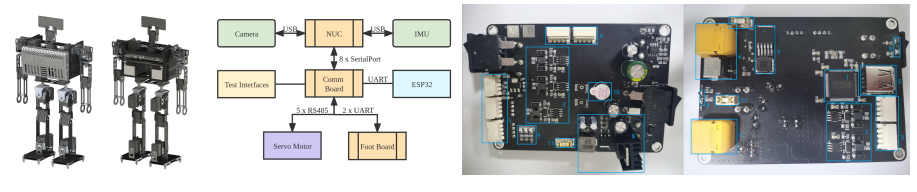
Table 1: Robot Specifications.
| Robot version | v2019 | v2023 |
|---|---|---|
| CPU Board | Nvidia Jetson TX2 | Intel NUC 11 Enthusiast |
| CPU | NVIDIA Denver & Cortex-A57 | Intel i7-1165G7 |
| Geekbench Score(Multi) | Lower than 2834(Nvidia NX) | 4411 |
| GPU | 256-core NVIDIA Pascal | Nvidia Geforce RTX 2060 |
| CUDA cores | 256 | 1920 |
| Communication Chip | STM32+FT232RL+MAX3443 | CH348L+MAX3485 |
Table 2: VIO Algorithms Compare
| Algorithms | CPU Usage | Mem Usage | Error of Loop (%) |
|---|---|---|---|
| VINS-Fusion | 270 | 2.4 | 2.6 |
| OpenVINS | 100.7 | 2.1 | 4.3 |
| ORB-SLAM3 | 265 | 13.2 | 2.2 |
Visual Inertial Odometry (VIO) Algorithm Test
Combining VIO to complete self-positioning can effectively improve positioning accuracy. We have tested three algorithms using AMD 2700x and 16G 3200MHz memory, the results are shown in the table 2. The follow-up work will be to improve the self-positioning accuracy by combining the VIO algorithm.
Future Works and Conclusion
In addition to the imperfect work mentioned above, we also plan to achieve the following points.
- Improve robot recognition and friend-or-foe recognition to achieve stronger perception capabilities.
- Add more targeted football tactics such as breakthrough and marking.
- Real-time gait planning based on MPC combined with ZMP criterion.
- A visualizer for better tuning of gait parameters.
We have not participated in international competitions for three years. All members are participating in the competition for the first time. We hope to make more improvements in the next six months. Looking forward to seeing you all.