Rhoban Football Club – Extended abstract Humanoid Kid-Size League, Robocup 2023 France
J. Allali, C. Brocaire, C. Dobigeon, M. Duclusaud, C. Gaspard, H. Gimbert, L. Gondry, O. Ly, G. Passault, A. Pirrone
CNRS, LaBRI, University of Bordeaux and Bordeaux INP, 33405 Talence, FRANCE
Abstract This extended abstract presents some current ongoing work of the Rhoban team for the RoboCup 2024.
End-to-end localization
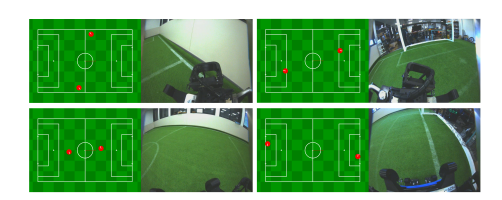
The current localization approach relies on features detection (using YOLOv8[2] network) that are fed to a custom particle filter. The annotation process is however tedious, and the features we annotate are mere proxies to the real quantity that we want to estimate: the pose of the camera on the field.
Thanks to laboratory ground truth (in our case, HTC Vive trackers), we are able to auto-label images and efficiently build datasets where the camera pose is known. We created a first dataset containing 15k such images, and are exploring the possibility of training a end-to-end neural network for camera pose estimation for the case of RoboCup soccer fields.
Footsteps planning improvement
Our footsteps are currently planned using a custom reinforcement learning formulation. We plan to publish and open-source this work to make it available as a separate software component usable by other teams.
This environment is also currently being improved to better take in account near obstacles such as opponent robots, and to embrace a more accurate specification of the possible footsteps that the robot is able to take.
Motors limitations
The planning of the walk is currently done independently of the motors capabilities. However, the motors have limitations in terms of speed and torque, which can be exceeded in the planned walk. By exceeding these limitations, we cannot ensure that the motors will be able to follow the planned walk. For this reason, we limit the speed of the motors based on an estimation of their torques in the whole body control.
Our pressure sensors allow for a (currently under-utilized) measures of external forces acting on the robot, which can eventually be used to provide estimation of the torques involved in the actuators.
Those torques can then be used for a better state estimation, yielding better trajectory following in whole body control, but also be used offline to build a better models of the actuators using self-supervised methods as in [1].
Experimenting new robot design
We are currently working on a new robot design with torque controllable motors. The main idea is to use a mix of harmonic drive and quasi-direct-drive motors to increase the torque and speed of the actuators. We also plan to use new transmission systems such as timing belts and linkages to reduce the inertia of the robot's end effectors.
The dimensions of the motors and the reduction ratios are chosen according to the needs of the current walking algorithm of Sigmaban. The goal is to optimise the power/weight ratio of the robot.
The design of the new robot is still in progress, we hope some advancements can be shared during the next RoboCup.
References
- Jemin Hwangbo, Joonho Lee, Alexey Dosovitskiy, Dario Bellicoso, Vassilios Tsounis, Vladlen Koltun, and Marco Hutter. Learning agile and dynamic motor skills for legged robots. Science Robotics, 4(26):eaau5872, 2019.
- Ultralytics. Github repository : Ultralytics/ultralytics: Yolov8, December 2023.