AcYut4 (Teen Size League) - Technical Description Paper
B.K. Rout, Akash Gupta, Tushar Agrawal, Apurva Srivastava, Deepak G, Dhairya Seth
Center for Robotics & Intelligent Systems, Birla Institute of Technology and Sciences, Pilani
http://www.bits-pilani.ac.in · http://www.acyut.com
Abstract AcYut (www.acyut.com) is the first and only team from India to have participated in RoboGames (formerly called "RoboOlympics"), held at San Francisco, USA, which is the world's largest open robot competition according to the Guinness Book of World Records. After the overwhelming success of AcYut I in 2008, the team successfully built stronger, taller and better versions of the robot. AcYut4 is an autonomous humanoid robot with 28 degrees of freedom. This paper describes the technical specifications, mechanical design, electrical architecture, software systems, and control mechanisms of AcYut4 for RoboCup 2011.
Introduction
AcYut (www.acyut.com) is the first and only team from India to have participated in RoboGames (formerly called "RoboOlympics"), held at San Francisco, USA, which is the world's largest open robot competition(www.robogames.net) according to the Guinness Book of World Records. After the overwhelming success of AcYut I in 2008, the team also successfully built another stronger, taller and better version of the robot, AcYut II as an entry for Robo Games, 2009. This was followed by the release of AcYut III in April 2009 and the results were more than satisfactory. The humanoid managed to win the Bronze medal in RoboGames 2009. The team reached the pinnacle of success the next year when Acyut II won Gold and its sibling Acyut III clinched Silver in the Sumo wrestling event of RoboGames 2010. Acyut III also won Bronze (KungFu) and Silver (Freestyle) in the same edition of the games.
The robot also created a new world record for the most weight lifted by a large humanoid (40 CDs) at FIRA 2010, held at Bangalore in September 2010.
Team has been preparing for RoboCup since one year and has upgraded the robots to autonomous stage. Before appearing at RoboCup 2011 at Turkey, Team AcYut will also participate at RoboCup Iran in April 2011.
Hardware
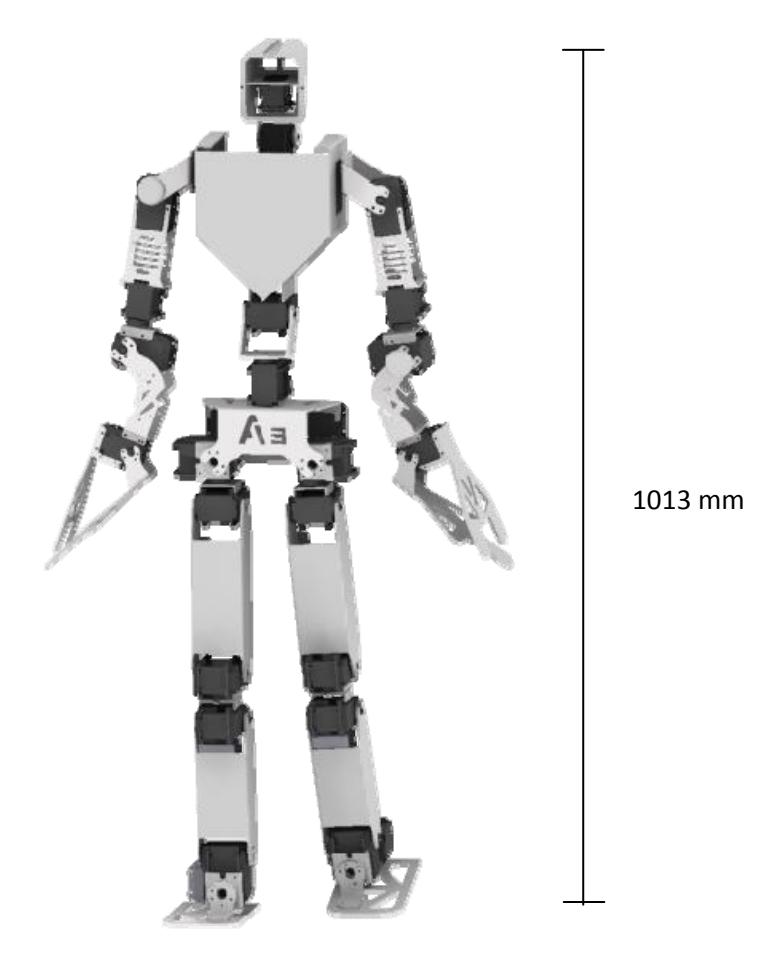
AcYut‐4, the newest version of AcYut has 28 Degrees of freedom; 14 in legs, 10 in arms, 2 in head and 2 in Torso. Every degree of freedom is actuated by single Robotis Dynamixel motors. The links between two joints have been made using Aluminum 6061 metal.
Physical Specifications of the robot are as Follows:
Height: 1013 mm Width: 410mm Depth: 258mm Weight: 7.3 Kg
1. Mechanical Design
AcYut‐4, the newest version of AcYut has 28 Degrees of freedom; 14 in legs, 10 in arms, 2 in head and 2 in Torso. Every degree of freedom is actuated by single Robotis Dynamixel motors.
The links between two joints have been made using Aluminum 6061 metal.
List of Degree of Freedoms for the humanoid
| Body Part | Roll | Pitch | Yaw |
|---|---|---|---|
| Head | Yes | Yes | |
| Shoulder | Yes | Yes | |
| Elbow | Yes | Yes | |
| Torso | Yes | Yes | |
| Hip | Yes | Yes | Yes |
| Knee | Yes | ||
| Toe | Yes | Yes |
Specification of Motors
| Actuator | Torque | Speed |
|---|---|---|
| EX‐106 | 106 Kgcm @ 18.5V | 0.143 sec / 60 Deg @ 18.5V |
| RX – 64 | 64 Kgcm @ 18.5V | 0.162 sec / 60 Deg @ 18.5V |
2. Electrical Design
Robot consists of 3 Processors.
- Gumstix Overo Fire (720 MHz ‐ Omap 3530 Microprocessor) Master Controller
- LPC2106B for Image Processing Slave Controller
- Atmega 328 To process data from IMU Slave Controller
The entire motor line consists of 28 motors which connect to the microprocessor with a single link using an RS‐485 line.
The power supply management system includes 2 rechargeable Lithium‐Polymer 5‐cell batteries (18.5V, 2600mAh)
Software Specifications
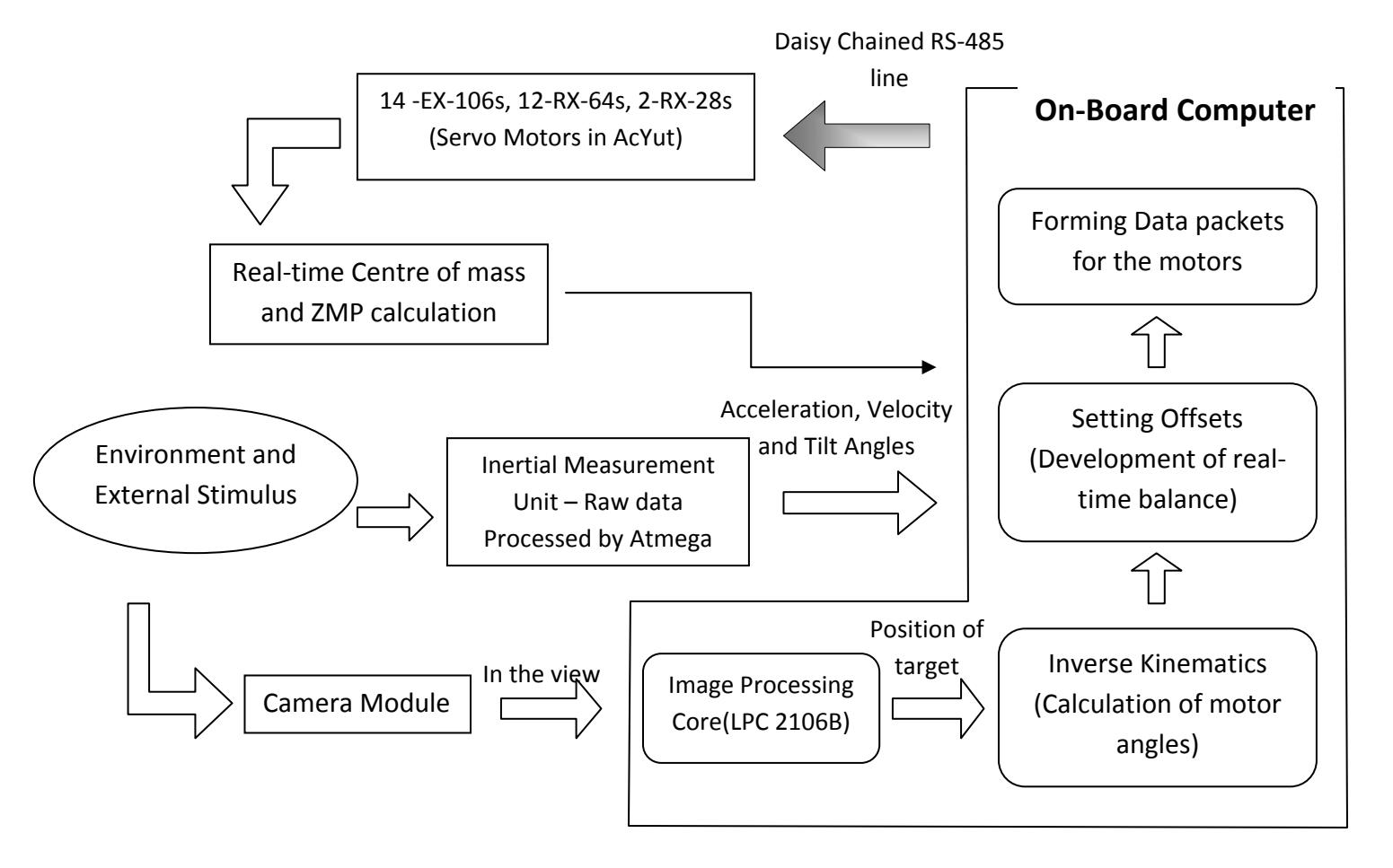
The software architecture consists of three processes, Recognition, Motion and Balancing. The three processes runs in parallel and interchange data through a message queue. Cognition is responsible for information perception, self‐localization and behavior decision, while Motion is responsible of gait planning and motor controlling.
Gumstix receives the target coordinates from Image processing Unit (LPC2106B) and it generates trajectory of motion to reach the target position using Inverse Kinematic engine. Also to ensure that the robot is balanced, a feedback system has been implemented.
Image Processing
Camera: CMUcam3 ‐ CIF resolution (352x288) RGB color sensor
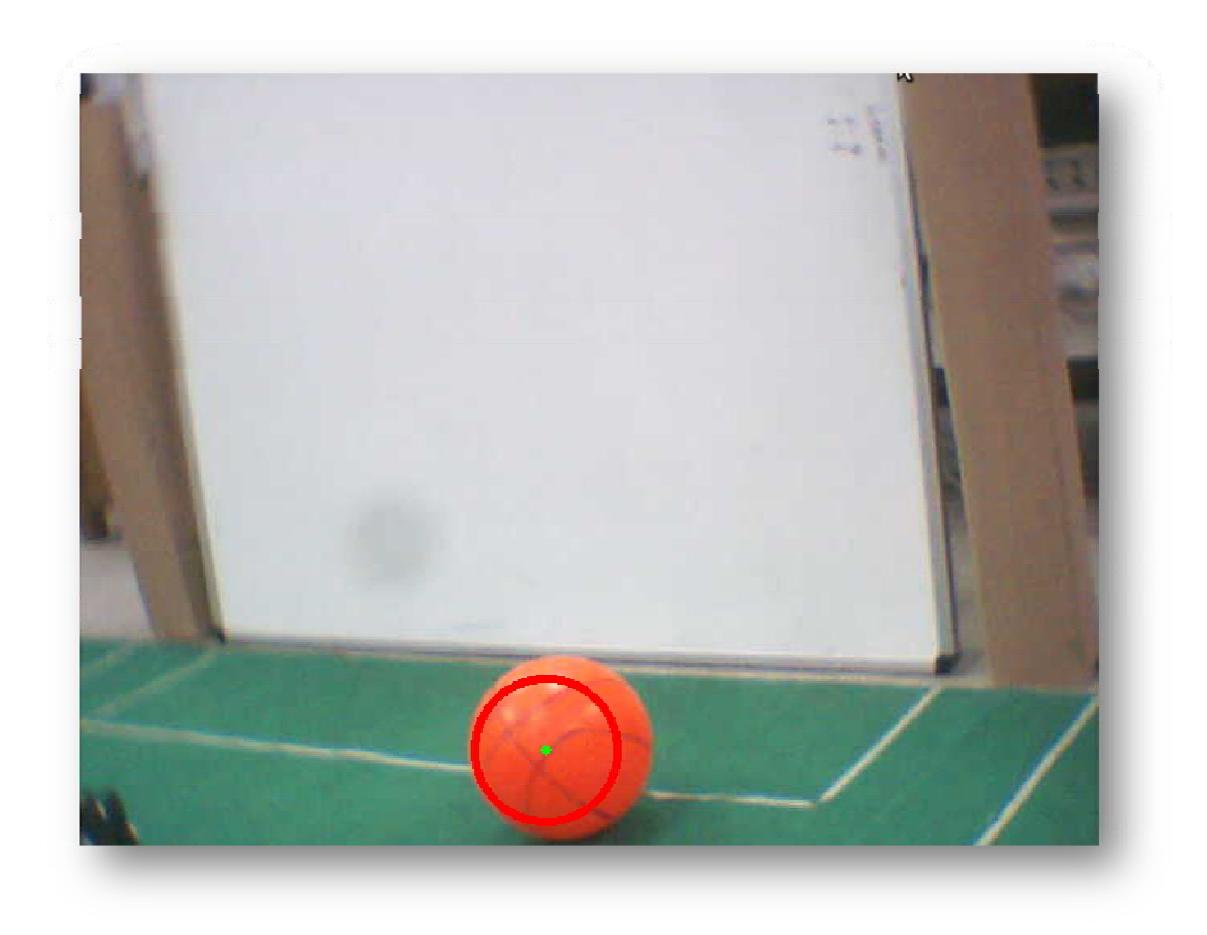
The Image Processing unit (LPC2106B) mounted on the head of AcYut is used to detect the ball, the goal, the corner poles and the field lines of interest. The image is taken in an RGB Color space and converted to a space optimized form. Next, the image is scanned into a grid of horizontal spaces for ease of computation.
A pre‐defined set of interest areas are defined for detection. The segmented image areas and patterns are compared with these pre‐defined ones.
Right after the detection of an image of interest its many parameters are calculated. The ball detection is followed by the precise detection of the centroid of the geometry and the estimation of the size/radius of the ball. On finding the goal (owing to the many similar colored pixels in the same pattern/area), the edges of the goal and its size estimates are found. This indicates the direction in which to aim for the best possible oriented goal.
Using this environment, a calculated trajectory is developed to reach the ball and complete the goal.
Sensors
The following sensors are used in AcYut4:
Sensors
| Sensor | Details |
|---|---|
| Camera | 328 X 288 Resolution 24FPS |
| Gyro (IMU) | ±300 Degree Angular Rate |
| Accelerometer (IMU) | ±3g |
Conclusion
AcYut 4 is an autonomous humanoid robot. In this paper we have mentioned the specifications and functions of AcYut4 and details about its Control System, Image Processing, localization and gait planning. We will continue to improve the system for the RoboCup 2011.