NimbRo TeenSize 2011 Team Description
Sven Behnke, Marcell Missura
Rheinische Friedrich-Wilhelms-Universität Bonn Computer Science Institute VI: Autonomous Intelligent Systems
http://www.NimbRo.net · www.NimbRo.net
Abstract Our team uses self-constructed robots for playing soccer. The paper describes the mechanical and electrical design of the robots. It also covers the software used for perception and behavior control.
Introduction
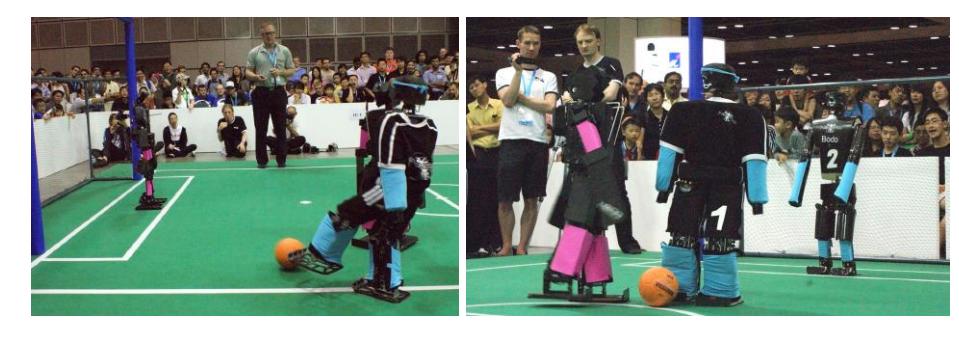
Our TeenSize team participated with great success at last year's RoboCup Humanoid League competition in Singapore. The robots won the first 2 vs. 2 soccer tournament, the technical challenges, and received the Louis Vuitton Best Humanoid Award. Figure 1 shows the final soccer game, where our robots met CIT Brains from Japan. The field players of both teams were able to find the ball and to kick it reliably and both teams had goalies able to quickly jump to the ground. Because our robot Dynaped was usually the first at the ball, the game ended 10:0 for NimbRo.
2 Mechanical and Electrical Design
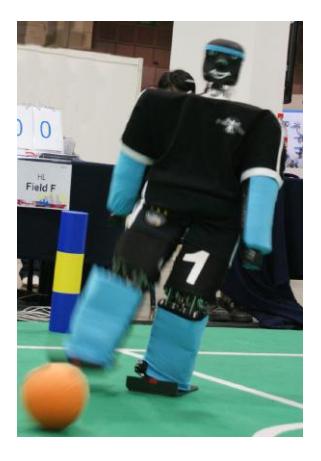
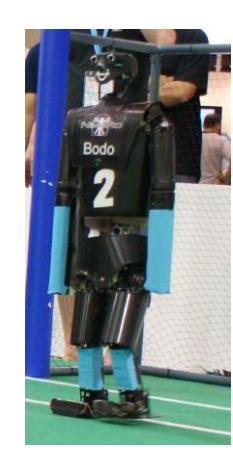
Fig. 2 shows our two TeenSize robots: Dynaped and Bodo. As can be seen, the robots have human-like proportions. Their mechanical design focused on simplicity, robustness, and weight reduction.
Dynaped is 105 cm tall, and weighs 7 kg. The robot has 13 DOF: 5 DOF per leg, 1 DOF per arm, and one joint in the neck that pans the head. Its legs use a parallel kinematics, which keeps the hip parallel to the ground in sagittal direction. The joints are driven by master-slave pairs of Robotis Dynamixel EX-106 actuators.
Bodo is 103 cm tall and has a weight of about 5 kg. The robot is driven by 14 Dynamixel actuators: 6 per leg and 1 in each arm. For all leg joints, except hip yaw, we use large RX-64 actuators. All other joints are driven by smaller DX-117 actuators.
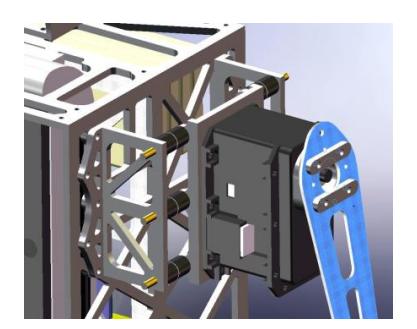
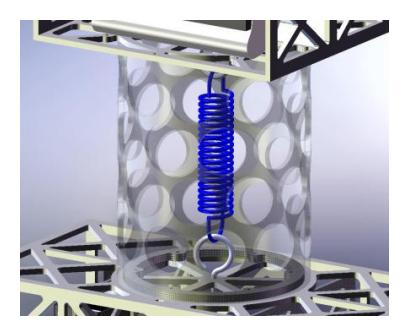
The skeleton of the robots is constructed from aluminum extrusions with rectangular tube cross section. In order to reduce weight, we removed all material not necessary for stability. The feet and other flat parts are made from sheets of carbon composite material. For protection, we included a layer of foal between the outer shell of the robots and their skeleton. As shown in Fig. 3, Dynaped and Bodo have a mechanical fuse between the hip and the spine, which allows the robots to jump quickly to the ground as a goalie.
3 Perception
Our robots need information about themselves and the situation on the soccer field to act successfully.
3.1 Proprioception
The readings of accelerometers and gyros are fused to estimate the robot's tilt in roll and pitch direction. The gyro bias is automatically calibrated and the lowfrequency components of the tilt estimated from the accelerometers are combined with the integrated turning rates to yield an estimate of the robot's attitude that is insensitive to short linear accelerations. Joint angles, speeds, and loads are also available. Temperatures and voltages are monitored to notify the user in case of overheating or low batteries.
3.2 Computer Vision
We capture and process YUV images. Pixels are color-classified using a color look-up table. In the downsampled color-classified image we detect the ball, the goals, the poles, goal-posts, restart markers, field line features, obstacles, team mates, and opponents by color and size. We estimate distance and angle to each feature by removing radial lens distortion and by inverting the projective mapping from field to image plane. For field line features at corners and Tjunctions, we also estimate their orientation relative to the robot.
With limited FOV, parts of the soccer field and the dynamic world state can not be perceived directly. This knowledge has to be inferred and estimated indirectly instead. The goalkeeper, for example, must estimate its pose within the goal through localization using a limited set of visible landmarks. Also, it is valuable to distribute knowledge of the ball position among the players in a team using localization information.
The robot can not perceive its motion directly. Instead, we model its motion based on its gait target velocity. The model accounts for the high noise in its execution. Also, the distance and angle measurements to landmarks are subject to high noise, especially due to inclinations of the robot during walking.
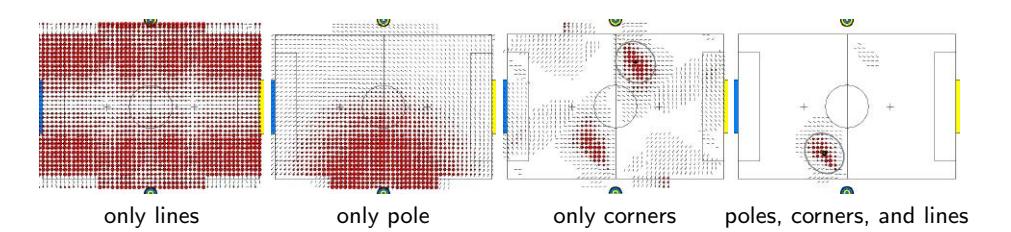
As the goals, the poles, and the goal posts are not sufficient for our localization purposes, we use landmarks like the restart markers, field line corners, and field line T-junctions in addition. We estimate the robot's pose on the field using a particle filter (MCL) [7].
To handle unknown data association of unidentified landmarks, we sample the data association on a per-particle basis. The association of field line corner and T-junction observations to landmarks also utilizes landmark orientation. The belief resulting from different features is illustrated in Fig. 4. Further details can be found in [5].
4 Behavior Control
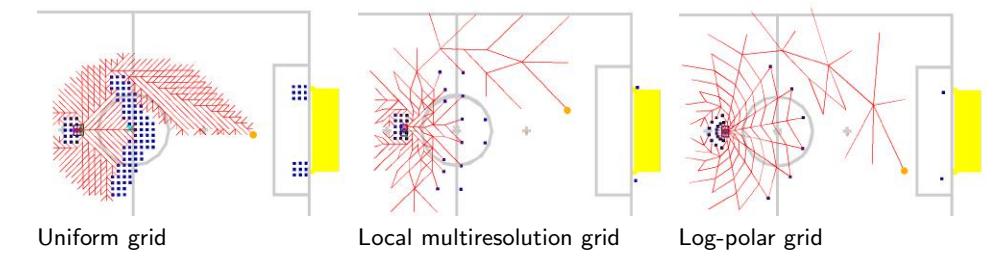
We control the robots using a framework that supports a hierarchy of reactive behaviors [1]. This framework allows for structured behavior engineering. Multiple layers that run on different time scales contain behaviors of different complexity.
5 Conclusion
At the time of writing, Jan 28th, 2011, we made good progress in preparation for the competition in Istanbul. We will continue to improve the system for RoboCup 2011. The most recent information about our team (including videos) can be found on our web pages www.NimbRo.net.
Acknowledgements
This project has been supported by Deutsche Forschungsgemeinschaft (German Research Foundation, DFG) under grant BE 2556/2.
Team Members
Currently, the NimbRo soccer team has the following members:
- Team leader: Prof. Sven Behnke
- Members: Marcell Missura, Matthias Nieuwenhuisen, and Michael Schreiber
References
- Sven Behnke and Jörg Stückler. Hierarchical reactive control for humanoid soccer robots. International Journal of Humanoid Robots (IJHR), 5(3):375–396, 2008.
- S. Kajita, F. Kanehiro, K. Kaneko, K. Yokoi, and H. Hirukawa. The 3D linear inverted pendulum mode: A simple modeling for a bipedwalking pattern generation. In Proceedings of IROS, pages 239–246, 2001.
- Marcell Missura, Tobias Wilken, and Sven Behnke. Designing effective humanoid soccer goalies. In Proc. of International RoboCup Symposium, Singapore, 2010.
- Andreas Schmitz, Marcell Missura, and Sven Behnke. Learning footstep prediction from motion capture. In Proceedings of International RoboCup Symposium, Singapore, 2010.
- Hannes Schulz, Weichao Liu, Jörg Stückler, and Sven Behnke. Utilizing the structure of field lines for efficient soccer robot localization. In Proceedings of International RoboCup Symposium, Singapore, 2010.
- Ricarda Steffens, Matthias Nieuwenhuisen, and Sven Behnke. Multiresolution path planning in dynamic environments for the standard platform league. In Proceedings of 5th Workshop on Humanoid Soccer Robots at Humanoids 2010, Nashville, 2010.
- S. Thrun, W. Burgard, and D. Fox. Probabilistic Robotics. MIT Press, 2005.