AcYut-5 2012 Team Description Paper: TeenSize Humanoid Robot Soccer Team
B.K. Rout, Tushar Agrawal, Apoorv Shrivastava, Deepak Gopinath, Apoorv Umang, Himanshu Hansaria, Kaustubh Nawade, Khannan Sundar, Mandar Thombre, Pulkit Goyal, Tarang Shah
Center for Robotics & Intelligent Systems; Birla Institute of Technology and Sciences, Pilani, Rajasthan, India
http://www.bits-pilani.ac.in · http://www.acyut.com
Abstract Team AcYut was founded in 2008 at BITS-Pilani with the aim of innovating and building India's First Humanoid Robot. It consists of Undergraduate students from all disciplines.
The Specifications and the working of the Fifth version of AcYut, AcYut-5, are provided in this paper.
Keywords: Humanoid, TeenSize, Robot soccer
Introduction
AcYut is India's first Indegenously developed Humanoid team. It is the only Indian team to have participated in International Robotics Competetions like RoboGames, held at San Francisco, USA. After the overwhelming success of AcYut I in 2008, the team also successfully built another stronger, taller and better version of the robot, AcYut II as an entry for RoboGames, 2009. This was followed by the release of AcYut III in April 2009 and the results were more than satisfactory. The humanoid managed to win the Bronze medal in RoboGames 2009. The team reached the pinnacle of success the next year when AcYut II won Gold and its sibling AcYut III clinched Silver in the Sumo wrestling event of RoboGames 2010. AcYut III also won Bronze (KungFu) and Silver (Freestyle) in the same edition of the games.
The robot also created a new world record for the most weight lifted by a large humanoid (40 CDs) at FIRA 2010, held at Bangalore in September 2010.
Finally, in 2011, the team participated in RoboCup-2011, Istanbul, Turkey, where, it was awarded a third position in the TeenSize Category.
In the Last one year, working under the guidance of Prof. B.K.Rout, the team has improved several algorithms in the robot, ranging from Localisation to dynamic balancing and footstep planning for the next edition of RoboCup, RoboCup-2012.
Hardware
This section describes the hardware components of AcYut-5.
Mechanical Design
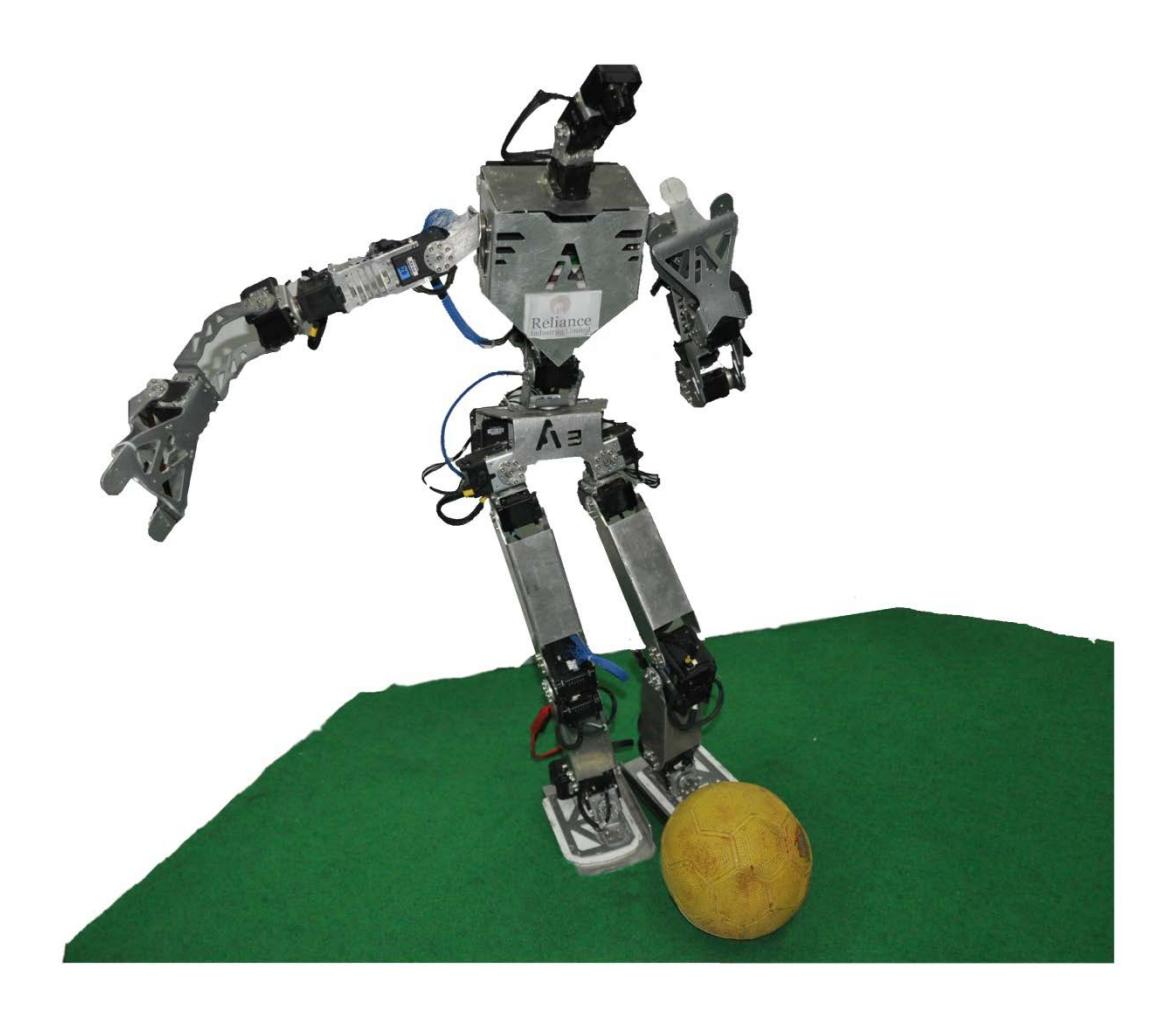
AcYut-5, the newest version of AcYut has 28 Degrees of freedom; 14 in legs, 10 in arms, 2 in head and 2 in Torso. Every degree of freedom is actuated by single Robotis Dynamixel motors.
The links between two joints have been made using Aluminum 6061 metal.
Physical Specifications of the robot are as follows:
- Height of the robot: 1013 mm.
- Weight of the robot: 7.2 Kg
- Walking speed: 20cm/Sec
- Number of degrees of freedom: 28
- Type of motors:
- Robotis EX -106 +: 106Kgcm @ 18.5V in Legs.
- Robotis RX – 64: 64 Kgcm @ 18.5V Arms
- Robotis RX -28: 28Kgcm @18.5V in head
The entire motor line consists of 28 motors which connect to the microprocessor with a single link using an RS-485 line.
List of Degree of Freedoms for the humanoid
| Body Part | Roll | Pitch | Yaw |
|---|---|---|---|
| Head | Yes | Yes | |
| Shoulder | Yes | Yes | |
| Elbow | Yes | Yes | |
| Torso | Yes | Yes | |
| Hip | Yes | Yes | Yes |
| Knee | Yes | ||
| Toe | Yes | Yes |
Electrical Design
Type of sensors used (incl. type of camera(s)):
- Pointgrey Firefly MV camera: RGB resolution (640 X 480) CMOS color sensor
- Gyro, Accelerometer, and Magnetometer Sensors
Computing unit(s):
- Master Controller: Intel Atom D525 processor (1.8 GHz)
- Slave Controller: Atmega 328 IMU Data Filtering
Other specs:
- Wireless LAN (IEEE802.11a/b/g)
- The power supply management system includes 3 rechargeable Lithium-Polymer 5-cell batteries (18.5V, 2700mAh)
Sensor specifications
| Sensor | Details |
|---|---|
| Camera | 640 X 480 Resolution 24FPS |
| Gyro (IMU) | ±300 Degree Angular Rate |
| Accelerometer (IMU) | ±3g |
Control System
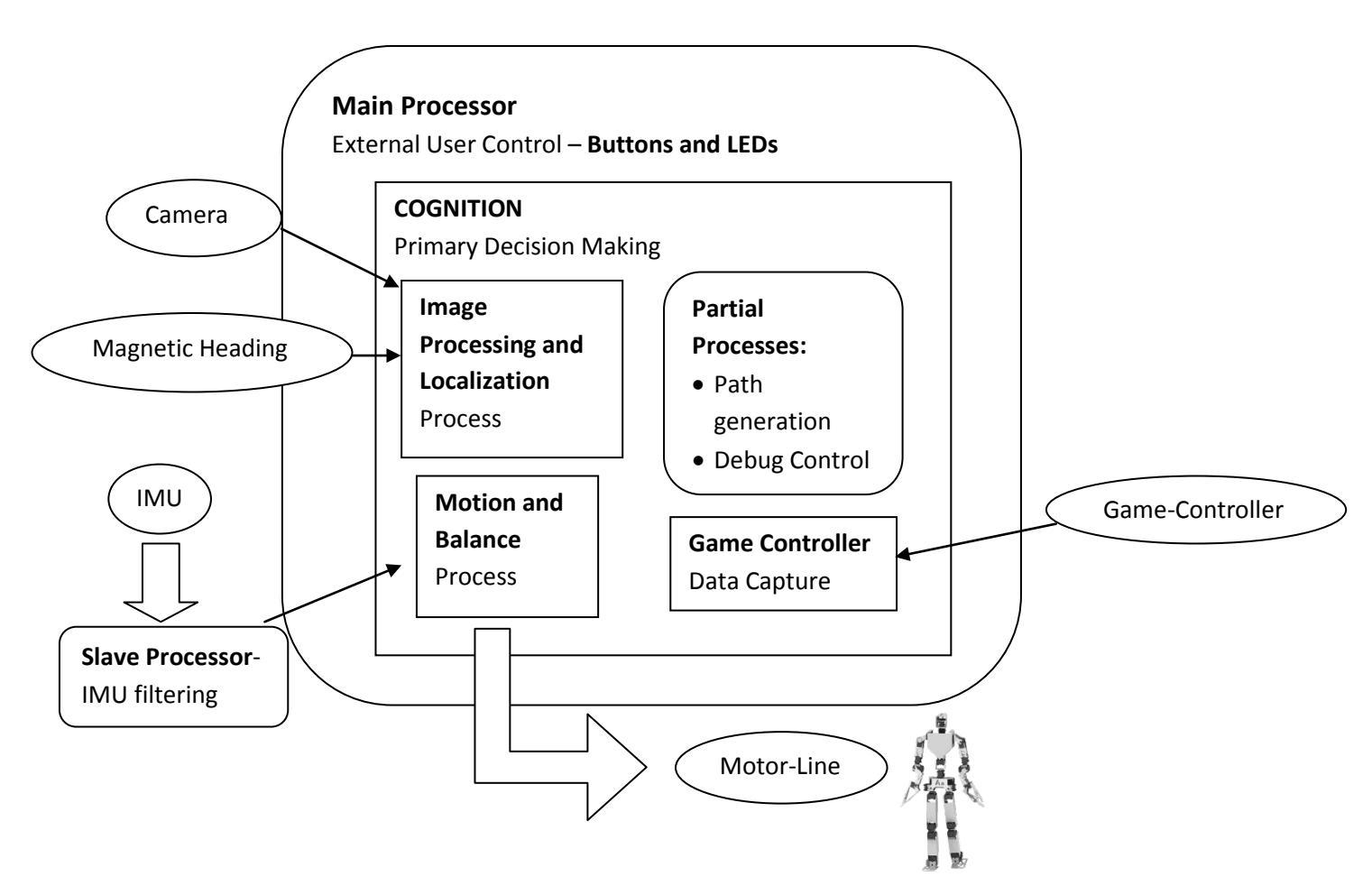
The entire control system of AcYut is Distributed as follows:
Interfacing
Interfaces used are:
- USB: Camera, Wi-fi module.
- RS-485: Motors.
- TTL: IMU
- Digital I/O: Buttons and LEDs
- LAN: An ssh based communication is used for controlling the processor externally.
Software Specifications
The software architecture consists of 3 processes. Two of these processes run parallel:
Image Processing and localization
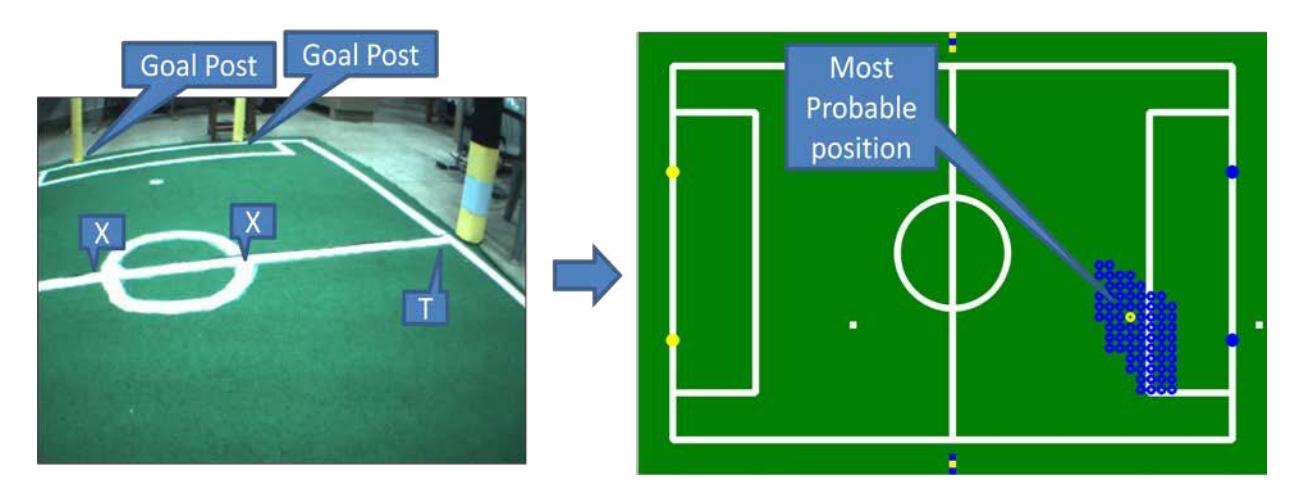
This is responsible for acquiring environment field data including the ball, goal posts, landmark poles, and the field lines and their intersections (including T and X joints), using the camera and forming associative field maps.
The image is taken in an RGB Color space and converted to a space optimized form. A pre-defined set of interest areas are defined for detection. The segmented image areas and patterns are compared with these pre-defined ones. Certain required parameters are calculated from the segmented image.
Localization makes use of the Monte-Carlo approach, a probability based particle filter for which filters field probable particles (based on history of motion) on the bases of distance and orientation to landmarks. Using this model, a probability table is obtained, relating to every point on the field a certain probability of the robot being positioned there.
Also, the particles are also filtered based on a basic motion model, which remembers the past movements of the robot.
Localisation example
Localization example as demonstrated in field testing.
Motion and Balance
This is responsible for acquiring balancing data, appropriate gait generation and finally, actuator control. This includes the low-level closed loop architecture required to maintain robot balance at all moments.
This uses the IMU sensor for acceleration and orientation to determine the Centre of Mass position and orientation for finding effective deviation from intended trajectories (as per found offline to be appropriate for balanced motion), then offset values are determined for individual joints and finally the new values are applied onto the motors.
This process also keeps the updated memory of the past movements as made by the robot to account for filtering of particles in the localization.
Cognition
Over and above these processes, the third process, Cognition runs, which takes the required match based decisions, including start and stop, to manage the current behavior of the robot.
The various processes maintain an intercommunication link between them for quick reactions. The Image Processing continuously updates the environment variables as seen by the system and generates an internal map. It also takes the motion input for further filtering particles during self-localization. The motion system takes care of all motions to be sent to the robot, maintaining the primary balance conditions. Finally the behavior assigns the best decisions to be taken at every point in the game depending on the data from the other processes as well as the GameController data.
Path Generation
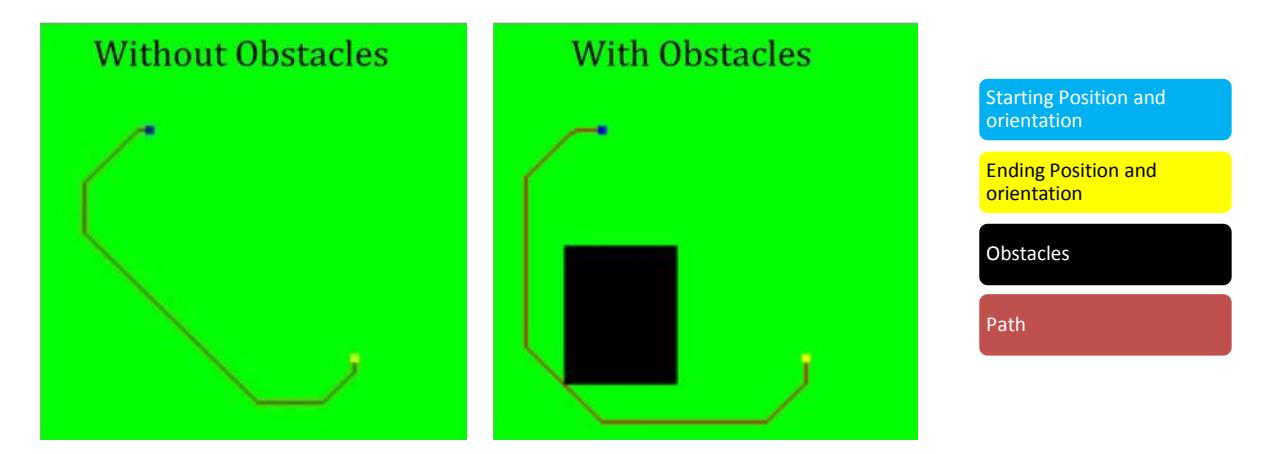
Using the environment created by the Localization and Image Processing process, an optimized trajectory is developed for reaching the goal position effectively and efficiently. This is done using a variation of the A* algorithm. Certain changes in the cost function are introduced to include orientation specific path generation.
Conclusion
AcYut 5 is an autonomous humanoid robot. In this paper we have mentioned the specifications and working of AcYut-5 and details about its Control System, Image Processing, localization, gait planning and decision making.
Team AcYut shall take part in the Humanoid TeenSize Robot Soccer league in RoboCup-2012, to be held in Mexico and put in our best effort for the same.
A person from the team with sufficient knowledge of the rules shall also be made available to be used as a referee.