Team FUB-KIT
Hamid Mobalegh, Amir Nassiraei, Lovisa Irpa Helgadottir, Takashi Sonoda, Kazuo Ishii, Raul Rojas
Freie Universität Berlin; Kyushu Institute of Technology
Abstract This paper describes the hard- and software of the RoboCup teen size team FUB-KIT. Team FUB-KIT was founded in 2012 on a collaboration between Freie Universität Berlin and Kyushu Institute of Technology. The research is aimed at developing bio-inspired legged mechanisms and controls. Both research groups have a long and successful history in Robotics research as well as in RoboCup.
1 Introduction
Despite more than two decades of research, bipedal locomotion is still extensively studied. They cover vast areas, from mechanical construction to stabilization and performance optimization. Recently, bio-inspired approaches have gained more attention, in the quest to bridge the performance gap between articial and biological systems.
The role of bi-articular muscles in bipedal locomotion has long been studied [10, 2, 11, 5]. The concept became attractive again in the context of mechanical bipedal walkers. Most of the bio-inspired works today provide one-to-one mechanical versions of the human musculoskeletal system and try to achieve the same functionality using engineering techniques.[3, 4, 9] A muscle like functionality is required for these systems to work properly. Such actuators are unfortunately non-existent today. We therefore consider to get our bio-inspiration in another way.
We try to reverse engineer the musculoskeletal system, to understand its concepts and try to adapt it for the requirements of the mechanical robot considering today's mechanical engineering feasibilities.
2 Hardware Description
2.1 Mechanics
The mechanical design of the FUB-KIT robots is based on the biologically inspired Multi Joint Mixed Actuation, shortly called MJMA. MJMA introduces a new actuator space [6], which is mechanically projected to the joint space. MJMA projection separates the degrees of freedom in a protable way for the control. Problems, such as joint synchronization, energy loss minimization and leg reaction time, are addressed by MJMA.
2.2 MJMA
Humanoid robots are known to be complex due to several diculties in their construction as well as in their control. The most challenging problem is the synchronization of the multi-joint chains. The commercially available servomotors provide a limited range of controllability, i.e. in position as well as in speed. It is a challenging task to drive a servo motor to follow a highly non-linear motion with an unknown non-constant load. The higher the number of actuators get, the more impossible becomes their control.
Energy recycling is essential for an ecient running. [2] There exist servomotors capable of back conversion and recycling of the mechanical energy, but they are fairly unknown. In fact there is an inverse relation between the precision of a servomotor and its energy eciency. Additionally, another problem arises, when one tries to combine the compliance as a mean to elasticity with the precise synchronization of the joints as there is a clear trade o between these two properties. Note that the required elasticity of the leg may only act in the radial direction, whereas in other directions the system should remain rigid and precisely synchronized.
MJMA mechanically rearranges the degrees of freedom so that the radial component of the leg movement is entirely generated by a single actuator. This takes a great contribution in the solution of the synchronization problem. Further, it would be possible to add passive compliance in form of springs or other energy accumulators to the radial movement without aecting the other degrees of freedom. This can signicantly reduce the energy loss due to the heel strike.
2.3 Actuators
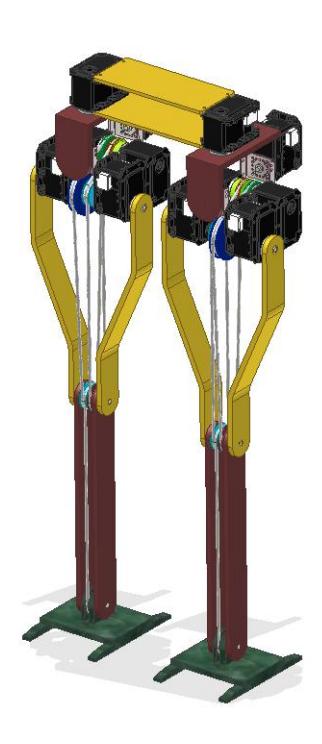
The weight of the robot can be reduced to a great extent by using MJMA. It becomes possible then to involve smaller actuators, which in turn, contribute to the weight reduction even further. In our construction we use a mixture of ROBOTIS MX-28 and MX-64. The driving torque is transferred to the joints using a cable system. Figure 1 shows a simplied diagram of the actuation.
3 Electronics
3.1 Vision Processor
To achieve a fast and reliable computer vision, an embedded vision processor is developed. The module is capable of pixel level processing of high resolution images obtained from an attached color CMOS image sensor. Several form- and color-based functions have already been developed and can be invoked upon request. The most frequently used algorithm is Gradient Vector Gridding described in [8].
3.2 Motion Processor
The complete task of low level motion control is assigned to a separate processor unit. As all servomotors are daisy chained on a single bus, there is a considerable trac to handle with. On the other hand it is of great importance that the robot remains reliable even if the main processor is not available for a short while. In this case low level reactive motions can continue running (the so called zombie mode).
3.3 Main Processor
Less critical functions such as localization, navigation and strategy planning are assigned to a Linux embedded platform. The main processing unit is the commercially available ARM Cortex A8 development board IGEPv2. It is equipped with 128MB internal ash and 512MB DDR2 RAM. Both wired and wireless LAN connections can be established to the unit which allows the robots to communicate with each other as well as with the game controller. To communicate with motion controller unit one of the available serial ports is used.
4 Software Description
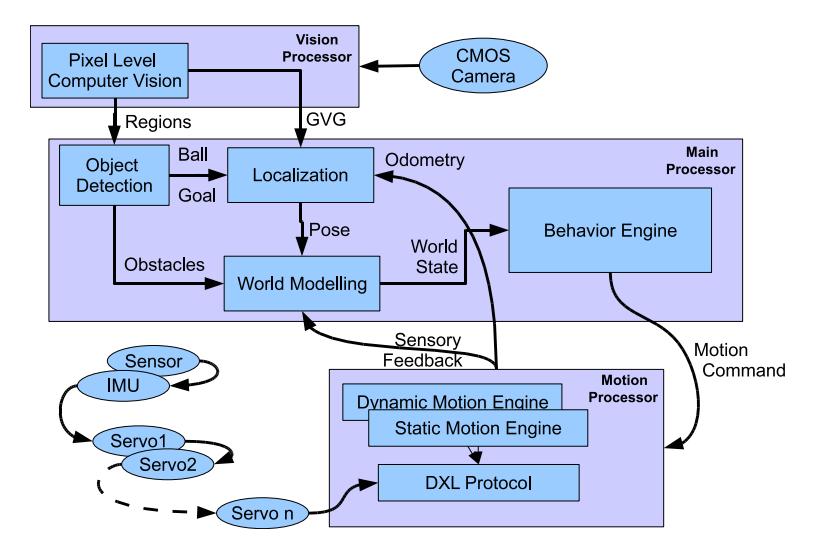
Figure 2 shows the Architecture of the software running on the robot.
4.1 Computer Vision
Pixel level computer vision is done on an embedded module. Following results are available from the Image processor:
Region-Growing provides a list of the contiguous regions of the same color in the image. The algorithm is proper for nding colored objects such as the goals and the ball.
Gridding reduces the resolution of the captured image without much loss in the colored object information, using priorities.
GVG reports a list of contours in the image indicated by the position and orientation of the segments. The algorithm is used for the self localization of the robot based on the eld lines.
Higher level image processing and world modelling is hosted by the main processor. It includes the following tasks:
Self-Localization using a particle lter with local suppression. It reports the absolute position and orientation of the robot on the eld using the eld lines and goals.
Ball-Modeling gives a model of the ball in the local coordinates system of the robot. It is updated using the odometer and visual feedback.
Obstacle-Detection models the obstacles on the local coordinates system of the robot and also tries to identify them.
4.2 Behavior Control
For behavior control a multilayer, modular system is designed. A graphical user interface facilitates the connection of existing modules and denition of new ones. The system works on a data/event ow basis. The modular construction helps rapid recycling of the existing functional blocks. Modules can either be directly programmed in C or build from other modules. The development environment generates an intermediate code for execution on the robot.
4.3 Motions
Two basic groups of motions are dened and handled separately: Static and Dynamic motions. Static motions are implemented using key-frames and interpolation. Dynamic motions are in contrast calculated and generated using dynamic feedback systems. Walking/Running is the most important dynamic motion. For a stable walking gait we have so far developed in 3 main streams:
Linear-Control In this method a deterministic parametrized gate is generated. Several linear controllers adjust these parameters based on the real time feedback gained from the joints or the gyro. For lateral stability the technique described in [7] is used.
FIR-CPG The method is similar to the classic CPG. However the nodes are replaced with FIR lters, whose parameters are adjusted using machine learning techniques.
SNN-CPG In this approach we draw inspiration from neuroscience and simulate the CPG using spiking neural network (SNN). SNNs are more biologically plausible than other articial neural networks, as they use temporal coding (spike timing) instead of rate coding [1]. The SNN-CPG creates the gait rhythm, but inputs from sensors (gyroscope etc.) serve as reex signals that modulate the movement of the limbs. This network setup has been shown to create a more human-like walking pattern [5].
Motions are implemented on the motion processor of the robot. A serial interface allows the communication between motion and cognition layers.
5 Results
Figure 3 shows several frames of the walking cycle. An omnidirectional openloop CPG is used for the test. Table 1 shows the maximum reached speeds in this test.
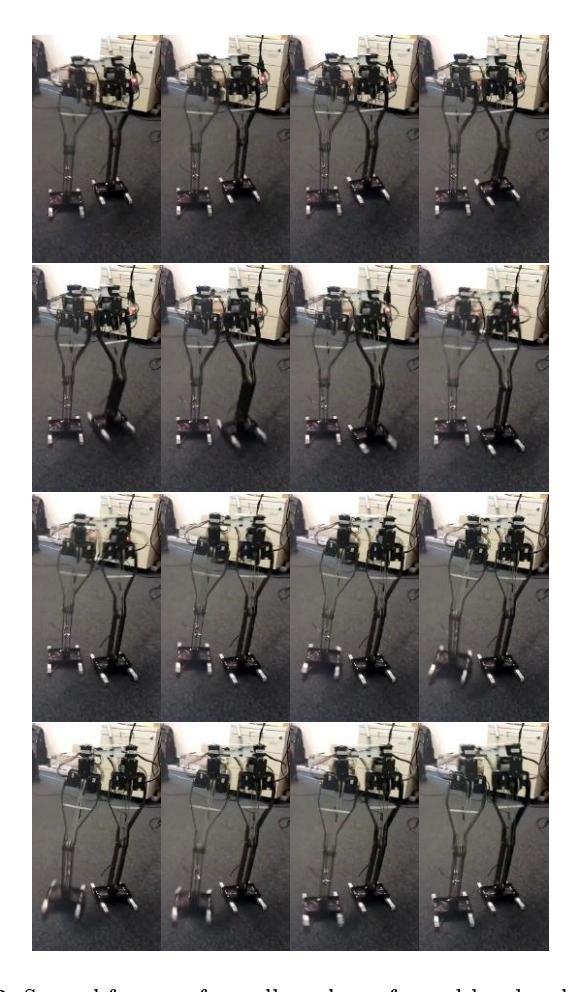
Table 1. Maximum walking speeds reached by the platform
| Value | Unit | |
|---|---|---|
| Forward | 28 | cm/sec |
| Backward | 16 | cm/sec |
| Sidewards | 32 | cm/sec |
| Rotation | 85 | deg/sec |
References
- Dayan, P., & Abbott, L. (2001). Theoretical Neuroscience: Computational and Mathematical Modeling of Neural Systems. Cambridge, Massachusetts: The MIT Press.
- Iida, F., Rummel, J., & Seyfarth, A. (2008). Bipedal walking and running with spring-like biarticular muscles. Journal of Biomechanics, 41 (3), 656 667.
- Jacobs, R., Bobbert, M., & van Ingen Schenau, G. (1993). Function of mono-and biarticular muscles in running. Medicine and science in sports and exercise, 25 , 11631163.
- Jacobs, R., Bobbert, M., & van Ingen Schenau, G. (1996). Mechanical output from individual muscles during explosive leg extensions: the role of biarticular muscles. Journal of Biomechanics, 29 (4), 513523.
- Klein, T. J., & Lewis, M. A. (2012). A physical model of sensorimotor interactions during locomotion. Journal of Neural Engineering, 9 (4), 046011.
- Mobalegh, H. (2011). Development of an Autonomous Humanoid Robot Team. Ph.D. thesis, Ph. D. Thesis. Freie University of Berlin.
- Moballegh, H., Mohajer, M., & Rojas, R. (2009). Increasing foot clearance in biped walking: Independence of body vibration amplitude from foot clearance. RoboCup 2008: Robot Soccer World Cup XII, (pp. 157165).
- Moballegh, H., von Schmude, N., & Rojas, R. (2012). Gradient vector griding: An approach to shape-based object detection in robocup scenarios. RoboCup 2011: Robot Soccer World Cup XV , (pp. 162173).
- Novacheck, T. (1998). The biomechanics of running. Gait & posture, 7 (1), 7795.
- Radkhah, K., Maufroy, C., Maus, M., Scholz, D., Seyfarth, A., & Von Stryk, O. (2011). Concept and design of the biobiped1 robot for human-like walking and running. International Journal of Humanoid Robotics, 8 (03), 439 458.
- Saito, Y., Matsuoka, T., & Negoto, H. (2005). Study on designing a biped robot with bi-articular muscle type bilateral servo system. In Robot and Human Interactive Communication, 2005. ROMAN 2005. IEEE International Workshop on, (pp. 490495). IEEE.