Team AcYut – Team Description Paper 2014
Dr. B. K. Rout, Kaustubh Nawade, Tarang Shah, Pranet Verma, Akshay Morey, Shreyas P. Dixit, Anand Parwal, V. Aditya, Pratyush Kar
Center for Robotics and Intelligent Systems; Birla Institute of Technology and Science, Pilani, Rajasthan, India
www.bits-pilani.ac.in · www.acyut.com
Abstract This paper explains the working of our humanoid robots, AcYut, which we intend to use for the RoboCup Humanoid Teen size soccer competition. As per the regulations of the competition, AcYut's structure is designed in accordance with human proportion. It is able to walk utilizing the Linear Inverted Pendulum Model and an Inertial Measurement Unit. In order to perceive its environment it is equipped with a camera. Image processing and decision making takes place on an Intel Atom processor.
Introduction
AcYut is a series of humanoid robots developed by the undergraduate students of Birla Institute of Technology and Science, Pilani. The aim of the project is the development of a humanoid robot that has the capabilities of being used in actual applications. Our team made its first humanoid robot, AcYut I, in 2008. AcYut I was India's first indigenously developed humanoid robot. After AcYut I, the team built a stronger, taller and better version of the robot, AcYut II. AcYut II was semi-autonomous and could be operated by use of a controller. The team also developed a third version of the robot, AcYut III, which had superior computing power enabling incorporation of advanced algorithms. Improving upon the design of AcYut III, AcYut IV was developed. AcYut IV was the team first entry to RoboCup in 2011. It managed to reach the third position in the TeenSize Humanoid category. The team has also won other accolades, some of the notable ones being Gold and Silver medals in humanoid Sumo wrestling at RoboGames 2010 and world record for the most weight lifted by a large humanoid (40 CDs) at FIRA 2010, held at Bangalore in September 2010.
Over the last two years our team has worked, under the guidance of Dr. B. K. Rout, to incorporate several modules into our system. Localization and behaviour have been included in our system and the earlier modules of gait generation and image processing have been improved. Overall functioning of the robot has, as a result, improved significantly.
Mechanical Design
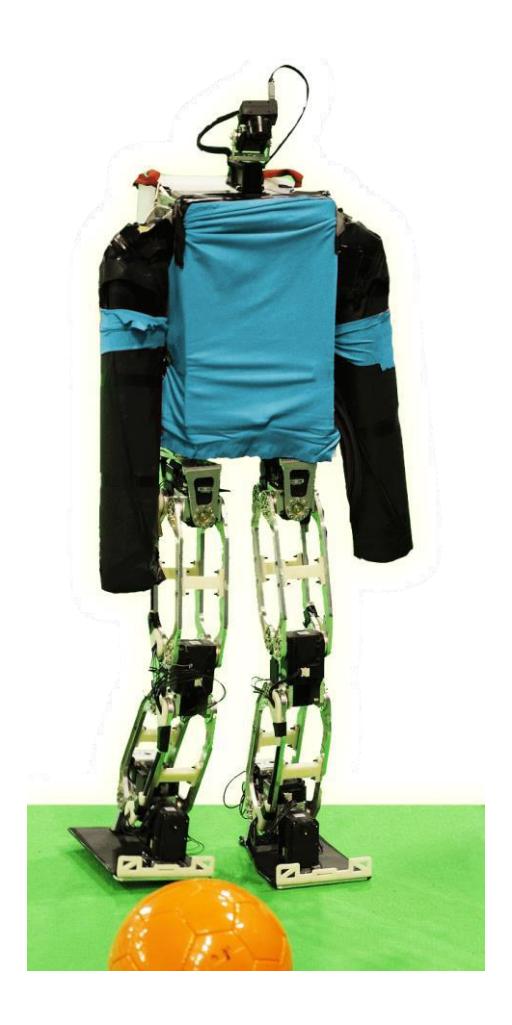
AcYut 7 has 28 degrees of freedom distributed as follows: 14 in legs, 10 in arms, 2 in head and 2 in Torso. Every degree of freedom is actuated by Robotis Dynamixel motors. All brackets of AcYut are made of Aluminium 6061-T6 and are designed to reduce the net weight of the robot while providing adequate strength.
Physical Specifications of the robot are as follows:
- Height: 99 mm
- Weight: 7.2 kgs
- Walking Speed: 20 cm/s
- DOFs: 28
- Actuators: i. Robotis MX – 106: 106Kgcm @ 14.5V in Legs. ii. Robotis RX – 64: 64 Kgcm @ 18.5V Arms iii. Robotis RX – 28: 28Kgcm @18.5V in head
Electrical Design
In order for the robot to be able to play a soccer match a camera has been installed on the robot. Images provided by the camera are processed by an Intel Atom processor. The main processing unit also provides wireless capabilities to the robot. An inertial measurement unit also enables the robot to obtain the roll and pitch of the torso which are utilized for balance and stability.
Electrical components in the system are as follows:
- Sensors: a. Camera: iDS UI-1221LE-C-HQ (752x480 CMOS color) b. IMU: 9 DOF Razor IMU
- Processor: Intel Atom D525 (1.8GHz)
- Batteries: Lithium Polymer 18.5V
- Other: Wireless LAN (IEEE802.11a/b/g)
Software and Algorithms
Behaviour
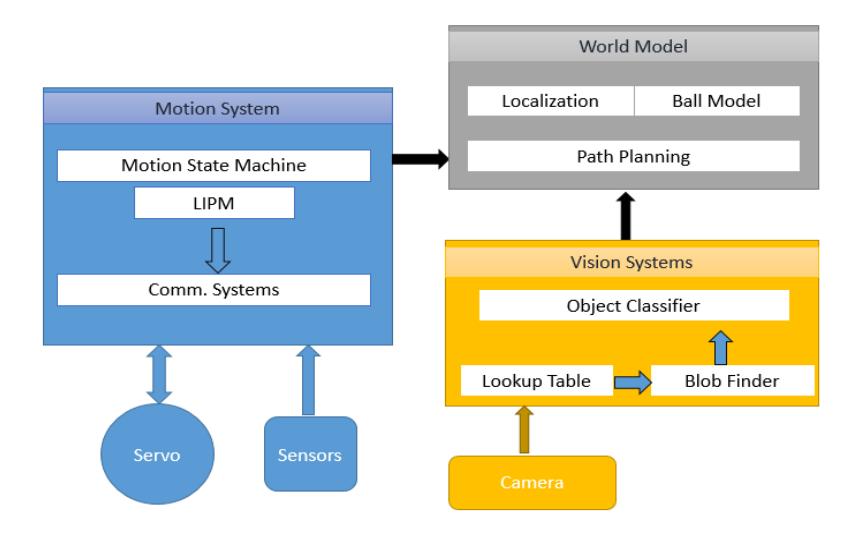
The behaviour module coordinates the flow of data between different modules and is involved in decision making based on results obtained from various other modules. The behaviour module provides data required to all other modules and receives their output. For example, the behaviour module directs the image processing module to seek specific objects in the environment and receives their coordinates. For purposes of decision making a decision tree is employed. Game and robot states are defined which are used along with acquired data to take decision. Finally depending on decisions instructions are provided to the motion sub-system which controls the robot actuators.
Image Processing
Image processing extracts information from an image captured by the camera. The module detects the ball, goal and field lines. Detection is done primarily on the basis of colour and filtered on basis of shape for differentiating between specific landmarks and background noise. For detection of field lines Schulz algorithm is used.
Localization
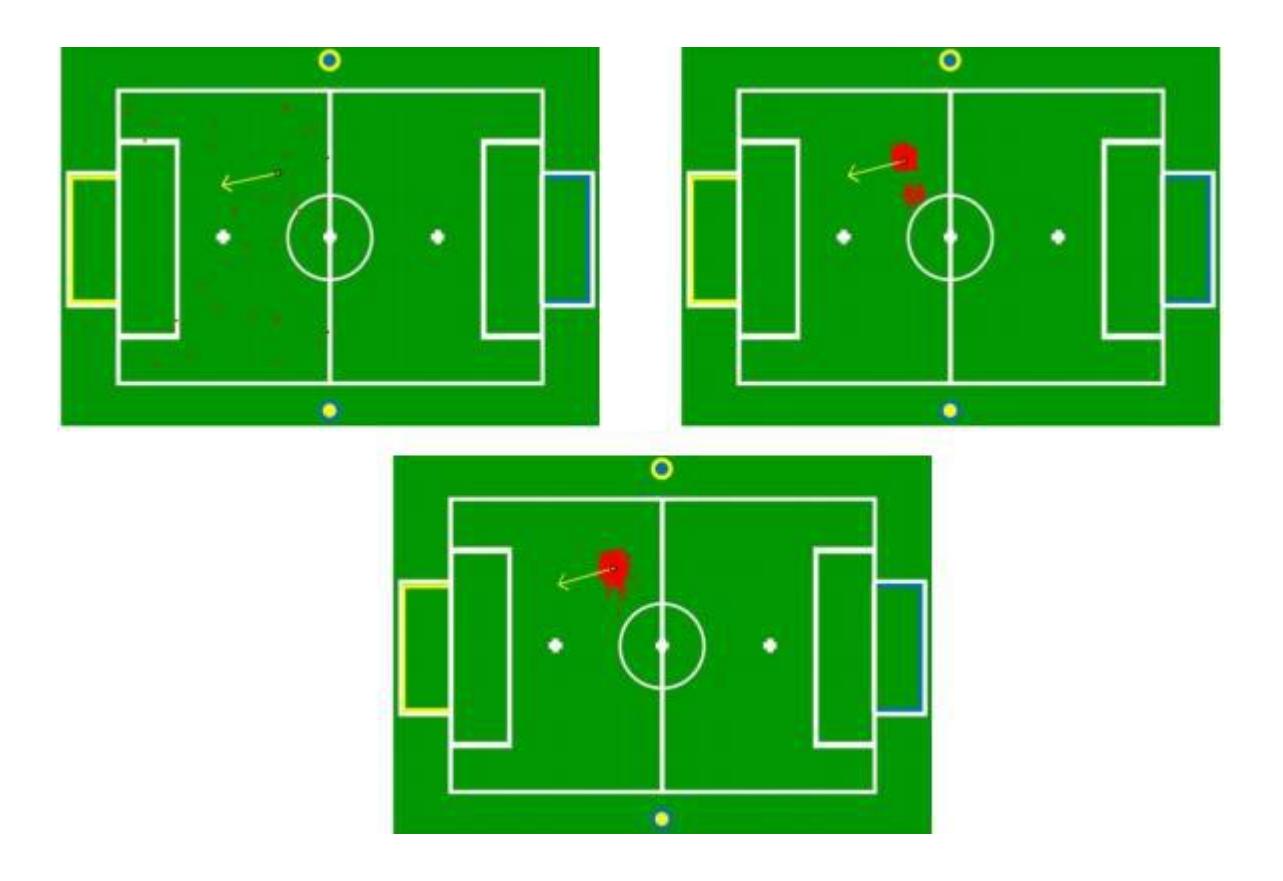
This module enables the robot to determine its own position within the soccer field. Monte Carlo localization is used. Particles for the localization model are randomly chosen within the field area and probability of each particle is calculated based on distance from observed landmarks.
Some results of Monte Carlo Localization are given below
Path Generation
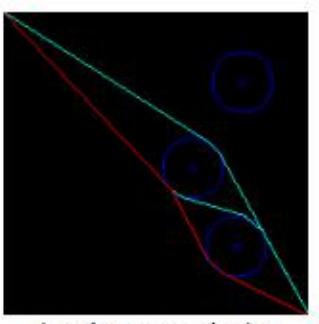
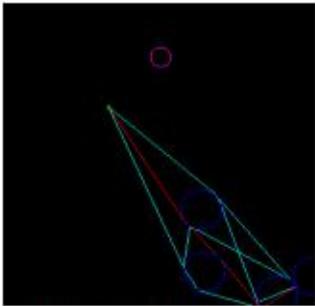
After localization and ball detection have been successfully performed, the path generation module is used to find the best possible path to the ball. For this we use a geometry based approach which provides quick results. Obstacles are modelled as circles and arcs of concentric circles are taken as the shortest route around the obstacles. Shortest distance between two points not blocked by an obstacle is the straight line joining the two points, whereas the cost is decided based on various factors like the time it takes for AcYut to turn in comparison to straight line walk.
In the above figures the dark blue circles represent obstacles detected, purple circle represents the centre of the opponents goal position, the light blue lines are possible paths and the red lines represent the path chosen by the robot. In the first figure obstacle avoidance is demonstrated while the other two show in-game paths generated during a practice session. In order to enable the robot to orient itself towards the goal virtual obstacles are used.


Gait generation and balance
This module is responsible for the balance and stability of the robot in dynamic as well as static conditions; gait generation and motor control. For gait generation the Linear Inverted Pendulum Model is used. The LIPM allows for generation of stable and smooth trajectories which account for the velocity of the robot. For maintaining balance at all points of time feedback from the IMU is used. Using this data and the joint angles of individual actuators the centre of mass of the robot is determined. Based upon deviation of the COM from its intended trajectory a correction is applied to joint angles which enable the robot to regain balance. The module also updates the past movement record providing a input for the localization module.
Conclusion
AcYut VI is an autonomous humanoid robot. In this paper we have mentioned the specifications and working of AcYut VI and details about its control system, image processing, localization, path planning, decision making and gait generation.
Team AcYut shall take part in the Humanoid TeenSize Robot Soccer league in RoboCup-2014, to be held in Joao Pessoa and put in our best effort for the same.
A person from the team with sufficient knowledge of the rules shall also be made available to be used as a referee.
References
- Kajita et al. The Linear Inverted Pendulum Mode A simple modeling for a biped walking pattern generation in IEEE International Conference on Robotics and Automation, Maui Hawaii, USA – November 2001
- Sven Behnke. Online Trajectory Generation for Omnidirectional Biped Walking in IEEE International Conference on Robotics and Automation, Orlando, Florida - May 2006
- Hannes Schulz et al. Line Structure-based Localization for Soccer Robot. IEEE-RAS Intl. Conf. On Humanoid Robots (Humanoids 2009), Paris(France), 2009
- Jen-Shiun Chiang et al. An Efficient Object Recognition and Self-Localization System for Humanoid Soccer Robot. SICE Annual Conference 2010
- Nizami Gasilov et al. Two stage Shortest path algorithm for solving optimal obstacle avoidance problem. IETE Journal of Research, May – June 2011