WF Wolves & Taura Bots Teen Size 2015
Christopher Tasch, Diego Luceiro, Eduardo Henrique Maciel, Fernando Berwanger, Minda Xia, Frank Stiddien, Leandro Tomé Martins, Lucas Wilke Dalla Rosa, Oliver Krebs, Renato Ventura Bayan Henriques, Reinhard Gerndt, Rodrigo da Silva Guerra, Stefan Krupop, Tobias Bolze, Walter Fetter Lages
Ostfalia Univ. of Applied Sciences – Computer Science Dept., Wolfenbüttel, Germany; Universidade Federal de Santa Maria – Santa Maria, RS, Brazil; Universidade Federal do Rio Grande do Sul – Porto Alegre, RS, Brazil
Abstract This is the Team Description Paper for the joint team WF Wolves & Taura Bots for the Teen Size Humanoid League robot soccer tournament during RoboCup 2015. Taura Bots is a new, brazilian team from Universidade Federal de Santa Maria together with Universidade Federal do Rio Grande do Sul, that is collaborating with WF Wolves, who have participated in all Kid Size competitions since 2009. This collaboration allowed us to exchange hardware, software and expertise, giving us confidence to attempt Teen Size for the first time in 2015.
1 Introduction
To produce a robust and competitive team of bipedal soccer playing robots is not an easy endeavor. This requires a good balance of skills involving mechanics, electronics and both low and high level software design. This is even more so when considering the increasing size and weight of these humanoid robots. With that in mind, we decided to form a joint team, combining the accumulated experience and resources of WF Wolves, who have participated in RoboCup Humanoid League Kid Size since 2014, together with the expertise and motivation of Taura Bots, a new brazilian team founded in 2014. One of our main goals is to upgrade the existing infrastructure of WF Wolves and apply it also to larger robots, starting at Teen Size category in 2015.
Team WF Wolves, a German team from Ostfalia Univ. of Applied Sciences (OUAS) has been involved in RoboCup Soccer since 2007, starting in Humanoid League in 2009. Since 2013 they have been using Da-v1n, a DARwIn-OP based Kid Size robot, and in 2014 they introduced Detlef, which is a NimbRo-OP based robot, shortened to 85cm of height, enabling it to be compatible with both Kid Size and Teen Size categories. Team Taura Bots is a team formed by two Brazilian universities: Universidade Federal de Santa Maria (UFSM) and Universidade Federal do Rio Grande do Sul (UFRGS). Albeit being newly formed, four of Taura Bots student members have already taken part in RoboCup before, in exchange programs with OUAS. They also count also with the guidance of a RoboCup experienced brazilian professor. At their introduction, in 2015, Taura Bots are bringing a totally new robot design: Orbit (described below).
As part of this collaboration, WF Wolves & Taura Bots is applying to both Teen Size and Kid Size categories, as a joint team in both cases.
2 Research Overview
WF Wolves has ongoing interest in computer vision, including color independent vision, self-localization and world modeling. Our joint team in 2015 will share the same vision and localization system developed by WF Wolves.
Taura Bots has interest in hardware design and control, including the design of Series Elastic Actuators, and the development of a whole-body real-time multiple-input/multiple-output (MIMO) control architecture. These items are described in more detail in the following subsections.
2.1 Vision and Localization
WF Wolves is developing a robust self-localization system integrating a Monte Carlo based algorithm with line crossings and goal poles as input parameters. To distinguish the goal sides an algorithm including feature detection of the background combined with recognition of team members is being developed. For color independent ball detection, edge detection is being used. Besides the ball, detection of goal poles, field lines and robots is also being improved.
2.2 Series Elastic Actuator
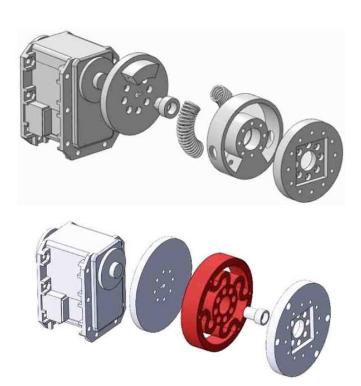
Members of Taura Bots have been developing a new modular type of series elastic actuator (SEA) based on the Dynamixel servomotors [1] (see Figure 1). For 2015 this design has been greatly simplified, allowing the whole spring module to be assembled in just two moving mechanical parts and one circuit board. Moreover, fixture holes are now compatible with Dynamixel's MX-64 and MX-106 servo horns, and the magnetometer is being upgraded from 10-bit to a new 14-bit version.
2.3 Whole Body Control
Taura Bots has just finished the design of its new Teen Size humanoid robot, all of which is being modelled in great detail also in ROS architecture allowing for realistic simulations to be performed. The new robot will be equipped with two NUC PCs, one for higher level vision and localization (as usual), and another for whole body control (instead of the usual dedicated microncontroller). This body control PC will be running a real time OS, collecting sensor data and assuring a precise computation and control of the necessary torques at each joint. The modelling and implementation of this MIMO whole body control architecture is topic of intense research, being part of the theme of the Ph.D. thesis of one of the team members (see [2,3] for his previous work on the subject). This is expected to greatly improve the performance over the usual individual per-joint PID control.
3 Hardware
Our joint team will be taking part in RoboCup 2014 with two different robot designs: (1) Detlef and (2) Orbit.
3.1 Detlef
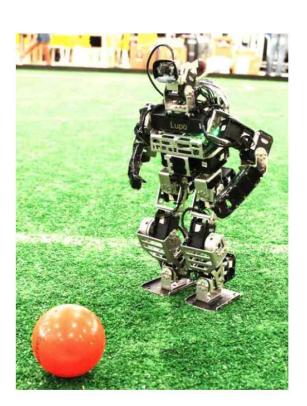
Detlef (see Figure 2) is a robot based on NimbRo-OP [4], with height shortened to 85cm allowing it to take part in both Kid Size and Teen Size categories. This robot uses Dynamixel MX-106 servo actuators in the legs and MX-64 in the arms and neck. Metal and carbon parts were built in OUAS's workshop, with some parts being created with a 3D printer. WF Wolves plans to bring three of these robots to RoboCup 2015 in July.

3.2 Orbit
Orbit (see Figure 3) is a new original robot design, created by Taura Bots specially for the Teen Size category and above. Inspired by successful robot designs such as Copedo, Dynaped and others, Orbit is equipped with a parallel joint mechanism for both upper and lower legs. However, the links of the parallel mechanism are designed in such way to allow the legs to be fully contracted (see Figure 4). Moreover, to avoid having to restrict the degrees of freedom, as it tipicaly happens in parallel link desgins, we added separate pitch actuators to ankle and waist in both legs. This combines the robustness of the parallel mechanism with the non-compromise flexibility of independent pitch control. Additionally we included eight SEAs on the knees of both legs, four per leg, two for the upper leg parallel mechanism, and the other two for the lower leg parallel mechanism. Much beyond just protecting the servo gears against impact, this redundant design also allows SEAs to work against each other causing tension in the internal springs and thus modulating rigidity, and/or accumulating energy for a jump.
Taura Bots is currently constructing two units of Orbit, which should be brought to RoboCup 2015 in China, if successfully qualified for teen size. Should the design proof itself robust and reliable we plan on upgrading the size of this robot to fit the adult size category in 2016.


3.3 Orbit Specifications
The Figure 5 shows basic dimensions of Orbit, this robot have the height above 1.1m, weight 13.37 kilograms and has 30 DoFs.
Orbit Specifications
| Parameter | Value |
|---|---|
| Weight | 1161 [mm] |
| Height | 13.37 [Kg] |
| DoF | 30 |
| Sensors | 01 [Webcam Logitech C920] 01 [Microphone] |

4 Software
The high-level framework to be used in 2015 is the same presented for the Kid Size, which is inspired by FUmanoids [5]. It uses a blackbox architecture dividing the system into separate modules. A thread pool is used in combination with a scheduler to automatically determine the module execution order based on dependencies.
The vision system developed by WF Wolves and already used in previous years combines probabilistic algorithms with speed optimizations [6,7]. For 2015 work is being done to adapt the system to become color independent, in compliance with the new rules.
Besides walking and kicking, other motions are programmed by interpolating predefined key-frames [8]. This is the case for goalkeeper motions and getting up.
For the walking engine we are currently implementing the Capture Step framework [9]. At the moment we are working with ordinary independent PID joint control, but we have started work on a whole body MIMO control which should improve walking performance and stability.
For kicking we are adapting the Kick Engine developed by WF Wolves for use in the larger robots.
References
- Leandro Tomé Martins, Roberta de Mendonça Pretto, Reinhard Gerndt, and Rodrigo da Silva Guerra. Design of a modular series elastic upgrade to a robotics actuator. In RoboCup 2014: Robot Soccer World Cup XVIII, 2014.
- Eduardo Henrique Maciel. Desenvolvimento de um modelo simplificado dos membros inferiores de um robô bípede utilizando o ros. Master's thesis, Universidade Federal do Rio Grande do Sul, 2014.
- Eduardo Henrique Maciel, R. V. B. Henriques, and Walter Fetter Lages. Control of a biped using the robot operating system. In 6th Workshop on Applied Robotics and Automation, 2014.
- Max Schwarz, Julio Pastrana, Philipp Allgeuer, Michael Schreiber, Sebastian Schueller, Marcell Missura, and Sven Behnke. Humanoid teensize open platform nimbro-op. In RoboCup 2013: Robot Soccer World Cup XVII, 2013.
- FUmanoids. Mixed team communication protocol, 2014.
- Jan Carstensen. Computer vision – a probabilistic and modular approach. Bachelor Thesis, 2011.
- Charles Neu and M. Eichelberger. Goal detection for humanoid soccer players localization. Bachelor Thesis, 2011.
- S. Michalik. Dynamisches laufen von humanoiden robotern. Bachelor Thesis, 2010.
- Marcell Missura and Sven Behnke. Balanced walking with capture steps. In Proceedings of the 18th RoboCup International Symposium, 2014.