Team Parand Teen Humanoid Team Description Paper <RoboCup2017 Humanoid Kid/Teen Size Robot League>
Ahmad Amiri, Farzad Nadiri
Department of Computer and Mechanic Engineering, Parand Islamic Azad University, Parand, Tehran, Iran
Abstract This paper is written to introduce Team Parand in international Robocup2017 competitions which will take apart in Japan.The document will give brief information about this team researches in hardware and software field.During the current year team worked on implementing acurate localization techniques, better stability, balance and vision algorithms and also designing natural motions and more accurate walking algorithms.
Keywords: acurate localization, humanoid stabilization, vision
1-Introduction
In latest years humanoid robots are developing surprisingly to reach the dream of international robotics committee which is hosting a soccer match between humans and robots.Parand humanoid robotics team gathered in 2008 in order to develop humanoid robots and focused on making the robots much more intelligent.This team was successful enough to gain several honors in national and international events.
In IranOpen2010 Team Parand managed to reach the second place using 3 pre-made Bioloid Premium Kit robots.but recent years the team developed its software and hardware abilities and designed several kid size and teen size robots with some important features. Further more team Parand participated in Robocup2014 in Teensize league and took the Third place. It is important to mention that, this team partciapted in Robocp2015 competitions and achieved the championship of Teen-Size league[1][2].
2-HardwareDesign
2.1 Mechanical Structure
During recent two years we have used Baset mechanical structure wich is based on team Parand previous designs with some improvemnets[3] that increase speed, stability and decrease battery consumption. In new structure , some advantages are reached such as more stability, high speed movements by using high torque servo motors, increase kicking distance by designing a proper weight and shape foots. Further more, robots with this structural platform are considered as both Kid-Size and Teen-Size.
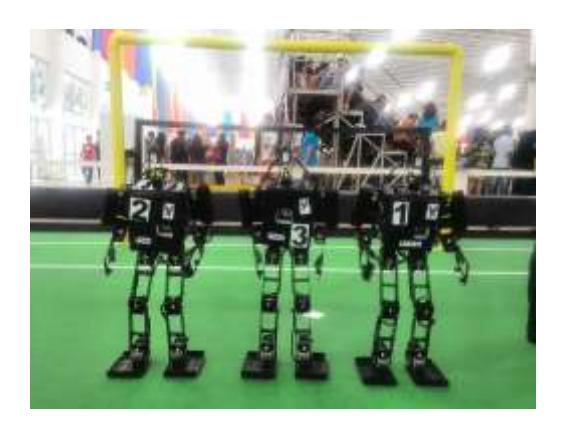
Table 1. Diako Humanoid General Specifications
| weight | 8kg |
|---|---|
| height | 90cm |
| Processing Unit | QutePc3023 1.6 GHz processor |
| Degrees of Freedom | 20 DOF |
| Actuators | MX-64, MX-106R, MX-28 |
| Camera | Logitech C930 |
| Batteries | Li-Po 16 |
| Operating System | Windows Embedded 8.1 |
2.2 Electronics
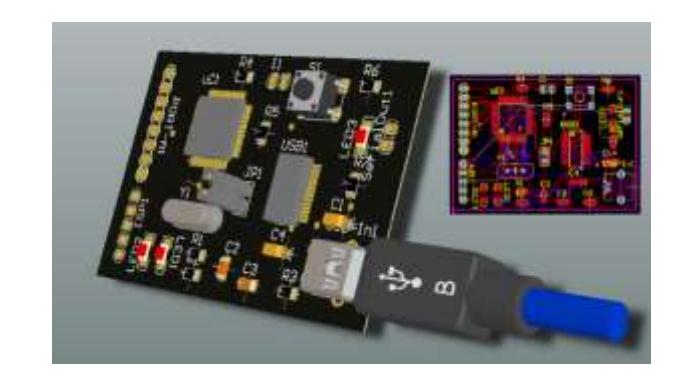
The new version of PRO-IMU[4] wich has major performance improvemnets is developed and also a new circuit designed and manufactured based on Atmel Atmega32 microcontroller to perform sensor fusion algorithm.
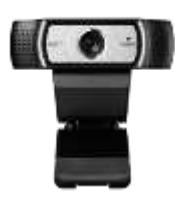
Further more former camera replaced by the new Logitech C930 webcam.
3-Software
3.1 Vision
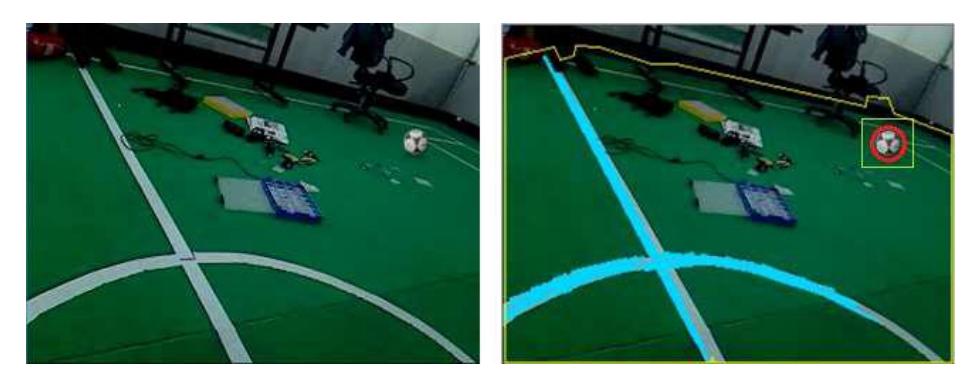
Inorder to have a robot with high accuracy and performance, it's essential to prevent the robot to proccess objects and features out of the field. To solve this issue we have implemented Graham's algorithm[5] to extract green field convex hull as the region of intrest for further processings.
White lines are detected using Hough transform and group them by their angle and distance. Each group contains lines with same angles and certain distance will merge together and make the field line.
Ball detection algorithm is perfomed by using Hough Transform to detect white circle in robot's neighbor and perform histogram matching while the gaze is looking far around.
Furher more thick white line which it's lower coordinate has intersection with field convex hull is recognized as the goal post.
3.2 Locomotion
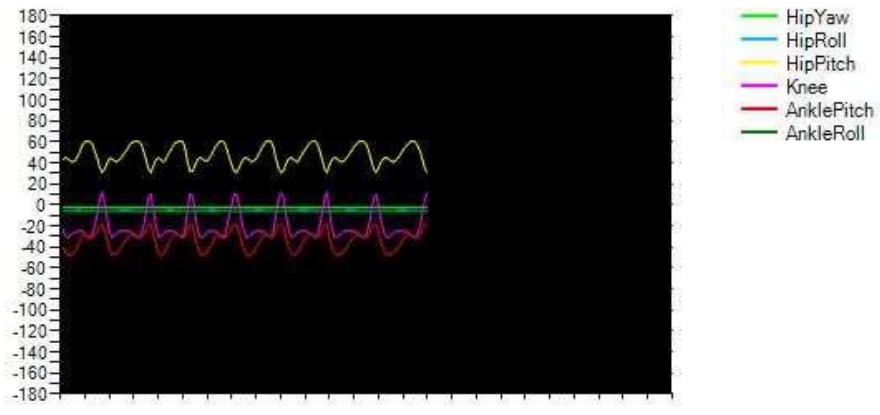
Recent years several walk engines with different methods and trajectories integrated in motion platform but each one had some issues. By using former experiences and analysis, custom trajectories generated and integrated in former walk engine in order to gain more efficient and flexible walk engine.
Static motions as kicking and standup are designed in Parand Motion Editor which is a Key Frame Motion Editing utility inspired by Roboplus motion editor [6].
3.3 Localization
As robots are become more intelligent and perform faster and also due to major changes in rules in recent years, to estimate position and orientation of robot, implementing an accurate and robust localization algorithm is became necessary and fundamental.
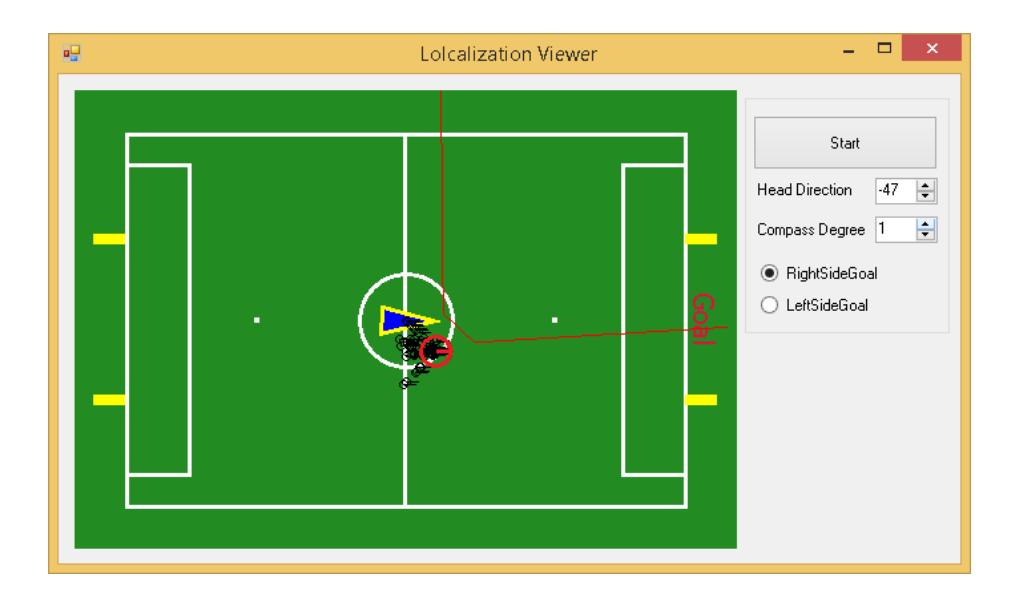
Monte Carlo localization is a well-know particle filter to probablistcally determine robot's position using features detected in vision modul,odometry data and also sensors data.
"Whenever the robot moves, it shifts the particles to predict its new state after the movement. Whenever the robot senses something, the particles are resampled based on recursive Bayesian estimation, i.e. how well the actual sensed data correlate with the predicted state. Ultimately, the particles should converge towards the actual position of the robot". [7]
The Monte Carlo Localization is almost implemented on the robots as shown in figure below.
References
[1] https://www.robocuphumanoid.org/hl-2015/results/. Last accessed 23th December 2016 [2] Navid Fayaz, Ahmad Amiri, Farzad Nadiri,Omid Mohammadi, Masoud Kazemi, , Rahmaan Barouj ,Marzieh Hashemian. "Parand Humanoid TeenSize Team Description Paper," 2015. [3] Hafez Farazi, Mojtaba Hosseini, Vahid Mohammadi,Farhad Jafari, Donya Rahmati, Dr. Esfandiar Bamdad, "Baset Kid-Size 2014 Team Description Paper," 2014. [4] https://github.com/ahmad-amiri/PRO-IMU , PROBOTIX OpenSource IMU . Last accesssed 23th December 2016. [5] Graham, R.L. (1972). An Efficient Algorithm for Determining the Convex Hull of a Finite Planar Set. Information Processing Letters 1, 132-133 [6] Rahman Barooj, Navid Fayaz, Farshid Khajehdehi, Ahmad Amiri, Farzad Nadiri, Hamid Pormalek,Masoud Kazemi, Amir Jambori, Omid Mohammadi. "Parand Humanoid TeenSize Team Description Paper," 2014. [7] Wikipedia , Last Update 19 April 2015, Monte Carlo localization, available at https://en.wikipedia.org/wiki/Monte_Carlo_localization. Last accessed 23th December 2016.