WF Wolves & Taura Bots – Humanoid TeenSize Team Description for RoboCup 2017
Tobias Bolze, Vitor Dallasta, Reinhard Gerndt, Alexander Gabel, Tanja Heuer, Oliver Krebs, Tom Lorenz, Ivan David Riaño Salamanca, Frank Stiddien, Rodrigo da Silva Guerra
Ostfalia University of Applied Sciences, Wolfenbüttel, Germany; Federal University of Santa Maria (UFSM), Santa Maria, Brazil
Abstract This team description paper describes the joint team WF Wolves & Taura Bots, their robots and current research status. The robot hardware is specified in detail, separating out the mechanical platforms from the electrical systems. Also the fields of research, the developed software and planned revisions are illustrated. Hereby WF Wolves & Taura Bots applies for participation at the RoboCup 2017 for Team Competition in Nagoya, Japan.
1 Introduction
WF Wolves & Taura Bots is a joined robot team founded in 2014. The team integrates WF Wolves from Germany and Taura Bots from Brazil. While WF Wolves have some years of experience in RoboCup competitions, Taura Bots is a new established team. WF Wolves participate in RoboCup Soccer League for several years now. The team won the world championship in the Mixed Reality League twice. In Humanoid League they modified their robot platform over the years. Since 2013 they use a DARwIn-OP based platform and a new software framework. With the new hardware and software they won the German Open 2013 and got a good ranking in world championship in Eindhoven. In 2014 they introduced a new platform based on NimbRo-OP in Brazil. There they had some Brazilian supporters, who founded the team Taura Bots afterwards. With this new team the mixed team WF Wolves & Taura Bots was formed and lined up first in Hefei 2015. In Hefei (KidSize/TeenSize) and in Leipzig (TeenSize) we made the second place in the category Technical Challenge. Together we want to concentrate manpower at the research of humanoid robots.
2 Research Overview
This section gives an overview about the focussed research topics for the following RoboCup competition.
2.1 Robustness of the Robots
Furthermore the artificial grass is a hard challenge for the stabilization of the robots. Therefore we directed our work on three different things. First we focused on studs on the one hand side. With that we reached a better grip for the robot on the field. On the other hand side we improved the sequences and the closedloop controllers. Hence we achieved less falls during a kick motion and a more stable work. Besides we built a robot with a series knee. That fact improves a faster walk and a higher kick range. With those three aspects we improve the robustness of walking and kicking. Furthermore there are plans for weight cells in the feet to get more information of the effective forces.
2.2 New Bodyboard
Our team developed a new Body board for all real time tasks like controlling the servo motors, reading sensor data and execution of closed-loop controllers. The basis is a developer board with an ARM processor. It is connected to an own created shield board. This includes voltage regulators, user interfaces and servo connectors. Our software was adapted to the new hardware and works properly. We expect to use these new boards for the following competition in Nagoya.
2.3 Stereo Vision
To get the best vision results, two different approaches were tested. We compared the standard mono vision approach to the Bumblebee stereo camera. The detection rate, distance estimation and processing times were compared to the standard approach [8]. As a result the Bumblebee has a better distance estimation but a worse performance compared to the standard mono vision. Both aspects will continuously be more explored.
3 Mechanical Hardware
(No introductory text in this section)
3.1 Robots
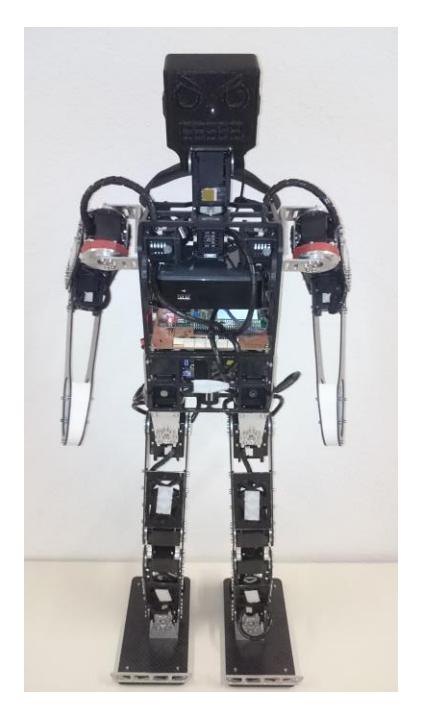
We have two existing types of robots. While three of our robots are nearly one type, there is only a small change of a series knee. The other type of robot is a new created design from the Taura Bots.
Detlef & Hans are robots based on the NimbRo-OP. The size is valid for the TeenSize and it uses Dynamixel MX-106 in the legs and MX-64 for the arms and the head. The aluminum and carbon parts were milled in our university's mechanical workshop. Plastic parts like the head were created with a 3D printer from ABS.
Gambi (with Series Knee) has the same construction like above except his knee (see Fig. 1). It is a modified knee with two Dynamixel MX-106 servos in a row.The change is shown Fig. 2.
Dimitri is an open-source humanoid robot that uses the elastic actuators in its joints. We are proposing the introduction of Dimitri. Our goal is to provide a simple, hackable and yet complete RoboCup humanoid platform that is completely open source and make it also commercially available for purchase as a kit. This robot has an average 1241,79mm of height and weighs 16kg, and is composed of 28 Dynamixel MX-106R and 3 Dynamixel MX-64R.
3.2 Studs
To get a better stabilization of the robot, we tested different kind of studs. They were designed by us and created with the 3D printer from ABS [9]. The best working studs are shown in Fig. 2.

3.3 Series Elastic Actuator
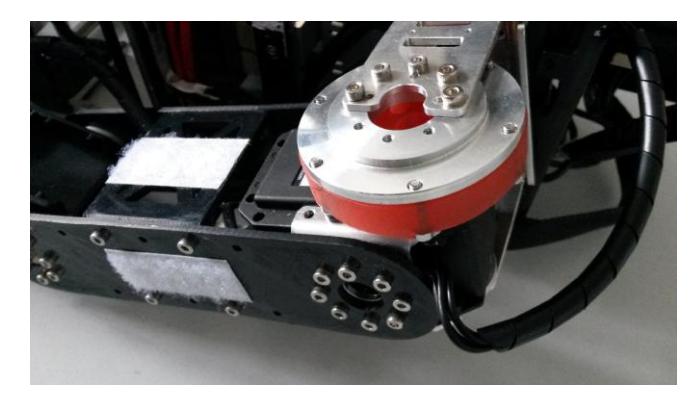
The design of the robot actuators used the last years was very static and servos can be destroyed by strong jerks. So we researched actuators that are more elastic and offer advantages in humanoid movements (see Fig. 3). We tested actuators modified with springs, which could improve walking [3][4][5][6].
4 Electrical Hardware
The electrical system is custom made and designed specifically for our humanoid robots. Two of three different boards were particularly designed. A mini PC board with a standard x86 processor is used for high-level control, vision and behaviour. Besides the robots have a body board for controlling the servos and generating the movements. For power management and user control our third board is integrated in the system. All the boards are located in the torso of the robots.
4.1 Body Board
The core of our body board is an Atmel AT91SAM7 microprocessor which runs at 96 MHz. It controls the movement of the servos and generates motion patterns for walking and kicking or plays prepared key-frame motions, e.g. for getting up. To stabilize the robot the motions can be parameterized by inertial measurement data. The body controller communicates with the main board via an USB connection.
4.2 Main Board
Our Teen Size robots have Intel NUC computers with Core i5 in addition to 4 GB DDR3 RAM, USB 3.0 and wireless LAN. Dimitri uses OpenCM 9.04 with motions generated in the onboard PC.
4.3 Inertial Measurement Unit
The body boards are equipped with a nine degrees of freedom inertial measurement unit consisting of gyroscope, accelerometer and magnetometer each with three axis. While gyroscope and accelerometer provide sensor data for stabilizing the motions, the magnetometer is not used. Dimitri uses a USB-based IMU manufactured by Phidgets.
4.4 Visual Sensor
The new used camera is the Logitech C920 HD Pro Webcam as visual sensor. The camera runs up to a 1.920 x 1.080 resolution at 30 FPS. Dimitri uses a FireFly USB camera from Point Grey Research equipped with a 6mm wide angle lens.
4.5 Power Supply
The power for the robots is supplied by lithium polymer batteries. The robots have 4 cells and 5200 mAh. To provide different required voltages, we use a separate board with voltage regulators, which can be powered additionally by an external supply. This board can also switch the power for the servos via transistors, so the servo power can be controlled by the body controller. Additionally, the main board and body board have their own local regulators.
5 Software
(No introductory text in this section)
5.1 Framework Architecture
Till the last year our high-level architecture was inspired by the framework published by the team FUmanoids. Last year we switched to a ROS based framework. The main advantage of our ROS based framework is the modularity that enables easy code exchanges with our cooperation. Moreover it is a further step in the direction of cooperations with other teams, since ROS is getting more popular.
5.2 Vision
Our vision consists of three parts. We worked on the ball detection using a cascade classifier implemented in OpenCV. With the introduction of artificial grass the problem of some reflections on the field occurred. For that reason we developed some approaches on finding the right field colour and field-lines for basic localization [10]. Finally we created a goal detection so that the robot kicks the ball in the right direction.
5.3 Behaviour and Communication
Our behaviour is dynamical and can change its role while playing. Until now we have implemented two fundamental roles: Goal keeper and the striker. Furthermore, we integrated communication between our robots based on the Mixed team communication protocol developed by the team FUmanoids [7]. Therefore, the robots can exchange their data and agree on the roles.
5.4 Key-frame Motions
Even though static motions prove to be the inferior control method, some motions are too complex to be easily generated. Our robots therefore use predefined key-frame motions e.g. for goalkeeper motions and getting up.
5.5 Walk Engine
For locomotion, such as walking forward, backwards, sideways and turning, an omnidirectional walk engine is used, calculating the servo positions in real time. This allows controlling the body using high level commands instead of combining a predefined set of key-frame motions. It also allows incorporating sensor data for stabilization. Besides this, it is sufficiently abstract to allow running the same behaviour on different robots without the need of sophisticated calibration [1]. The stability was improved with a new closed-loop control based on the IMU data.
5.6 Capture Step
The team also implemented its version of the Capture Step algorithm to walk developed by [11], which makes the robot identifies the position in which to put a foot in the act of walking to keep your balance.
5.7 Kick Engine
We use a kick motion generator that was developed by us [2]. This allows the robots to kick in nearly every direction depending on the ball position. With two vectors, one for the current ball and one for the target position, the engine calculates the required movements in real time. For more stabilization a closedloop control was added and the sequence was improved [9].
6 Conclusions
Our changes in robot hardware and software provide improvements in comparison to the previous year. A better robustness for the motions and upgrades for vision and localization show promise results. WF Wolves & Taura Bots is looking forward to participate in the RoboCup 2017 for the Team Competition in Nagoya.
References
- Michalik, S.: Dynamisches Laufen von humanoiden Robotern. Bachelorthesis, Ostfalia - University of applied Sciences, 2010.
- Krebs, O.; Gerndt, R.: Dynamic Ball Kicking for Humanoid Robots. In: First Brazilian Workshop on Service Robotics, Santa Maria, 2013.
- Martins, L. T.; Gerndt, R.; Guerra, R. S.: Series Elastic Actuator and Its Application For Humanoid Platform. In: First Brazilian Workshop on Service Robotics, Santa Maria, 2013.
- Martins, L. T.; de Mendona Pretto, R.; Gerndt, R.; da Silva Guerra, R.: Design of a modular series elastic upgrade to a robotics actuator. In Robot Soccer World Cup (pp. 701-708). Springer International Publishing, 2014
- Martins, L. T.; Tatsch, C.; Maciel, E. H.; Henriques, R. V. B.; Gerndt, R.; da Guerra, R. S.: Polyurethane-based modular series elastic upgrade to a robotics actuator. In Robot Soccer World Cup (pp. 347-355). Springer International Publishing, 2015
- Martins, L. T.; Tatsch, C. A. A.; Maciel, E. H.; Gerndt, R.; da Silva Guerra, R. : A polyurethane-based compliant element for upgrading conventional servos into series elastic actuators. IFAC-PapersOnLine, 48(19), 112-117, 2015
- FUmanoids, Mixed Team Communication protocol, 2014. Available online at https://github.com/fumanoids/mitecom.
- Krebs, O.; Bolze, T.; Gerndt, R.: Bumblebee Stereo Camera for Robotic Soccer A Case Study. In: RoboCup Humanoid Open Workshop, Dresden, 2015.
- Krebs, O.: Closed-Loop Kinematic Scheme for Kicking Motion of Humanoid Soccer Robots. Bachelorthesis, Ostfalia - University of applied Sciences, 2015.
- Lorenz, T.: Visuelle Lokalisierung eines humanoiden Roboters anhand von Feldlinien. Bachelorthesis, Ostfalia - University of applied Sciences, 2016.
- Missura, Marcell, and Sven Behnke. "Balanced walking with capture steps." RoboCup 2014: Robot World Cup XVIII. Springer International Publishing, 2014. 3-15.