Team Parand Teen-Size Humanoid Team Description Paper (RoboCup2018 Humanoid Teen Size Robot League)
Ahmad Amiri, Farzad Nadiri, Zinat Nayebzadeh, Mehran Mansouri
Department of Computer and Mechanic Engineering, Parand Islamic Azad University, Parand, Tehran, Iran
Abstract This team description paper is written to present Team Parand for participating in Robocup2018 Montreal, Canada. The document will give an overall information about research interests and also in hardware and software. Robots are equipped with a separate ARM-based processor dedicated for I/O, sensor fusion and also running walk engine. Furthermore vision system is upgraded with new camera which ables the robots to proccess high resolution images in main processor. Ball detection is improved using histogram of oriented gradients (HOG) feature extraction and linear SVM classification.
1-Introduction
Team parand was started its journey in developing humanoid robots by participating in humanoid kid size soccer league with 3 pre-made Bioloid Premium Kit robots produced by Robotis. The team achived the second place in IranOpen2010 kidsize competitions.
Due to the limitation those robots had, the team gardually took the initial steps toward designing and manufacturing its own robots inorder to address the new requirements. Since 2013 along with introducing the new Teen-Size robots the team achived the First place in IranOpen2013 Teen-Size league and had an ongoing remarkable success both in IranOpen and Robocup competitions.
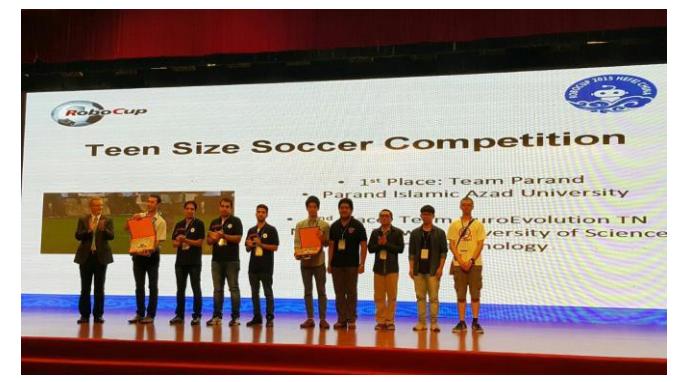
Team Parand participated in Robocup for the first time in 2014 in Teensize league and took the Third place. This team also partciapted in Robocp2015 competitions and achieved the championship of Teen-Size league[1][2].
Commitment
Team Parand commits to participate in the RoboCup2018 Montreal, Canada Humanoid Teen-Size League competitions and also provide a member with sufficient knowledge of the rules for being referee in Humanoid League.
2-Hardware Overview
2.1 Mechanical Structure
During recent three years we have used Baset mechanical structure wich is based on team Parand previous designs with some improvemnets[3] that increase speed, stability and decrease battery consumption. In new structure, some advantages are reached such as more stability, high speed movements by using high torque servo motors, increase kicking distance by designing a proper weight and shape foots. Further more, robots with this structural platform are considered as both Kid-Size and Teen-Size.
Table 1. Parand Humanoid General Specifications
| Specification | Value |
|---|---|
| weight | 8kg |
| height | 90cm |
| Processing Unit | QutePc4001 1.8 GHz processor |
| Degrees of Freedom | 20 DOF |
| Actuators | MX-64, MX-106R, MX-28 |
| Camera | Logitech C930 |
| Batteries | Li-Po 16 |
| Operating System | Windows 10 |
2.2 Electronics
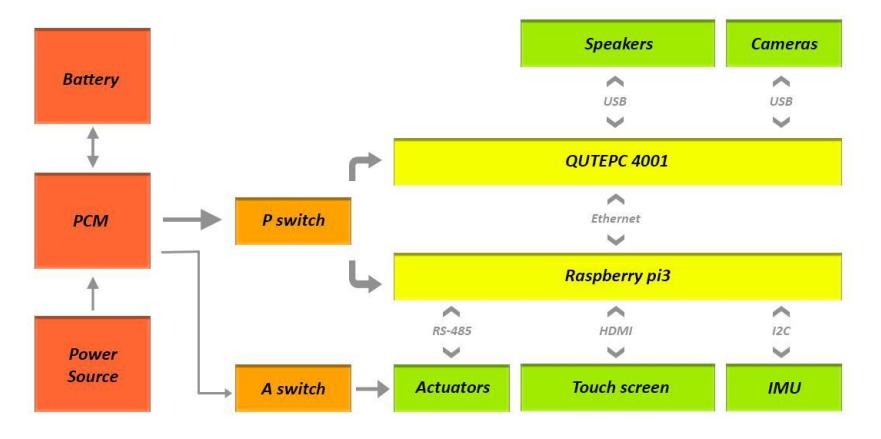
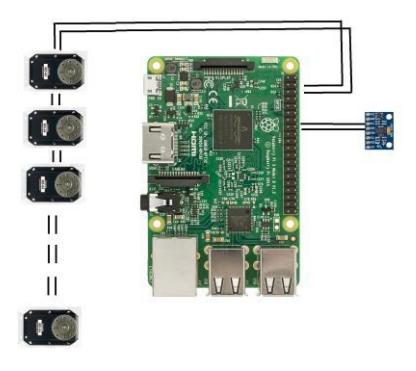
Underlying electronics contains a 4 cell LiPo battery which is connected to a smart charging manager board. All I/O operations are performed by the third-generation Raspberry Pi processing unit. It also excutes the Madwick sensor fusion algorithm[4] on accelerometer, gyroscope and magnetic field datas recieved from InvenSense Mpu-9150 sensor module. Moreover former C905 camera replaced by the new Logitech C930 webcam which provide high resolution images.
3-Software
3.1 Vision
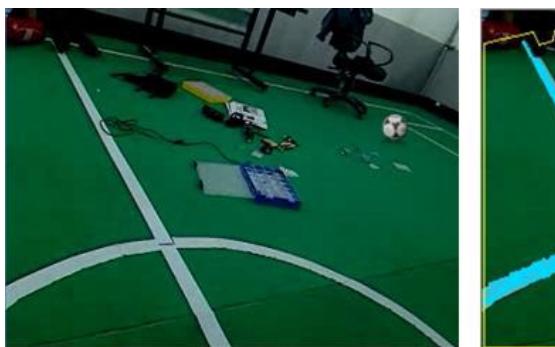
Hence rules changed in recent years extracting field features are getting more difficult and also more details are needed. Accordingly high resolution camera is required and also high resolution frame proccessing seems essential.
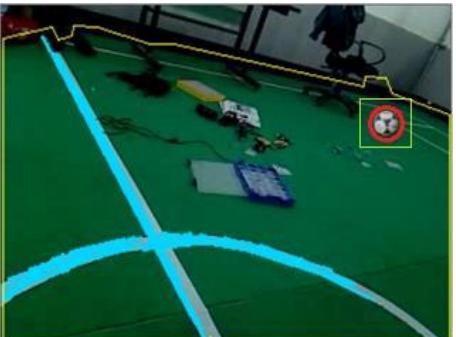
In order to have a robot with high accuracy and performance, it's essential to prevent the robot to proccess objects and features out of the field. To address this issue Graham's algorithm[5] is implemented to extract green field convex hull as the region of intrest for further processings. White lines are detected using Hough transform and group them by their angle and distance. Each group contains lines with same angles and certain distance will merge together and make the field line.
As detecting the white ball in an environment with white lines and white goal posts require new techniques, ball detection was the main research area in robots software. Robots gained siginificant improvements in accuracy since using histogram of oriented gradients (HOG) feature extraction along with linear SVM classification[6]. In comparison with the former method using Hough Circle Detection the range of proper detected ball increased from 2 meters to 4.5 meters with higher frame rate and accuracy.
3.2 Locomotion
Due to the high performance requirement of new vision algorithms with the higher image resolution, the previous motion engine was struggling with some latencies while running on same processor along with the vision unit. Which finally caused utilizing a separate processor (Raspberry Pi 3) dedicated to executing static motions, walk engine, and stabilization algorithms.
Furthermore the previous walk engine had some weaknesses especially in side walk and turning around a spot. Therefor the open loop walk engine developed by team RHoban is substituted with the former one. As it is fairly simple and has a nice and need implementation, the stabilization algorithms easily added to the walk engine.
Static motions as kicking and standup are designed in Parand Motion Editor which is a Key Frame motion editing utility inspired by RoboPlus motion editor [7].
3.3 Localization
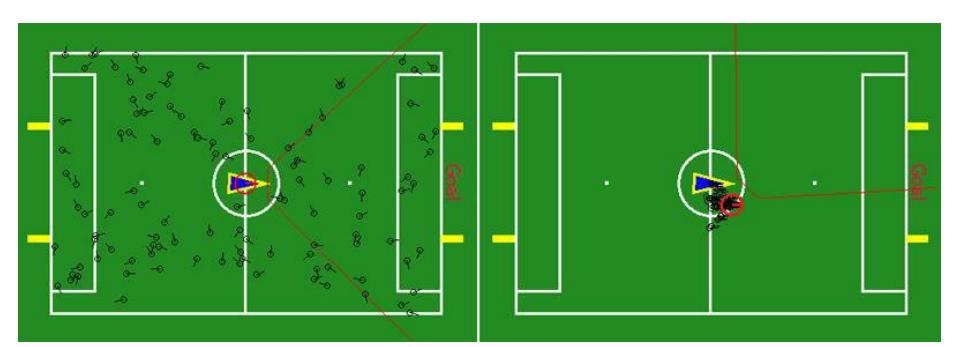
As robots are become more intelligent and perform faster and also due to major changes in rules in recent years, to estimate position and orientation of robot, implementing an accurate and robust localization algorithm is became necessary and fundamental.
Monte Carlo localization is a well-know particle filter to probablistcally determine robot's position and orientation using features detected in vision modul,odometry data and also sensors data.
References
- https://www.robocuphumanoid.org/hl-2015/results/. Last accessed 23th December 2016
- Navid Fayaz, Ahmad Amiri, Farzad Nadiri,Omid Mohammadi, Masoud Kazemi, , Rahmaan Barouj ,Marzieh Hashemian. "Parand Humanoid TeenSize Team Description Paper," 2015.
- Hafez Farazi, Mojtaba Hosseini, Vahid Mohammadi,Farhad Jafari, Donya Rahmati, Dr. Esfandiar Bamdad, "Baset Kid-Size 2014 Team Description Paper," 2014.
- Madgwick, Sebastian. "An efficient orientation filter for inertial and inertial/magnetic sensor arrays." Report x-io and University of Bristol (UK) 25 (2010).
- Graham, R.L. (1972). An Efficient Algorithm for Determining the Convex Hull of a Finite Planar Set. Information Processing Letters 1, 132-133
- Farazi H, Allgeuer P, Behnke S. A monocular vision system for playing soccer in low color information environments. InProceedings of 10th Workshop on Humanoid Soccer Robots, IEEE-RAS Int. Conference on Humanoid Robots, Seoul, Korea 2015.
- Rahman Barooj, Navid Fayaz, Farshid Khajehdehi, Ahmad Amiri, Farzad Nadiri, Hamid Pormalek,Masoud Kazemi, Amir Jambori, Omid Mohammadi. "Parand Humanoid TeenSize Team Description Paper," 2014.