BehRobot Humanoid Teen Size Team Team Description Paper 2019
Saeid Sharifi, Mohammad reza Amini, Hamid Sadri Manesh
Institute of Robotics and Intelligent Systems, Isfahan Islamic Azad University, Isfahan, Iran
Abstract This technical description explains Behrobot Teen size robot specification that have designed and customized to participate in Robocup 2019 Humanoid league for Teen size competition in Robocup 2019. This paper describes scientific aspects of our robot including mechanical improvements, Electrical design and software modifications. It also covers a summery of Behrobot achievements and performance in robocup competitions.
Introduction
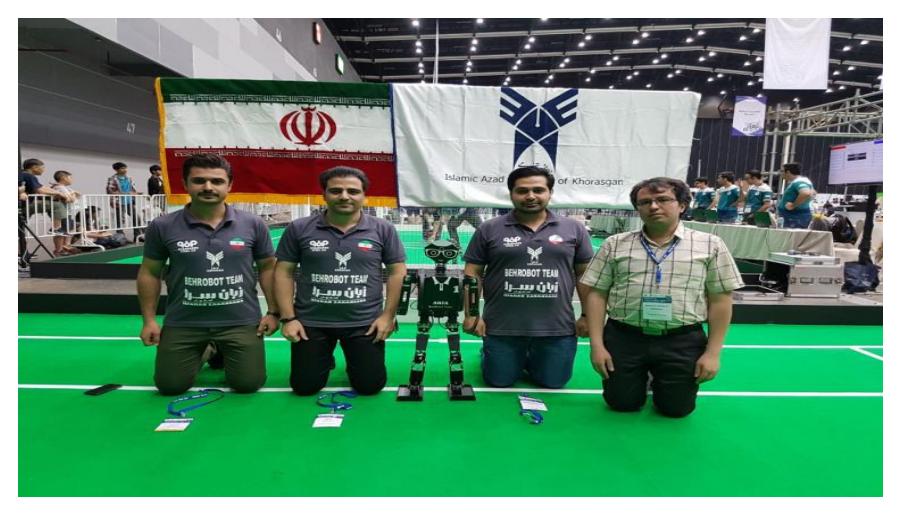
Robocup is a world project to progress artificial intelligence and related sciences like mechanical engineering, software and electrical engineering. One of the most important robocup leagues is Humanoid league which in robots with human anatomy similarity and walking skills should play soccer match. Humanoid robot soccer league includes 3 sub leagues: Kid, Teen and Adult. During 10 years robocup activity, we have built all of three sizes and finally we shifted to adult size. The goal of robocup is to prepare a team of humanoid robots to compete with humans on 2050. Our Teen size robot is designed to move to this aim. This project has started from September 2010 with cooperative of best researchers of Institute of Robotics and Intelligent Systems (Figure1). This paper also describes some scientific contribution in modified mechanical design, motion control, image processing, localization and path planning.
System & Control Overview
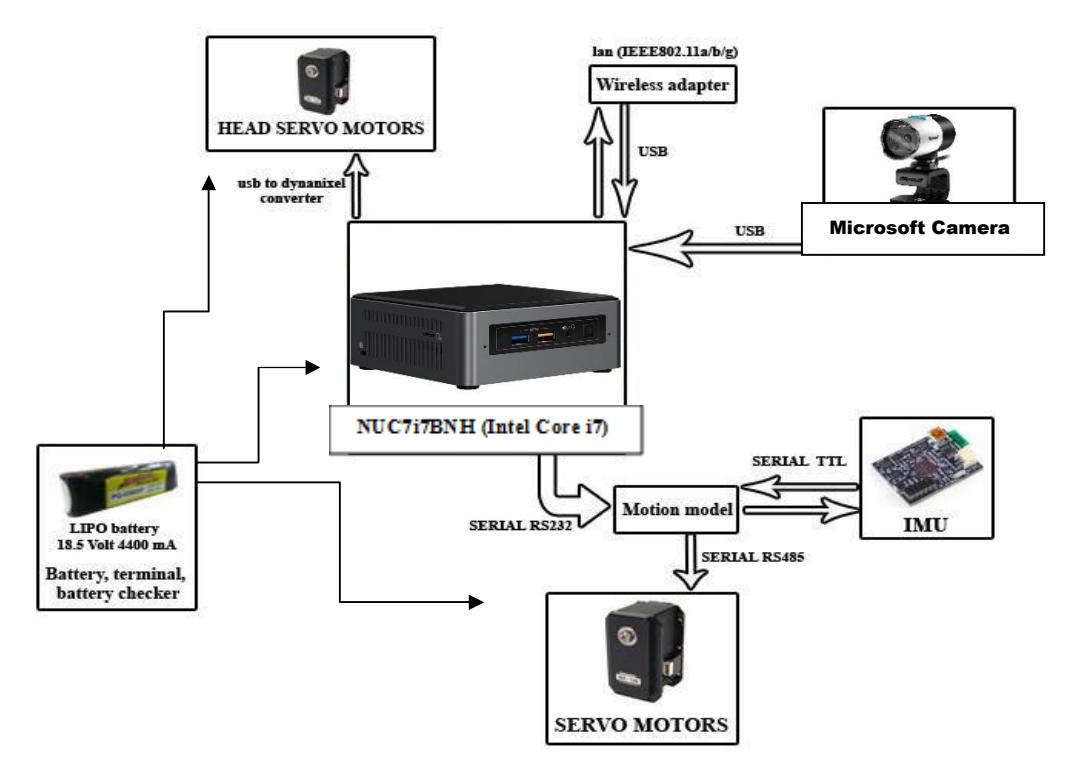
This section describes system structure and method of data transfer among different parts of robot. The robot consists of mechanical and electrical equipment like computer, electrical boards, sensors, camera, batteries and main body. Firstly, a camera as a main sensor sends field information as an image to main computer board and then these signals are captured. The main computer uses buffer memory and gets required information and detects objects position. Also we use an improved method for localization using particle filter and matching optimization that has more advantages in comparison with other previous methods that is used in humanoid soccer competition. Secondly, the role engine and behavior engine select strategy and another move. The commands are received by other CPU via RS232 and the moving commands are sent to all MX servo motors in legs, hands, head and trunk via RS485. Then each servo motor with specific ID number receives commands and adjusts angle modification. All servo motors are daisy-chained and on a single bus. Figure 2 shows general schema of connections in software and hardware parts. [1-4]
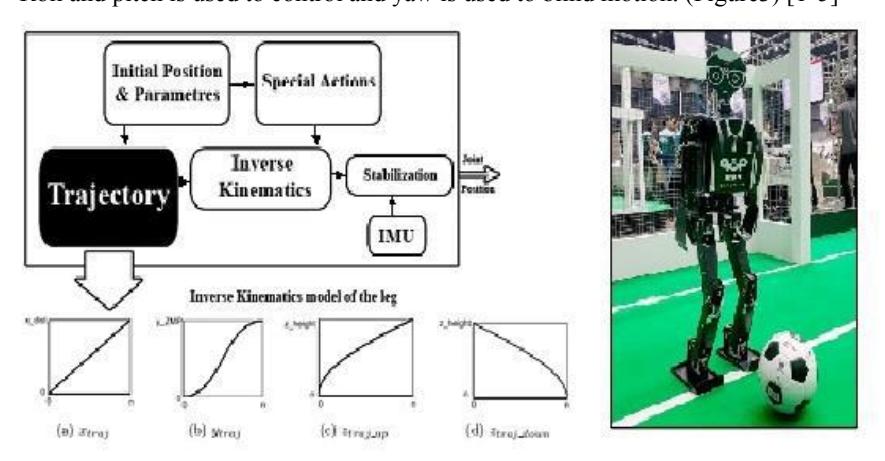
To enable a robot to play soccer match, we have implemented some skills including: walking autonomously, running and kicking. In order to have a robot which can recognize its environment correctly, we have used a digital 5 mega pixel camera (Microsoft Lifecam), IMU sensor. Also for processing and preparing acquired information for intelligent unit execution, decision part and control we have used a small industrial computer (Intel nuc i7) with Windows 10 operating system. Electronic part uses an equipped electronic circuit board to control servo motors which includes ARM LPC 2368 microcontroller for reading and transferring data to main computer via serial RS232 connection. The base of control is based on ZMP and inverse kinematics model of the leg. Also IMU that is embedded on the robot' hip provides angles of rotation in three dimensions about the robot's center of mass (roll, pitch and yaw). Roll and pitch is used to control and yaw is used to blind motion. (Figure3) [1-5]
Mechanical structure
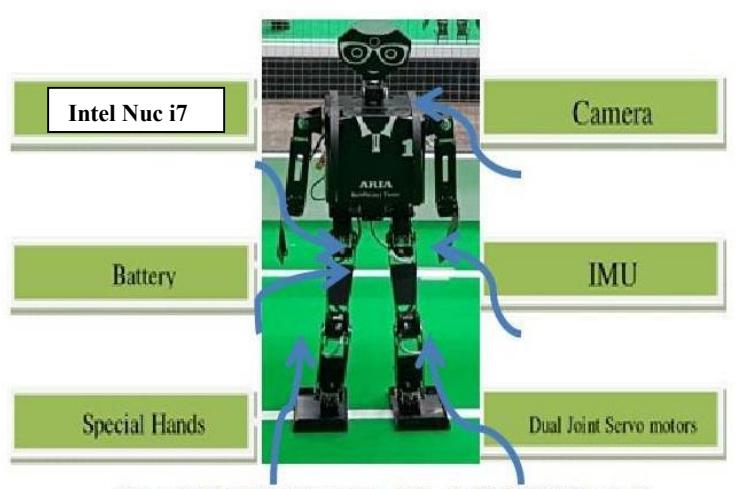
Mechanical structure is composed of aluminum alloy parts, 8 RX64 and 10 EX106 Dynamixel motors. Our robot is 155 centimeter tall and 12 kilogram weight. The robot includes more than 200 different parts including legs, trunk, arms and other joints. One of the robot main improvements is implementation of dual motor joints and parallel links of the legs that makes our robot to be more stable and to have better ability to walk and stronger kick. Also new design for hands is implemented to facilitate throw in challenge. (Figure4) (Table1)
Table 1. Behrobot specification
| Mechanical Structure | |||
|---|---|---|---|
| Head | Neck | 2 | Dynamixel RX28 |
| Trunk | Waist | 1 | Dynamixel 2*MX106 |
| Legs | Hip | 1 (X2) | Dynamixel 2*MX106 |
| Thigh | 2 (X2) | Dynamixel 2*MX106 | |
| Knee | 1 (X2) | Dynamixel 2*MX106 | |
| Ankle | 2 (X2) | Dynamixel 2*MX106 | |
| Arms | Upper Arm | 1 (X2) | Dynamixel RX64 |
| Shoulder | 1 (X2) | Dynamixel RX64 | |
| Elbow | 1 (X2) | Dynamixel RX64 | |
| Total | 21 | ||
| Electronic System | |||
| Camera | Micosoft life cam (5 MegaPixel) | ||
| Sensors | IMU | X-IO | |
| Processor | NUC7i7BNH (Intel Core i7) | 32GB RAM |
Electrical Structure
We have designed a servo motor driver to control motors via RS485. This driver uses ARM LPC2368 microcontroller and reads accelerator and gyroscope data through A/D converter and transfers information to the robot processor. Also ADXL330 accelerator sensor is used to robot fall detection. LIPO battery 18.5 Volt 4350 mA is used and is adjusted using some LT regulators before distribution to other electronical parts.
Software
Software structure handles many modules including Vision, AI and Hardware management. Vision is the main software section that consists of capture frame, segmentation as a preprocessing part, object detection, verification and localization. Another part is AI that consists of a decision tree, path planning and strategy engine. When there is a team-mate in the field, Strategy engine includes role and behavior engine. And finally in the hardware management part, motion control, battery checking, IMU and motors can be handled. (Figure5)
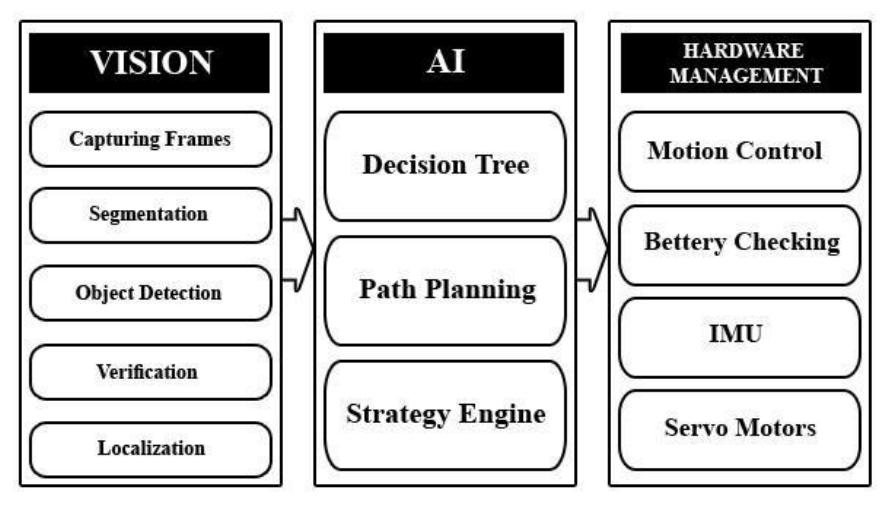
Image processing
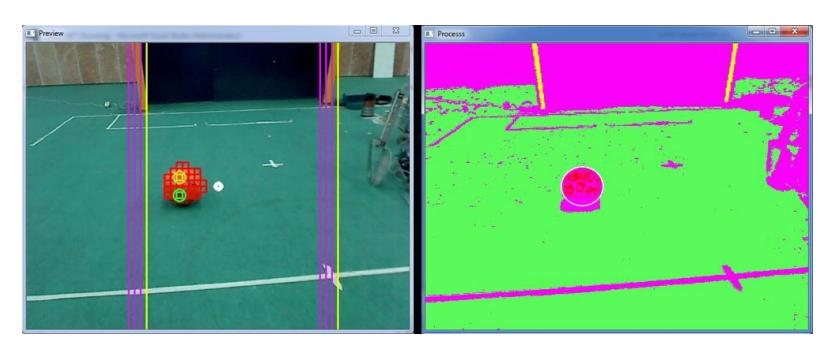
Using a fish eye lens, camera gets RGB images with 640480 resolution with 15 fps and when the ball is near to the robot, processor decreases resolution to 360240 to keep quality and high speed simultaneously. The vision system process images and uses a color look-up table. In the high level computer vision, we use K-MEANS clustering method and field line detection to have better image processing, localization and behavior decision. After capturing a frame, processor does pre-process image by segmentation using color table and k-mean clustering method. Then processor executes BFS object detection and verification algorithm. K-MEANS clustering method enables operator to add colors easily just by a few clicks before the game.(Figure6) [8, 9]
Localization
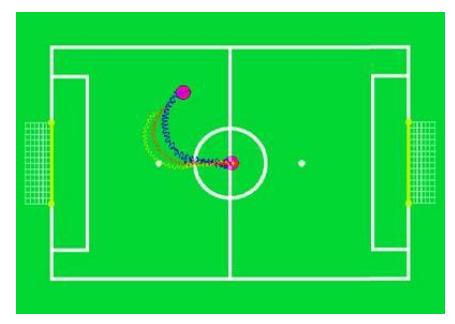
The robot uses particle filtering for reliable localization. The robot uses IMU sensor, goal posts , field lines and center circle as a basic elements to localization and then particle filter is used to track x,y and Ө and also to solve kidnapping problem. Also Motion and vision model is used to update particles. Finally we use a method named matching optimization, and it helps robots to play even in larger field with variable light conditions during a game. In next years the humanoid league moves to larger field that is similar to actual soccer field at last on 2050. So the stable localization is essential to compete in future. (Figure7) [6,7]
Path planning
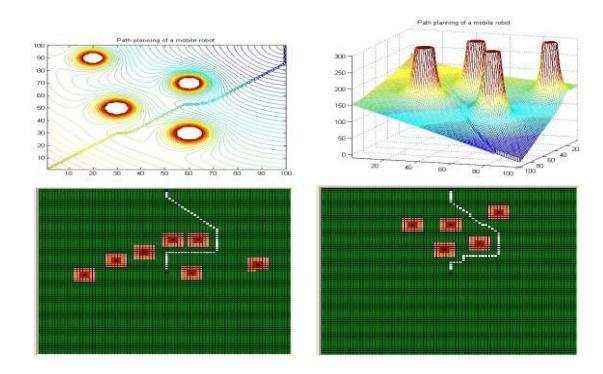
Potential field is used to have reliable and smooth path planning. In this method 3 main parameters are essential including 1- distance 2- angle 3- volume of obstacle. Also our algorithm can easily solves trapped situation in a local minimum using virtual forces. (Figure8) [10, 11]
Awards
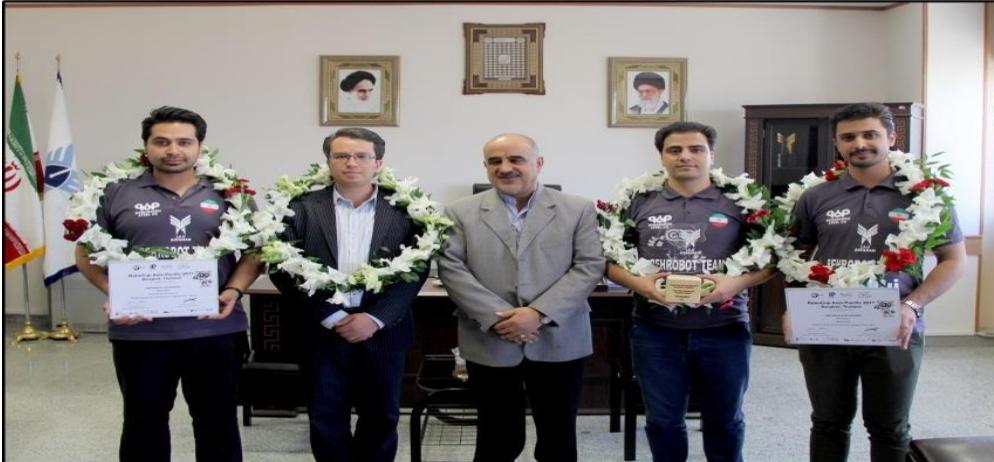
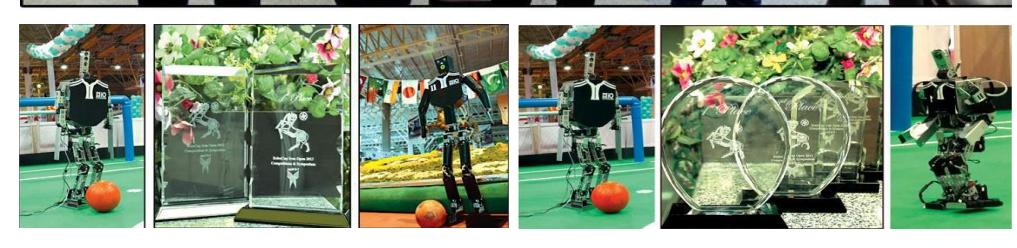
In 2004 we started our first robocup experience by participating in Middle size league in Germany, China and Iran and we continued with kid size humanoid robots. During 10 years robocup competitions not only we won many awards but also we shifted from kid size humanoid robot to teen and adult size humanoid robots. Figure 9 shows our successful efforts to design and implementation of new robots.

Our main achievements in robocup
- Ranked 1st Place Teen Size Humanoid League in Asia-Pacific Robocup competitions in Thailand-Bangkok, December 2017.
- Ranked 1st Place Teen Size Humanoid League Technical challenge in Asia-Pacific Robocup competitions in Thailand-Bangkok, December 2017.
- Ranked 1st Place Adult Size Humanoid League in 8th International IranOpen Robocup competitions in Iran-Tehran, April 2013.
- Ranked 1st Place Teen Size Humanoid League Technical challenge in 8th International Iran-Open Robocup competitions in Iran-Tehran, April 2013.
- Ranked 1st Place Teen Size Humanoid League in 7th International IranOpen Robocup competitions in Iran-Tehran, April 2012.
- Ranked 1st Place Teen Size Humanoid League Technical challenge in 7th International Iran-Open Robocup competitions in Iran-Tehran, April 2012.
- Ranked 3th Place Kid Size Humanoid League in 7th International Iran-Open Robocup competitions in Iran-Tehran, April 2012.
- Ranked 1st Place Kid Size Humanoid League Technical challenge in 7th International Iran-Open Robocup competitions in Iran-Tehran, April 2012.
- Ranked 3th place Humanoid Soccer Robot League (Kid Size) in 5rd International Iran-Open Robocup competitions in Iran-Tehran, April 2010.
- Ranked 1st place Humanoid Kid-Size Soccer Robot League in 1st National Khwarizmi Robotic Competitions in Iran-Tehran, November 2008.
- Ranked 2nd place Middle Size Soccer Robot League in 1st National Khwarizmi Robotic Competitions in Iran-Qazvin, November 2008.
- Ranked 1st Place Middle Size Soccer Robot League in 3rd International Iran-Open Robocup competitions in Iran-Qazvin, April 2008.
- Ranked 2nd place Middle Size Soccer Robot League in 2nd International Iran-Open Robocup Competitions in Iran-Tehran, April 2007.
- Ranked 2nd place in Middle size league in 2nd International China-Open Robocup Competitions in China 2007.
Conclusion
In this paper the scientific contribution of Behrobot Teen size is described. Also some new methods are introduced to have an efficient soccer robot based on previous expriences in humanoid robot comptetion in kid and Adult size. Behrobot humanoid robot not only uses reliable software and hardware structure but also is in improvement process to have a faster walking speed to be able to compete in world robocup 2014 in Brazil and Asia-Pacific 2017 (Bangkok).
References
- Andreas Schmitz, Marcell Missura, and Sven Behnke "Real-Time Trajectory Generation by Offline Footstep Planning for a Humanoid Soccer Robot" In Proceedings of the 15th RoboCup International Symposium, Istanbul, July 2011.
- Ehsan Azimi, Mostafa Ghobadi, "Three-Dimensional Smooth Trajectory Planning Using Realistic Simulation" In Proceedings of RoboCup 2004, Robot Soccer World Cup VIII Lecture Notes in Computer Science Volume 3276, 2005, pp 381-393.
- MARTIN FRIEDMANN, JUTTA KIENER, "Versatile, High-quality Motions and Behavior Control of a Humanoid Soccer Robot" In proceedings of International Journal of Humanoid Robotics, Volume 5, Issue 3, Sep 2008,Pages 417-436.
- D. Scholz, M. Friedmann, O. von Stryk "Fast, Robust and Versatile Humanoid Robot Locomotion with Minimal Sensor Input" In Proc. 4th Workshop on Humanoid Soccer Robots at the 2009 IEEE-RAS Int. Conf. on Humanoid Robots, pp. to appear, Dec. 7 - Dec. 10, 2009.
- Sven Behnke and Jörg Stückler: "Hierarchical Reactive Control for Humanoid Soccer Robots" International Journal of Humanoid Robots (IJHR), vol. 5, no. 3, pp. 375-396, September 2008
- Hannes Schulz, Weichao Liu, Jörg Stückler and Sven Behnke: Utilizing the Structure of Field Lines for Efficient Soccer Robot Localization In Proceedings of 14th International RoboCup Symposium, Singapore, June 2010.
- Huimin Lu, Xun Li, Hui Zhang, Mei Hu and Zhiqiang Zheng, "Robust and realtime selflocalization based on omnidirectional vision for soccer robots" Advanced Robotics, 2013Vol. 27, No. 10, 799–811.
- Liu F, Lu H, Zheng Z. "A modified color look-up table segmentation method for robot soccer". In: Proceedings of the 4th IEEE LARS/COMRob 07; 2007; Monterrey, Mexico.
- Lu H, Zhang H, Yang S, Zheng Z. "Camera parameters auto-adjusting technique for robust robot vision" In: Proceedings of the 2010 IEEE International Conference on Robotics and Automation; 2010; Anchorage, Alaska, USA. p. 1518–1523.
- B. Zhang, W. Chen and M. Fei, "An Optimized Method for Path Planning Based on Artificial Potential Field", Proceedings of the Sixth International Conference on Intelligent System Design and Applications (ISDA2006), pp.226-231, 2006.
- Z. Yu, J. Yan, J. Zhao, Z. Chen and Y. Zhu, "Mobile Robot Path Planning Based on Improved Artificial Potential Field", Journal of Harbin Institute of Technology, Vol.43, No.1, pp.50-55, 2011.