ZJLabers Team Description Paper Humanoid TeenSize League of Robocup 2019
Yun Liu, Hongjian Jiang, Qiang Hua, Te Li, Yuehua Li, Senwei Xiang, Sumian Song
Intelligent Robot Research Center, Zhejiang Lab, Hangzhou, China
Abstract This paper describes the humanoid robots developed by team ZJLabers from Zhejiang Lab as an experimental platform for research in areas of bipedal locomotion and control, visual perception, self-localization and autonomous decision-making. The robots will also be used to compete in TeenSize humanoid league at Robocup 2019, Australia. Further details of the robots are provided, including robot specifications, mechanical design, electronics, sensor specifications as well as software overview.
Introduction
ZJLabers is a humanoid robot soccer team running at Intelligent Robot Research Center of Zhejiang Lab in Hangzhou, China. Our team was newly established in July 2018 and it is our first time to participate in Robocup TeenSize humanoid league competition. However, we are not completely a rookie to this competition as our team leader is an experienced Robocup veteran who had consecutively taken part in RoboCup 2015-2017 in KidSize and won 2nd place for each time. The research interests of our team are bipedal locomotion and control, visual perception, self-localization and autonomous decision-making. We are dedicated to making substantial contributions to achieve the ultimate goal of building up a team of humanoid robots that can play against human soccer team in 2050.
This document gives an overall description of the autonomous biped robots we built for the TeenSize humanoid competition at Robocup 2019 in Sydney, Australia. Our robot is developed based on the previous work of ZJUDancer and NimbRo[7,8]. In order to achieve superior performance, significant modifications and improvements have been made to the hardware and software of our robot. Details of our robot are provided in the following sections.
Robot Specifications
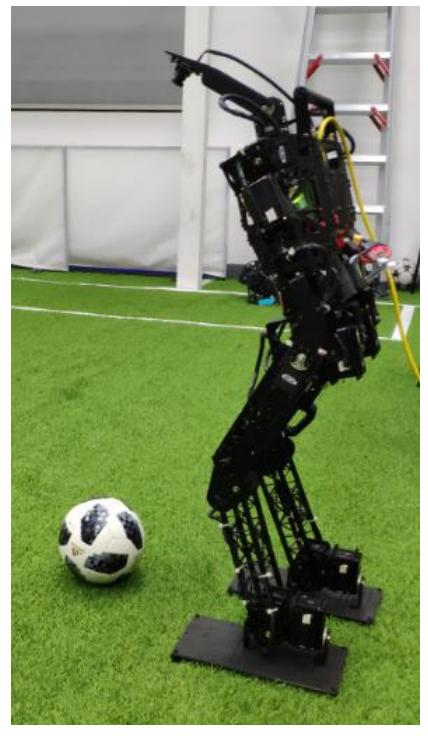
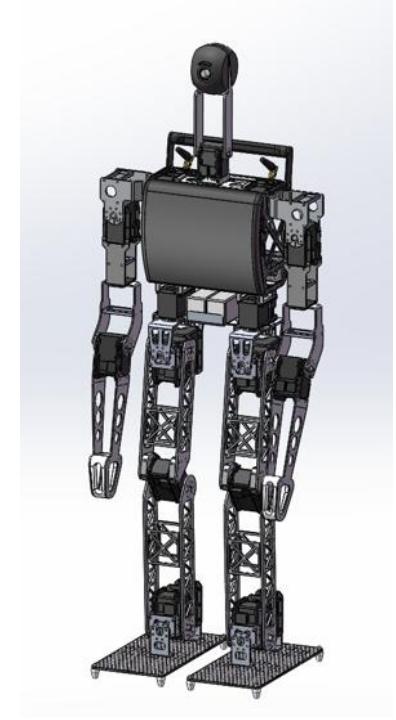
Table. 1 shows the general specifications of our robot. Referee directions can be sent to the robot through the wireless network. There are five roles in strategy named Striker, Defender, Support, Observer and Goalkeeper. Fig,1(a) shows our robot kicking the ball and (b) is the mechanical sketch of the robot. More details will be introduced in the following sections.
General Specifications of the robot
| Team Name | ZJLabers |
|---|---|
| Number of DOF | 20 |
| Height | 88.5cm |
| Width | 33cm |
| Weight | 5.8kg |
| Computing Unit | Nvidia Jetson TX2 |

Mechanical Design
Our robot has two legs, two arms, a trunk and a head, as shown in Fig.1. The robot has 20 DOFs with 6 in each leg, 3 in each arm and 2 in the head. In order to enable flexible leg movement, each leg is consisted of a 3-DOF hip joint, a 2-DOF ankle joint and a 1-DOF knee joint. Each DOF is realized by a servo motor. Table 2 shows the implementation details.
Compared to ZJUDaner, our robot is bigger to adjust to the TeenSize field. An extra DOF is added to the shoulder joint so that our robot is able to use arms to keep balance during movement. In addition, the forearms of the robot are longer, which proved to be very helpful for the robot to stand up from the ground when falling down. We changed the location of the computing unit for better heat dissipation. In contrast to Nimbro, the chest and feet of our robot are made of carbon fiber, which significantly reduces the weight and cost of our robot.
The battery is placed at the bottom. The handle is designed at the shoulder of the robot, which makes it convenient for the handler or referee to pick up the robot during the game. The emergency stop/power cut button is mounted on the shoulder of the robot.
Motor types and Distributions of DOF
| Part | Rotation Axis | Actuator |
|---|---|---|
| Neck joint | Yaw, Pitch | MX-28, MX-28 |
| Shoulder joint | Roll, Pitch | MX-64, MX-64 |
| Elbow joint | Pitch | MX-64 |
| Hip joint | Roll, Yaw | MX-106, MX-64 |
| Knee joint | Pitch, Pitch | MX-106, MX-106 |
| Ankle joint | Pitch, Roll | MX-106, MX-106 |
| Total DOF | 20 |
Electronics
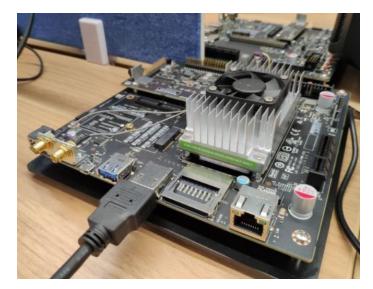
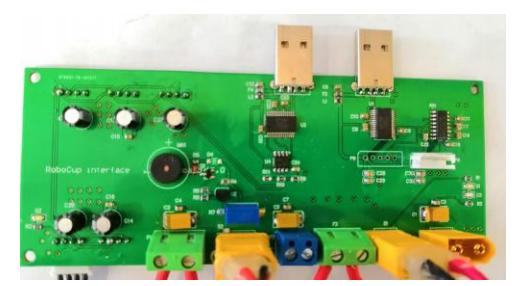
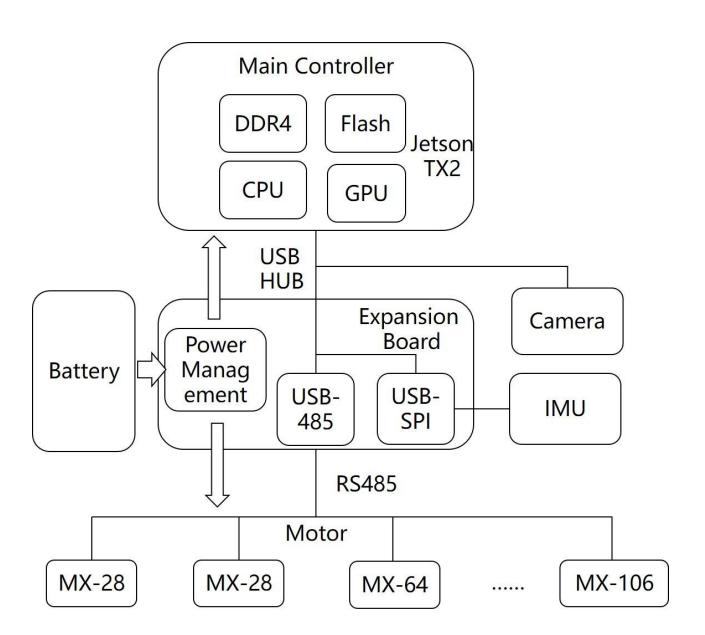
The circuit architecture can be seen in Fig.2 and 3. Our circuit mainly includes the main controller and the expansion board. The main controller adopts Jetson TX2 as the core computing unit, specifications of which are shown in Table3. The main controller processes object detection, self-location, strategy selection and multi-robot communication. Furthermore, the movement and balance maintaining are implemented in the main controller. We use a USB hub as a medium for connections between the main controller and IMU, camera and the motor controller. The expansion board communicates with the main controller via USB and s provides hardware interfaces for external devices. The power management component is also realized in this board, which would alarm when the battery drops below a certain critical voltage.
Electronic Specifications
| Main Controller | |
|---|---|
| GPU | NVIDIA 256 cores |
| CPU | ARMv8 (64-bit) |
| RAM | 8GB LPDDR4 |
| FLASH | 32 GB eMMC |
Sensor Specifications
There are 3 types of sensors equipped on our robot, which are image sensor, IMU, and servo motor.
- Image sensor. We use OmniVision OV2710 with 150degree FOV. This kind of camera has a wide view and it helps to improve the efficiency of perception.
- IMU. Analog device ADIS16405. Featured with tri-axis gyroscope, and triaxis accelerometer. It returns the angular velocity for the trunk of humanoid robot. After the design, the IMU remained at the center of the chest.
- Servo motor. We use Dynamixel MX-28R, MX-64R, MX-106R[4,5,6] to get angle feedback from the joints of the robot, such as shoulders and knees etc.
Software Overview
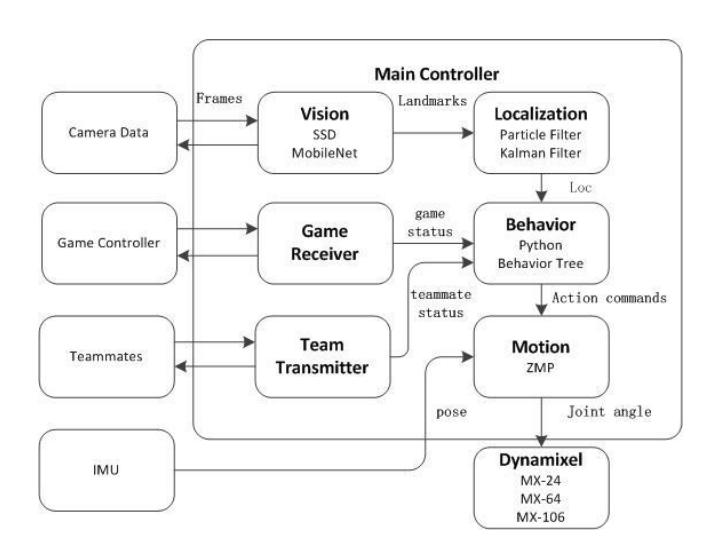
There are several separate modules for different tasks. The whole software architecture can be seen in Fig.4.
Conclusion
This paper presents the hardware and software overview of the robots developed by the members of team ZJLabers. As a newcomer to Robocup TeenSize humanoid league, we have put a lot of effort and time to be prepared for the competition, especially building our robot from scratch. We are excited to start a journey at Robocup 2019 and look forward to competing and sharing experience with other teams from all over the world.
References
- Henriques, J.F., Caseiro, R., Martins, P., Batista, J.: High-speed tracking with kernelized correlation filters. IEEE Trans. Pattern Anal. Mach. Intell. 37(3), 583596(2015), https://doi.org/10.1109/TPAMI.2014.2345390
- Howard, A.G., Zhu, M., Chen, B., Kalenichenko, D., Wang, W., Weyand, T., Andreetto, M., Adam, H.: Mobilenets: Efficient convolutional neural networks for mobile vision applications. CoRR abs/1704.04861 (2017)
- J. S. Gutmann and D. Fox: An experimental comparison of localization methods continued. IEEE/RSJ International Conference on Intelligent robot and System. vol. 1, no. 1, pp. 454459.
- User's Manual for Dynamixel MX-28
- User's Manual for Dynamixel MX-64
- User's Manual for Dynamixel MX-106
- Yusu Pan,Bo Peng,Chaofeng Jiang,Chunlin Zhou,and Rong Xiong: ZJUDancer Team Description Paper (2018).
- Philipp Allgeuer,Hafez Farazi and Sven Behnke: NimbRo Team Description Paper (2016).