Multifunction All-Terrain Mobile Robot IVWAN: Design and First Prototype
J.S. Martínez, G. Morán, B. Romero, A. Camacho, D. Gutheim, J. Varona, R. Velázquez
Mecatrónica y Control de Sistemas (MCS), Universidad Panamericana, Aguascalientes, Mexico
Abstract This paper presents the design and experimental platform of IVWAN (Intelligent Vehicle With Autonomous Navigation), an all-terrain omni-directional mobile robot with potential applications in the fields of space exploration, explosive disposal, reconnaissance, security, defense, rescue, and others. The mechanical system is based on a holonomic differential drive structure driven by two high-power electrical motors that allow the machine to negotiate obstacles and navigate rough terrain with a high degree of accuracy at a maximum speed of 20 km/hr. The control system is based on an embedded micro-controller architecture and 2 main sensors: a color camera and an array of ultrasonic sensors, which permit autonomous navigation of the robot. IVWAN can also be teleoperated, the robot is remotely controlled using a virtual reality helmet and a glove while video and data exchange are provided by a RF communication link. Overall design and first prototype are presented and discussed.
1 Introduction
Robotics and intelligent systems technology, including advanced software, sensors, microprocessors, micromechanics and microelectronics, have advanced to the point where it is now possible to develop highly functional and intelligent mobile robots for use at home, workplace, and public places to perform work currently handled by humans, or to educate and entertain.
Available locomotion systems for mobile robots can roughly be divided into legged and wheeled systems.
Legged robots offer some advantages when it comes to motion over extremely difficult terrain. The main relevance of walking machines is their abilities to adapt their posture on uneven terrain and to cross over high terrain discontinuities [1]. However, articulated robots are mechanically complex, difficult to control and not as fast as wheeled vehicles. The main activity in this research field concerns the control of complex kinematic structures by considering gait schemes and stability margin [2], [3].
Motion systems based on wheels or treads are relatively simple, reliable, fast and efficient. From a mobility perspective, wheeled vehicles offer the best solution when it is required to operate over rugged ground. When operations are conducted on roads, wheeled devices have demonstrated excellent maneuverability and speed. Wheeled vehicles offer better performance in terms of velocity, available payload and power economy due to the reduced friction losses and thus greater operating ranges [4]. The main research activity in this domain concerns the design of innovative steering and suspension systems [5], [6].
In this paper, we present the design and first prototype of IVWAN (Intelligent Vehicle With Autonomous Navigation). IVWAN is the result of an endeavor to create a low-cost but highly competitive intelligent all-terrain wheeled vehicle using a combination of vision capabilities and optimal decision making policies based on environment mapping.
The rest of the paper is organized as follows: Section 2 details both IVWAN's mechanical and electronic drive systems. Section 3 focuses on its vision system while Section 4 introduces a multisensory tele-operation platform developed for its remote control. Finally, Section 5 concludes the paper summarizing main concepts and future work perspectives.
2 Design and prototype
2.1 Mechanical system
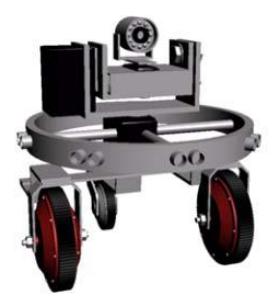
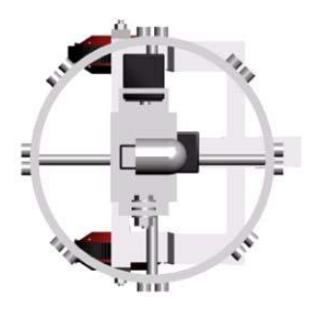
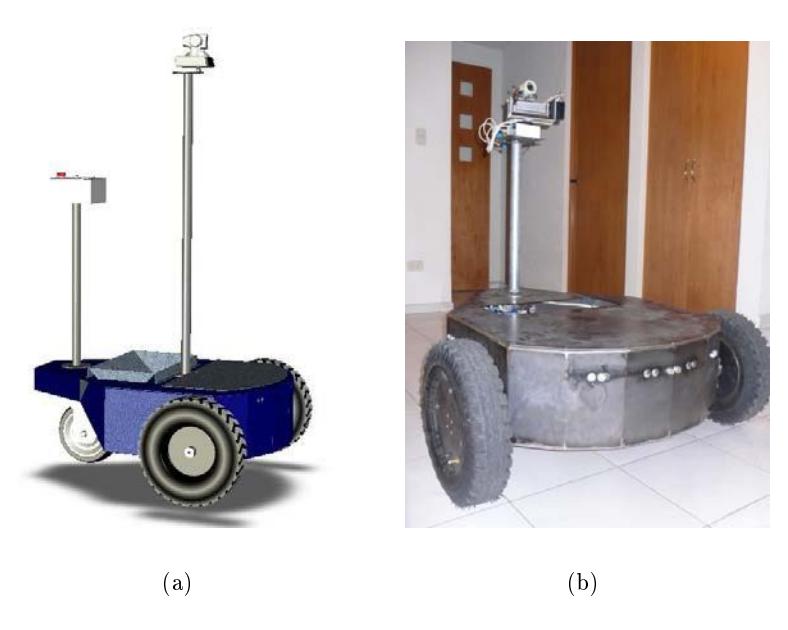
IVWAN's mechanical structure is based on a differential drive configuration consisting of 2 independently controlled front active wheels and one rear caster wheel (Fig. 1).
This configuration permits to consider IVWAN as an holonomic robot, i.e, a robot that immediately moves in any direction without needing to turn first.
This holonomic property simplifies both IVWAN's control and trajectory planning: (a) pure translation occurs when both wheels move at the same angular velocity and (b) pure rotation occurs when the wheels move at opposite velocities. This unique maneuver capability matches the pivoting ability of tracked vehicles and enhances functionality and survivability by permitting a 180-degree directional change when confined within limited spaces or while traveling on narrow roads.
2.2 Electronic drive and sensors
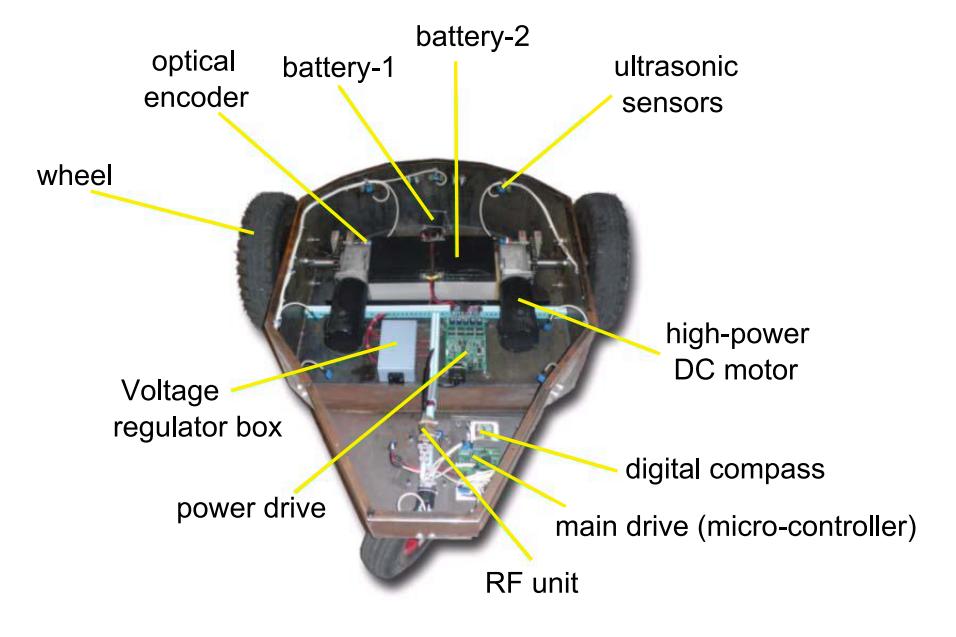
As seen from fig. 3, the motion system of the robot is based on two 24 V high-power DC motors (190 rpm at 55 N-m torque). Precise control can be achieved by using a Pulse Width Modulated (PWM) signal. The PWM control makes IVWAN capable of operating at very slow speeds within close range of target items without inducing jerking or shaking motions and at full speed (20 km/hr) when necessary.
Separated power supply units are used to meet IVWAN's power requirements: two sealed rechargeable lead-acid batteries (12 V, 12-Ah) connected in series provide the required voltage for the motors (battery-2 in fig. 3). A smaller battery (12 V, 1.2-Ah) is the main power source for the on-board electronics (battery-1 in fig. 3).
The video sensor is a standard, low-cost mini-camera with a resolution of 120x160 pixels that provides color images to either self-decision making or to transmit to the remote control station. To further enhance the viewing capabilities, a 2 DOF mechanism provides pan and tilt movements to the camera (Fig. 7(d)). This way, the operator can have a complete view of the environment surrounding the robot with 360-degrees of pan capacity. Image processing is conducted by an on-board laptop computer and a dedicated software.
An array of ultrasonic sensors has also been included to convey good situational awareness to the remote operator and to provide data feedback for autonomous operation. A set of 8 ultrasonic sensors was installed around the robot. They provide a total scan range of 360-degrees and they are able to detect obstacles placed on the surface up to 130 cm ahead of the robot.
Another important component for autonomous navigation is the electronic compass. This is an inexpensive sensor that uses the terrestrial magnetic field to provide a digital signal proportional to its orientation with respect to the magnetic north. This sensor is interfaced to the on-board drive unit for correcting the orientation of the robot in real-time.
The main control drive is based on an embedded micro-controller system. The micro-controller generates all PWM signals to drive the motors and the camera motion system. It is also responsible for collecting information from the sensors. When in tele-operated mode, the micro-controller processes the information sent by the human operator via the RF link and adjusts its control signals accordingly for setting the robot's speed, orientation, camera view, and others.
Finally, a commercial radio-frequency (RF) system is used to enable two-way full-duplex communication between the on-board electronic control drive and the remote command station. The RF system is connected to the embedded micro-controller system through a serial RS-232 protocol and, at the command station end, a RF transceiver is attached to a computer using the same serial protocol. The RF system employs Frequency-Shift Keying (FSK) modulation to transmit data up to a distance of 32 km away when line-of-sight or up to 450 m when indoors operation. The RF module transmits FM signals at a frequency of 900 MHz and has an integrated microphone for enabling audio communication between the robot and the remote command station.
3 Vision capabilities
One of the most popular applications for vision-based autonomous mobile robots is line following. This application requires the vehicle to follow solid and dashed lines along a path while avoiding obstacles, overcoming terrain changes and attempting to maximize speed. The challenge is to implement a reliable algorithm that works under variable and unpredictable conditions of luminosity, shadows, etc.
In this section, we briefly illustrate IVWAN's vision capabilities by addressing the line following problem.
IVWAN's vision system is based on a color camera from Panasonic providing $120 \times 160$ pixels images. This camera is connected to an on-board laptop computer while image processing is performed by LabVIEW $8.0^{-1}$.
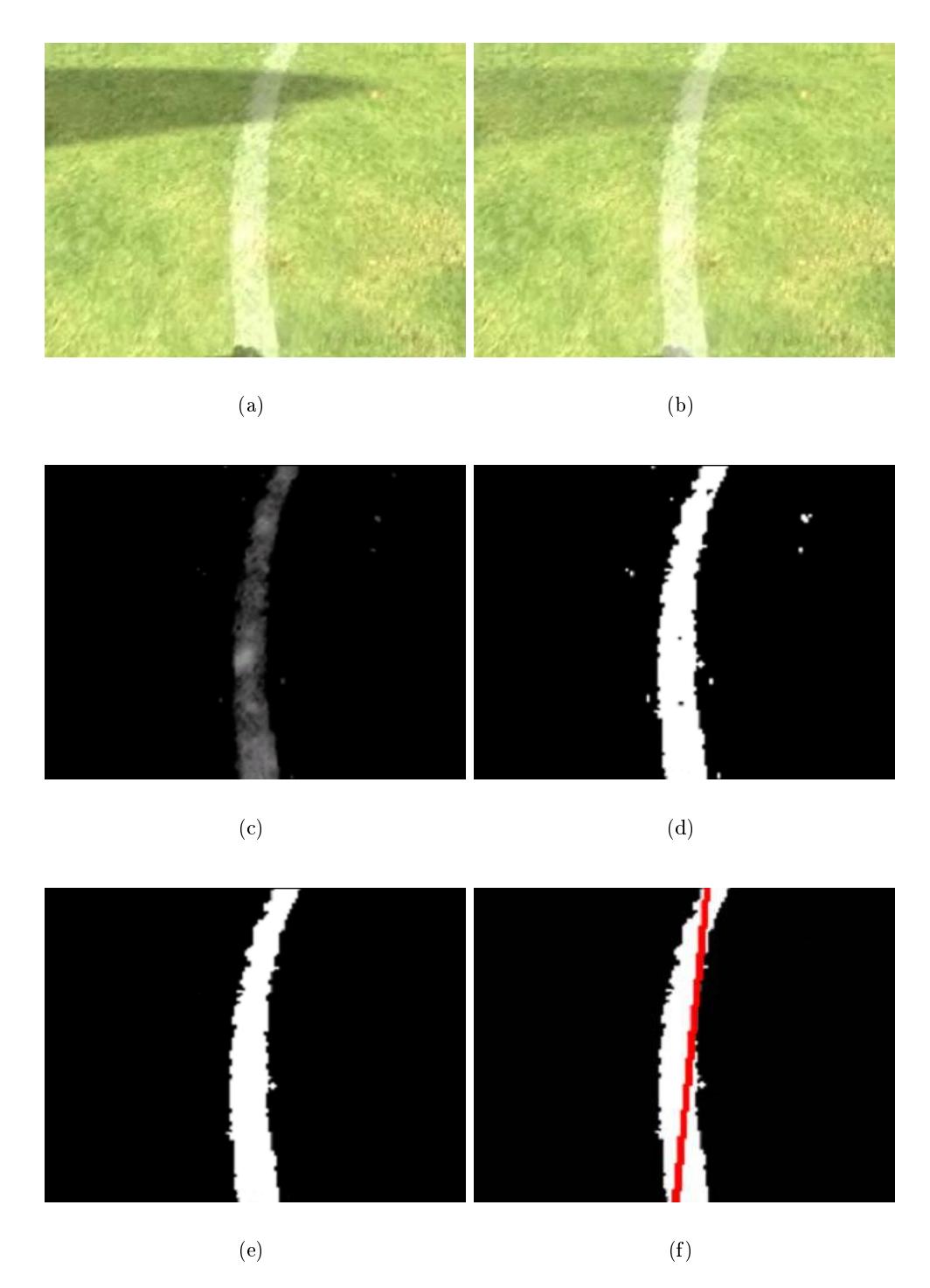
Fig. 4 shows a representative example of line following under certain conditions of luminosity and shadows. Fig. 4(a) shows the original image obtained by the camera. Note the presence of shadows and the luminosity level that makes problematic the automatic discrimination between the foreground (grass) and the line. Fig. 4(b) shows the same image with the shadow attenuated. This image was obtained by a RGB to HSI transformation, then a 60° rotation in the HS plane (so that yellow becomes closer to red) and then a transformation back to RGB.
In order to enhance the bright colors (blue) in the image, a RGB to gray level transformation was performed using R+G+3B instead of the typical [R+G+B]/3 (Fig. 4(c)). Next, a threshold was applied to better identify the bright colors (Fig. 4(d)).
To minimize the number of objects in the image and obtain those of bigger mass density, isolated vicinities of 3x3 were removed as well as holes of 3x3 were filled (Fig. 4(e)). At this stage, the image is acceptable and the Hough transform is reliable (Fig. 4(f)).
Finally, the resulting image is processed by a JAVA implemented algorithm to take the best decision based on the set of lines found.
4 Tele-operation
We have been working toward developing an active surveillance tele-operation platform where the operator can take real-time direct action over one or multiple robots without exercising detailed control over them and with no cognitive overload.
For this purpose, a multisensory human-robot interaction concept has been considered to enable an intuitive, effective and scalable control of mobile robots.
The active surveillance platform concept consists of a number of omni-directional mobile robots that navigate autonomously in an environment. As IVWAN, these robots are expected to be equipped with a video camera system, a loudspeaker/microphone set and an array of ultrasonic sensors distributed around their structure. Using a broadband wireless system, these two visual and audio data (future work will include tactile data) are transmitted to a server station where they are processed to provide a real-time perspective of the robots' activities to the user (Fig. 5).
The user may interrupt the autonomous navigation of any robot at any time, take full control of their actions and switch the control among them. Using a virtual reality helmet and glove, the user has in real-time both robots' visual and audio information. On the other hand, the user is able to re-position the robots with the glove, their cameras with the helmet (Fig. 6) and to speak through the robots' loud-speakers: a "quite" global user-environment interaction.
![Multisensory tele-operation platform for multiple robots: an operator can switch control among a set of robots and take decisions based on real-time multimodal information [7].](/tdps/soccer_midsize__2009__UP_Robotics/_page_6_Picture_0.jpeg)
4.1 VR-helmet and camera control
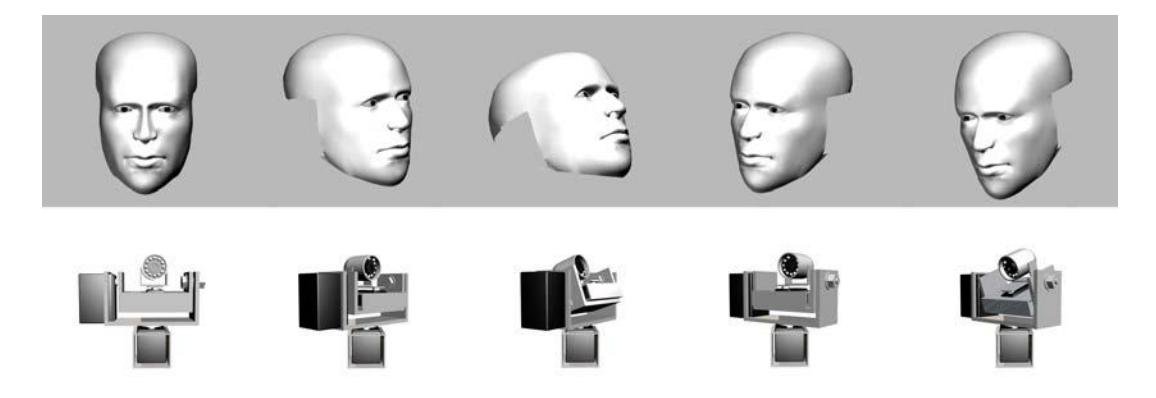
We are currently using an Emagin Z800 3DVisor virtual reality helmet, which is a compact, lightweight and low-cost device well suited for this application. This headset contains two active matrix video displays coupled with stereo headphones to deliver a real stereoscopic environment [8]. Additionally, the headset contains a 3D motion tracking unit capable of discerning head movements which are used by the tele-operation platform to manipulate the camera on the robot.
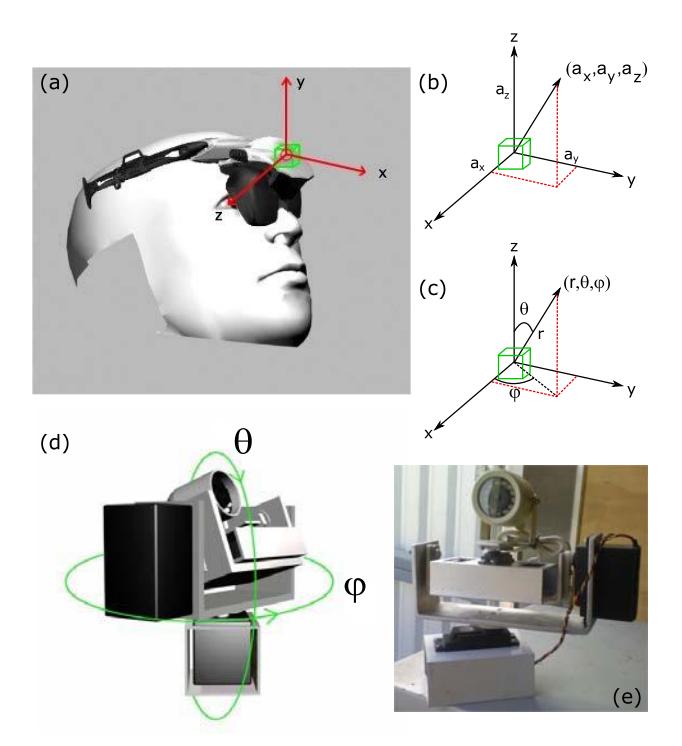
Fig. 7 shows the camera manipulation using the VR-helmet. Using accelerometers, the motion tracking unit senses both the earth's magnetic and gravitational fields and synthesizes the orientation of the helmet as a point of acceleration coordinates $(a_x, a_y, a_z)$ (Fig. 7(a)). Using a sampling frequency of 100 Hz, the head coordinates are updated. When they change, the system computes the rate at which the 3-tuple acceleration changes (Fig. 7(b)) and mathematically reconstructs the 3-dimensional spherical coordinates of its position (Fig. 7(c)), which are proportional to the ones of the camera mounted on the robot (Fig. 7(d) and Fig. 7(e)).
4.2 Glove
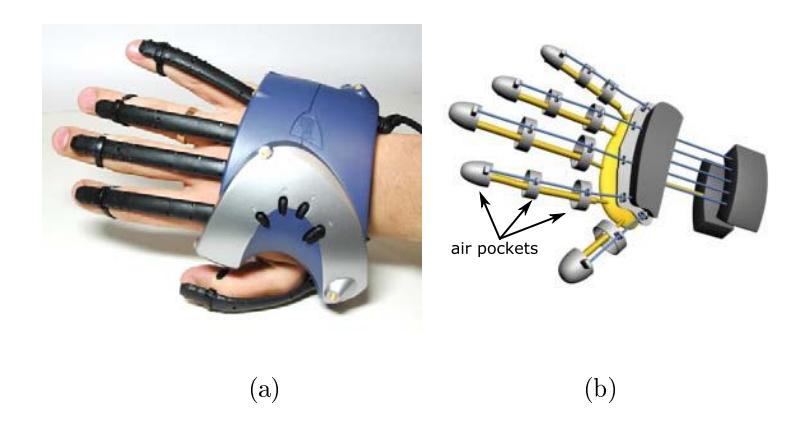
The P5 Glove from Essential Reality Inc. is currently being used for tele-controlling the robots' position (Fig. 8(a)). This device allows a full 6 DOF tracking (position and rotation) as well as finger bend capturing [9].
However, it does not provide any haptic feedback. We are also interested in providing the user tactile feedback when the robot makes contact with an object. For this purpose, we are implementing: (1) a pneumatic system of miniature inflatable air pockets mounted on the glove to apply a pressure along the user's finger (Fig. 8(b)) and (2) tactile sensors distributed along key contact points of IVWAN's structure.
5 Conclusion
This paper has presented the design and experimental platform of robot IVWAN, a mobile robotic system with potential applications in the fields of explosive disposal, reconnaissance, communications, sensing, security, defense, rescue, etc.
The simplicity of its mechanical design together with the use of commonly available materials offers multiple advantages such as an inexpensive and rapid prototyping. The motion system provides high-power excellent maneuverability and mobility to the robot.
The array of sensors and RF communication systems enhance the operational abilities of the robot by enabling autonomous navigation or remote operation from several kilometers away.
A tele-operation platform to control and coordinate multiple surveillance autonomous robots in real-time has also been introduced. Using a multisensory approach (i.e, sight, hearing and touch), the functionality of human-robot interaction is expected to increase.
Future research will include the development of artificial intelligence algorithms and object recognition by computer vision.
References
- C. Grand, F. BenAmar, F. Plumet, and P. Bidaud, "Stability and traction optimization of reconfigurable vehicles: Application to an hybrid wheel-legged robot," The International Journal of Robotics Research, vol. 23, no. 10-11, 2004.
- R. McGhee, "Finite state control of quadruped locomotion," In Proc. of the International Symposium on External Control of Human Extremities, 1996.
- S. Song and K. Waldron, "Machines that walk: the adaptative suspension vehicle," The MIT press, 1989.
- P. Hornback, "The wheel versus track dilemma," U.S. Army ARMOR magazine, March-April, 1998.
- E. Rollins, J. Luntz, A. Foessel, B. Shamah, and W. Whittaker, "Nomad: a demonstration of the transforming chassis," In Proc. of IEEE International Conference on Robotics and Automation, 1998.
- R. Volpe, "Rocky 7: A next generation mars rover prototype," Journal of Advanced Robotics, vol. 11, no. 4, 1997.
- J. Aguilera, M. Romo, R. Velazquez, and J. Varona, "Real-time multisensory teleoperation of multiple mobile robots for surveillance tasks," In Proc. of IFAC Symposium on Analysis, Design, and Evaluation of Human-Machine Systems, 2007.
- Emagin, Updated information available at: www.emagin.com.
- Essential-Reality, Updated information available at: www.essentialreality.com.